
What Are the Top Plastic Pallets from China?
Choosing the right pallet plastic from China requires more than comparing online prices. It involves material quality, load performance, factory capability, and supply reliability. In warehouse evaluations, HDPE and PP pallets often perform differently under cold storage, repeated washing, and forklift handling. A pallet may support 2,000 kilograms statically but carry far less on warehouse racking. That detail matters.
The best Chinese plastic pallets usually match a clear application. Export operations may need lightweight nestable designs, while distribution centers often prefer reinforced three-runner or nine-leg pallets. Check dimensions carefully, such as 1200 × 1000 millimeters or 1200 × 800 millimeters. Even a small size difference can affect conveyors and truck space. Surface texture also deserves attention. A rougher deck can reduce carton movement, but it may complicate cleaning.
Material transparency matters.
Professional buyers should request load-test reports, production samples, resin information, and inspection records. Factory visits or independent inspections can reveal warped decks, inconsistent welds, and recycled content that was not clearly disclosed. Certifications may support credibility, but they should be verified against the destination market and intended use. Food-contact applications require especially careful documentation.
No single model is perfect. I have seen buyers select a cheap pallet and later pay more for broken corners, difficult returns, and unstable stacking. That experience encourages a broader comparison. Consider total cost, service life, repair options, minimum order quantity, and communication quality. Chinese manufacturers offer impressive variety, but supplier claims still need practical verification. A reliable choice balances price, safety, durability, and the real conditions of your supply chain.
What Defines a High-Quality Plastic Pallet from China?
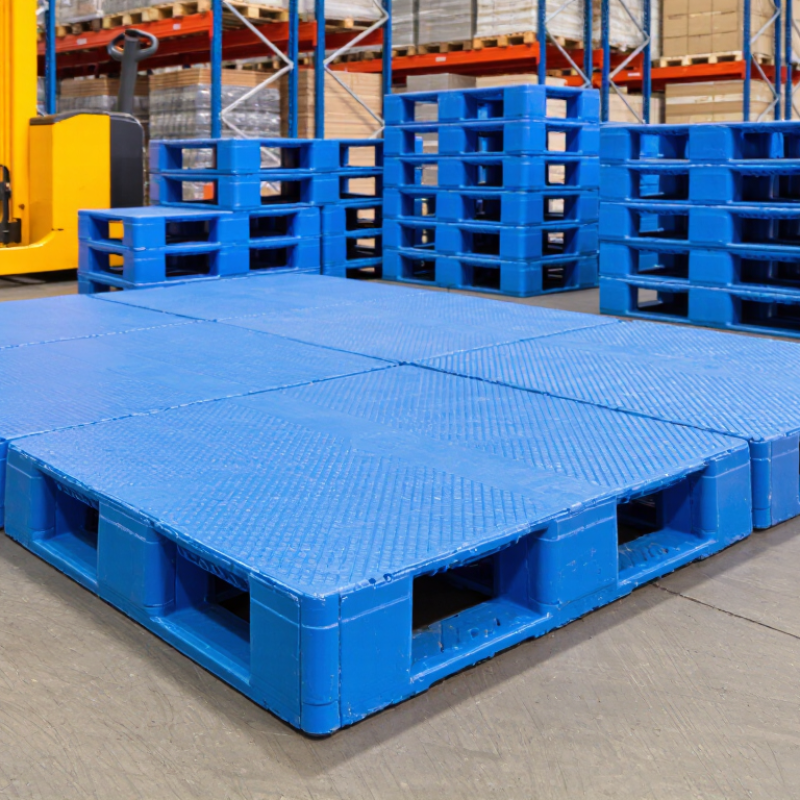
A high-quality plastic pallet from China begins with consistent material, not a glossy surface. Recycled content can reduce cost, but uncontrolled blends may cause brittleness in cold storage. Ask whether the pallet uses HDPE or PP, and request the material grade. The deck should feel rigid under hand pressure, while molded feet should align cleanly. Sharp flash, warped corners, and strong chemical odors deserve attention. Small defects often become expensive during repeated forklift handling. Looks can mislead.
Load data must match the real workflow. Check static, dynamic, and racking capacities separately. A pallet rated for 1,500 kilograms on the floor may fail at 800 kilograms in a rack. Quality suppliers provide test conditions, sample dimensions, and production tolerances. I would inspect several samples, weigh them, and measure deck thickness with calipers. One sample is not enough. It can hide variation.
Reliable Chinese manufacturing also depends on traceability. Batch codes, documented inspections, and clear replacement policies make claims easier to verify. Look for reinforced entry points, drainage openings, and smooth surfaces that clean without trapping residue. For outdoor use, UV stabilization matters; for freezer rooms, low-temperature impact testing matters more. A certificate alone does not prove performance. Factory visits help, though they cannot replace independent testing. My own judgment can be wrong, especially when price pressure encourages thinner designs.
What Are the Top Plastic Pallets from China? - What Defines a High-Quality Plastic Pallet from China?
| Pallet Type | Typical Size | Material | Typical Static Load | Typical Dynamic Load | Entry | Best-Suited Applications | Quality Indicators |
|---|---|---|---|---|---|---|---|
| Heavy-Duty Rackable Pallet | 1200 × 1000 mm | HDPE or reinforced PP | 4,000–6,000 kg | 1,000–1,500 kg | Four-way | Warehouse racking, automated storage, export logistics | Reinforced underside, stable feet, low deflection, consistent dimensions |
| Standard Export Pallet | 1200 × 1000 mm | HDPE or PP | 2,000–4,000 kg | 800–1,200 kg | Four-way | General manufacturing, international shipping, distribution centers | Uniform top deck, strong weld-free structure, barcode or label areas |
| Hygienic Food-Grade Pallet | 1200 × 800 mm | Virgin HDPE or food-contact PP | 2,000–4,000 kg | 800–1,200 kg | Four-way | Food processing, beverages, pharmaceuticals, cold-chain logistics | Smooth cleanable surfaces, low water absorption, traceable raw materials |
| Lightweight Nestable Pallet | 1200 × 1000 mm | PP or HDPE | 1,000–2,000 kg | 500–1,000 kg | Four-way | Empty-pallet return systems, retail distribution, low-cost transport | Reliable nesting ratio, low tare weight, reinforced handling points |
| Closed-Deck Spill-Control Pallet | 1200 × 1000 mm | HDPE | 2,500–4,000 kg | 800–1,200 kg | Four-way | Chemical containers, liquid goods, drums and leak-sensitive cargo | Continuous deck, raised perimeter edge, chemical-resistant resin options |
| Euro-Size Distribution Pallet | 1200 × 800 mm | HDPE or PP | 2,000–4,000 kg | 800–1,200 kg | Four-way | European distribution, grocery supply chains, standardized storage | Accurate footprint, compatible fork openings, anti-slip deck features |
| Temperature-Resistant Pallet | 1200 × 1000 mm | Impact-modified HDPE or PP | 2,000–4,000 kg | 700–1,200 kg | Four-way | Freezers, refrigerated warehouses, outdoor logistics | Verified low-temperature impact performance, reduced brittleness, stable geometry |
Which Types of Plastic Pallets Are Commonly Made in China?
China produces several practical types of plastic pallets for warehouses, factories, and export logistics. Injection-molded HDPE and polypropylene pallets are especially common. They resist moisture, insects, and repeated washing. Their smooth surfaces also reduce product damage during handling.
Nestable pallets have recessed feet that fit inside one another. They save space during empty returns and storage. Three-runner pallets support forklifts and pallet trucks from several directions. Six-runner pallets add more contact points and usually offer better stability. Reversible pallets have a flat deck on both sides. They suit double-sided handling but can require more storage space.
Rackable pallets include reinforced bottom runners for selective or drive-in racking. Their performance depends on beam spacing, load distribution, and temperature. Hygienic pallets, often built with closed decks, are easier to clean. They are useful where dust, spills, or frequent sanitation matter. Some Chinese manufacturers also produce spill-containment pallets with raised edges for drums and containers.
A pallet may look strong and still fail under uneven loading. That is a common mistake. Buyers should request static, dynamic, and racking load data, not only a catalog rating. Dimensions, deck openings, foot design, and forklift clearance deserve measurement. Material quality can vary between production batches, so sampling matters. A practical inspection should include weld-free surfaces, stable feet, drainage behavior, and resistance to repeated impacts. Cold conditions can make some plastics less forgiving. The cheapest option is not always the most reliable.
What Materials and Manufacturing Methods Are Used?
China’s leading plastic pallets generally use high-density polyethylene (HDPE) or polypropylene (PP). HDPE offers impact resistance in cold warehouses. PP provides higher stiffness and better heat performance. Recycled resin lowers cost, but its quality can vary between production batches.
The 2023 PlasticsEurope report recorded 400.3 million tonnes of global plastic production in 2022. The OECD Global Plastics Outlook reported that only 9% of plastic waste was recycled in 2019. These figures explain the growing use of recycled HDPE and PP in pallet manufacturing. However, recycled content should be verified through melt-flow testing, contamination checks, and batch records. A pallet may look strong. Hidden brittleness can appear after winter storage.
Injection molding is common for heavy-duty pallets. Molten plastic fills a steel mold under high pressure, creating consistent feet and deck ribs. Blow molding uses air pressure to form hollow, lightweight structures. Thermoforming heats plastic sheets, then shapes them over molds. It can reduce tooling costs, but dimensional control may be less precise. Welded components allow flexible designs, although joints need careful inspection.
A practical factory audit should check mold wear, cooling time, wall thickness, and load testing. Static, dynamic, and racking tests reveal different weaknesses. ISO 8611 provides recognized methods for testing flat pallets. No material choice is perfect. A lower-cost recycled pallet may need thicker ribs, tighter quality control, or a shorter service-life assumption.
How Do Chinese Plastic Pallets Compare in Cost and Performance?
Chinese plastic pallets can be attractive when purchase price matters. Typical export quotations range from about US$12 for light-duty pallets to US$70 for reinforced models, before freight and duties. These figures vary by resin, mold design, and order volume. China’s manufacturing scale often lowers unit costs, but cheaper material may reduce impact resistance. That trade-off is easy to miss.
Performance should be checked through load testing, not photographs. ISO 8611 provides methods for testing pallet stiffness, racking performance, and safe working loads. The World Bank’s 2023 Logistics Performance Index gave China a score of 3.7, reflecting strong logistics capability, but this does not guarantee every pallet factory has equal quality control. In practical use, a reinforced pallet may survive repeated forklift contact better, especially in cold warehouses. However, recycled content can create inconsistent results. Some suppliers provide test reports, but reports may not represent your exact mold.
Tips: Request static, dynamic, and racking-load results for the specific pallet model. Compare five-year cost, not only the invoice. Include repairs, return freight, cleaning, and disposal. Measure your heaviest load and aisle temperature. A small pilot shipment is wiser than a large first order. Even experienced buyers sometimes overlook pallet nesting depth, which can quietly increase storage costs.
How Can Buyers Choose a Reliable Chinese Plastic Pallet Supplier?
Choosing a reliable Chinese plastic pallet supplier requires more than comparing prices. The 2023 World Bank Logistics Performance Index gave China a score of 3.7 out of 5. Logistics are strong, but supplier quality still varies.
Ask for verifiable factory records, not polished brochures. A serious supplier should provide production capacity, mold ownership, material specifications, and batch traceability. Request samples in the exact size and design you need. Test static, dynamic, and racking loads under ISO 8611 conditions. A pallet that survives a warehouse floor may fail on a high rack. Small details matter. Check deck deflection, fork-entry clearance, anti-slip performance, and corner damage after repeated handling. In my experience, suppliers often quote maximum loads without explaining test conditions. That is a warning sign.
Material transparency also deserves attention. Request the percentage of virgin and recycled resin, plus color consistency and impact-test results. For food or pharmaceutical logistics, ask for relevant hygiene documentation and cleaning guidance. Review independent inspection reports, export records, and corrective-action procedures. The supplier should explain what happens after a failed batch. Poor answers are revealing. A third-party pre-shipment inspection can verify dimensions, weight, quantity, and visible defects before payment. However, one inspection cannot replace ongoing quality control. Start with a pilot order, measure breakage and handling performance, then negotiate larger volumes. Cost is important, but replacement freight and damaged goods can erase a cheap quotation quickly.
Related Posts
-
Top 10 Benefits of Using Plastic Pallets for Global Shipping?
-
Top Benefits of Using IBC Containers for Your Storage and Transportation Needs
-
2026 How to Choose the Best Metal Tote for Your Needs?
-
How to Choose the Right IBC Water Tank for Your Needs?
-
How to Choose the Right Stainless Steel Barrels for Your Needs?
-
Why Are Metal Drums Essential for Industrial Applications?

Get in touch with us,
We will contact you shortly!
What is the difference between Unline(Non-Epoxy Coated) or Lining(Epoxy Coated) Metal Drum?

Unline drums with internally bare metal surface is more susceptible to corrosion and rust while Lining drums are internally coated with Phenolic Epoxy Coating to provide a non-reactive barrier between the drum surface and your product, less risk of contamination. Note: Our Unline drums are coated with an anti-rust agent after washing to reduce risk of rust.
What are Unline(Non-Epoxy Coated) and Lining(Epoxy Coated) drums compatible with?

In Singapore, Recon Unline Drums are usually more costly than Recon Lining Drums. Hence, we recommend Recon Unline Drums to fill aromatics like Thinner, Xylene, Toulene& other solvents like Hexane, BA, CA, EA, MC, White spirit, etc.
We recommend the lower-priced Recon Lining Drums to fill hydrocarbons like IPA, Methanol, Ethanoland oil-based products like diesel, petrol, lubricants, engine, hydraulic, base, transmission fluid, additives, waste oil, etc.;
What is the difference between Grade A and Grade B Metal Drum ?

Grading of used drums are usually based on physical conditions like rustiness, deformities and residual contents. Grade A drums are totally free from internal rust, serious dents and are easy to clean. Grade B drums have different degrees of rust internally and aesthetically inferior compared to Grade A drums.
What content is suitable to fill in a Recon Grade A or Grade B Drum?

Recon Grade A drum is suitable to fill more costly virgin grade products while Recon Grade B drum is more suitable for recycled or waste products.
What is the difference between Open Top and Close Top Drums and their usage?

Closed top drums are for water and other liquid products. Open Top drums can be used for liquid too but are primarily for more viscous products. The Open Top (or open head with a lid) allows you to get in and out of the drum with your product easier.
What type of content are Metal or Plastic Drums suitable for?

Metal drums offer additional protection when dealing with potentially flammable substances. They provide superior fire resistance, impact protection, and longevity for storing class 1, 2, and 3 volatile chemicals.
Plastic HDPE Drums are suitable for corrosive chemicals like acids, alkaline and also water-based products.
Will there be any contamination in the reconditioned metal, plastic drums or IBC tanks?

All our reconditioned containers (metal/plastic drums, carboys, IBC tanks) are washed thoroughly with specially formulated cleaning agent, rinsed with clean water, dried, and tested for possible leakages during the recondition process. Stringent quality inspection is being conducted 100% on every reconditioned product before they are qualified for sale & delivery.
What is the drum gauge(thickness) and weight for reconditioned metal drums?

Reconditioned metal drums gauge can be 0.9mm to 1.0mm all round. Their weight can vary from 16 to 18kg.
Do you sell New Packaging Products too?

Yes, we are also a distributor for new pallets, metal drums, plastic drums, carboys, IBCs and stainless-steel tanks.
What additional services do you provide apart from selling reconditioned and new containers.?

We are an NEA licensed toxic industrial waste collector, who can collect and dispose of used toxic waste containers in Singapore.
Do you offer labelling and silkscreen on the containers ?

We can provide labelling and silk-screening on the containers.
Are you able to ship overseas ?

Yes, we can arrange export our products to any country in the world.
Leading the Way
to Carbon Neutrality