
Why Choose a Gas Generator Set for Global Power Needs?
Why Choose a Gas Generator Set for Global Power Needs?
Global electricity demand is entering a more demanding phase. The International Energy Agency’s Electricity 2024 report forecasts average annual demand growth of 3.4% through 2026. Data centres, manufacturing, cooling systems, and urban expansion are raising pressure on existing grids. Meanwhile, the 2024 Tracking SDG7 report estimates that nearly 685 million people lacked electricity access in 2022. Reliable local generation still matters.
A Gas Generator Set can provide dependable power for hospitals, factories, construction sites, and remote microgrids. Natural gas engines typically offer fast load response and stable operation. They can also support combined heat and power systems, where recovered exhaust heat warms buildings or industrial water. That improves fuel utilisation in suitable facilities. The IEA’s Gas 2024 analysis expects global gas demand to continue growing through 2025, supported partly by power-sector needs.
The practical picture is more specific. Imagine a cold-storage warehouse facing a short grid outage. A correctly sized gas generator set can maintain compressors, lighting, and monitoring equipment without interrupting product handling. ISO 8528-based selection, proper ventilation, fuel-pressure control, and scheduled maintenance remain essential. A weak installation can waste the advantages.
It is not a universal answer. Gas supply interruptions, infrastructure costs, methane leakage, and local emissions rules require careful assessment. The World Bank and IEA both stress that energy decisions must consider affordability, reliability, and environmental performance. Gas generation may be a bridge, not a final destination. Its value depends on application, fuel security, and honest lifecycle evaluation.
What Is a Gas Generator Set and How Does It Work?
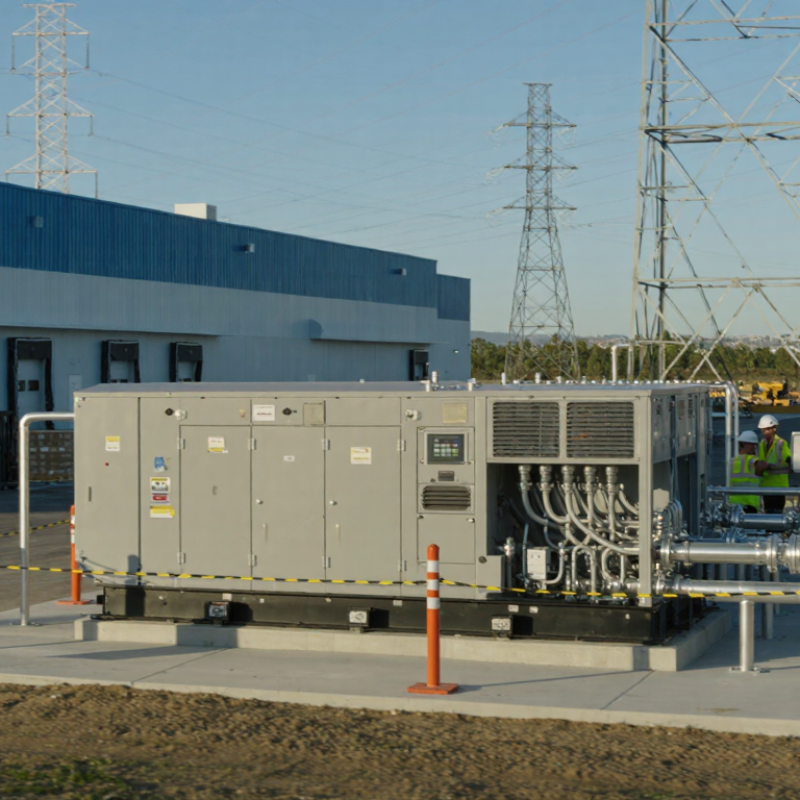
A gas generator set combines an internal-combustion engine, an alternator, a control panel, and safety systems. It converts the energy in natural gas or another approved gaseous fuel into electricity. The engine burns the fuel inside its cylinders, creating mechanical rotation. The alternator then changes that rotation into electrical power for buildings, factories, hospitals, or remote sites.
During operation, the control system regulates speed, voltage, temperature, and fuel flow. Sensors can detect overheating, low oil pressure, or unstable output. If a serious fault appears, the generator may shut down automatically. In practical installations, correct ventilation and exhaust routing are essential. Gas quality also matters. Poor fuel pressure can cause misfiring, lower output, or difficult starting. Engineers should match the generator capacity with real loads, including motors that require extra starting power.
Tips: Keep fuel lines clean and inspected. Test the system under load, not only at idle. Record unusual sounds, vibration, and temperature changes. Maintenance schedules should follow the equipment manual and local safety requirements. A gas generator can provide efficient power, but it is not maintenance-free. Actual performance may differ from laboratory figures, especially in high temperatures, at altitude, or with changing gas composition. That limitation deserves honest planning.
Why Choose a Gas Generator Set for Global Power Needs? – What Is a Gas Generator Set and How Does It Work?
| Data Dimension | Typical Gas Generator Set Data | How It Works or Why It Matters | Global Power Application |
|---|---|---|---|
| Basic Definition | An engine-generator system that burns a gaseous fuel to produce electricity. | The gas engine converts chemical energy into mechanical shaft power, while the alternator converts shaft power into electrical energy. | Standby, prime, peak-shaving, microgrid, and combined heat and power installations. |
| Common Fuel Types | Pipeline natural gas, liquefied natural gas, biogas, landfill gas, and treated syngas. | The fuel must meet the engine’s pressure, heating-value, moisture, and contaminant requirements. Gas conditioning may be required for renewable or low-quality gases. | Suitable for urban grids, remote sites, farms, wastewater plants, landfills, and industrial facilities. |
| Practical Output Categories | Micro: below 50 kW; small: 50–500 kW; medium: 0.5–5 MW; large: above 5 MW. | Actual classifications vary by manufacturer and market. Output selection should consider continuous load, starting current, altitude, ambient temperature, and future expansion. | From telecommunications and homes to hospitals, data centers, factories, and utility-scale distributed generation. |
| Electrical Efficiency | Approximately 35%–45% for many modern natural-gas generator sets at rated load. | Efficiency depends on engine size, combustion technology, load level, fuel quality, and operating conditions. Part-load operation generally reduces efficiency. | Can reduce fuel consumption and operating cost where reliable gas supply is available. |
| Combined Heat and Power Potential | Total electrical plus useful thermal efficiency can reach approximately 70%–90% in well-designed CHP systems. | Heat recovered from exhaust gas, engine coolant, and lubricating oil can provide hot water, steam, or process heat. | Hotels, hospitals, food processing plants, district heating systems, and wastewater treatment facilities. |
| Typical Carbon Dioxide Intensity | Approximately 0.35–0.55 kg of direct CO2 per kWh of electricity for natural-gas generation, depending on efficiency. | This is a fuel-combustion estimate and does not include upstream emissions or methane leakage. Biogas may reduce net lifecycle emissions when sustainably sourced. | Useful for comparing generation options during energy planning and emissions assessments. |
| Start-Up and Load Response | Typically starts within seconds to several minutes, depending on controls, reserve requirements, and unit size. | Automatic transfer systems, synchronizing controls, and load-sharing systems allow multiple units to support changing demand. | Emergency backup, islanded microgrids, renewable-energy balancing, and peak-demand support. |
| Fuel Supply and Storage | Pipeline gas can support long runtimes without on-site fuel storage; LNG and compressed gas require storage and delivery infrastructure. | Availability, pressure stability, emergency shutoff systems, and local gas-network reliability directly affect generator resilience. | A strong option where gas infrastructure is dependable, but dual-fuel or backup systems may be preferred in vulnerable locations. |
| Maintenance Considerations | Routine maintenance includes oil and filter service, spark-plug inspection, ignition-system checks, valve adjustment, cooling-system service, and emissions-system inspection. | Maintenance intervals depend on engine design, operating hours, load profile, lubricant quality, and fuel cleanliness. | Planned servicing helps improve availability and reduces the risk of unplanned outages. |
| Main Selection Factors | Required power rating, duty cycle, gas composition, site altitude, ambient temperature, emissions limits, noise restrictions, and grid-connection rules. | A correct technical assessment prevents under-sizing, poor fuel performance, excessive maintenance, and non-compliance with local regulations. | Supports dependable power planning across different climates, grid conditions, fuel markets, and regulatory environments. |
Note: Values shown are typical planning ranges. Actual performance varies by generator configuration, fuel quality, site conditions, operating load, maintenance status, and applicable local standards.



Get in touch with us,
We will contact you shortly!
What is the difference between Unline(Non-Epoxy Coated) or Lining(Epoxy Coated) Metal Drum?

What are Unline(Non-Epoxy Coated) and Lining(Epoxy Coated) drums compatible with?
What is the difference between Grade A and Grade B Metal Drum ?
What content is suitable to fill in a Recon Grade A or Grade B Drum?
What is the difference between Open Top and Close Top Drums and their usage?
What type of content are Metal or Plastic Drums suitable for?
Will there be any contamination in the reconditioned metal, plastic drums or IBC tanks?
What is the drum gauge(thickness) and weight for reconditioned metal drums?
Do you sell New Packaging Products too?
What additional services do you provide apart from selling reconditioned and new containers.?
Do you offer labelling and silkscreen on the containers ?
Are you able to ship overseas ?
Leading the Way
to Carbon Neutrality