
Top Droplet Molding Apparatus Manufacturers Worldwide

Choosing the right Droplet Molding Apparatus manufacturer requires more than comparing catalog prices. Performance depends on droplet uniformity, mold accuracy, temperature control, and production repeatability. These details shape product quality in laboratories, pilot facilities, and industrial environments.

This guide examines leading manufacturers worldwide through practical and technical criteria. It considers apparatus design, material compatibility, automation options, maintenance support, documentation, and quality assurance. Manufacturers with strong engineering teams often provide clearer specifications, validated operating procedures, and responsive technical assistance. Those advantages matter when a small variation in droplet size can affect testing results or final product performance.

Real-world usability also deserves attention. An operator may need to adjust a nozzle beside a heated chamber, inspect a transparent mold, or clean narrow channels after a long production run. Good equipment should make these tasks controlled and repeatable. Safety features, accessible replacement parts, installation guidance, and staff training should not be treated as minor extras.

No ranking can fit every application. A compact system may suit research work, while a higher-throughput platform may better support commercial production. Published specifications are useful, but independent verification remains important. Some manufacturer claims may require closer review.

That is the practical challenge.

The following overview highlights established suppliers and explains where each may perform best. It also recognizes possible limitations, because reliability comes from evidence, service history, and consistent results—not impressive marketing language alone. Readers should confirm current certifications, regional support, and compatibility requirements before making a purchasing decision.
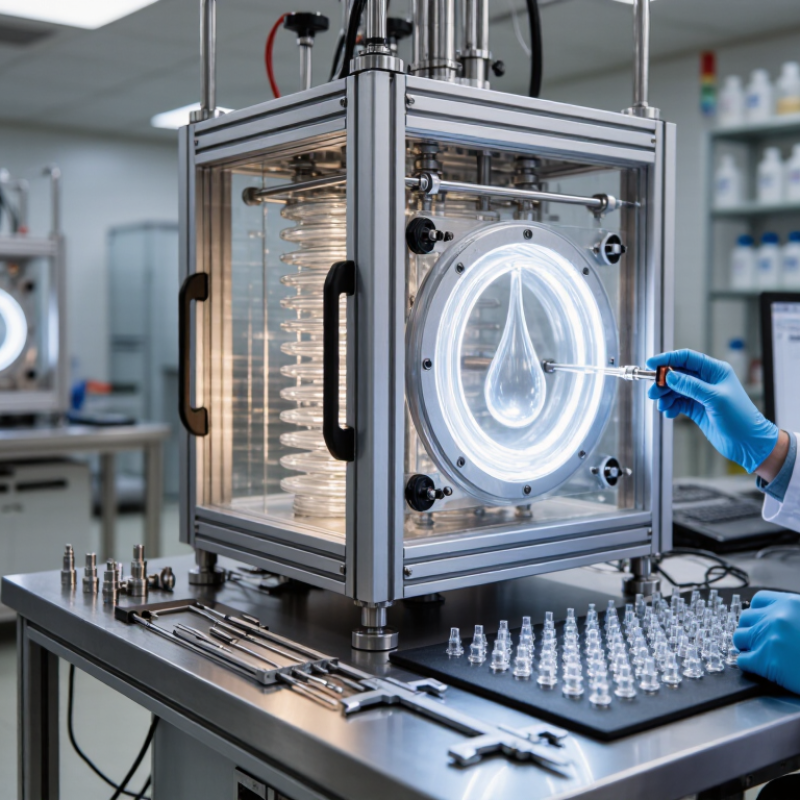
Top Droplet Molding Apparatus Manufacturers Worldwide

Droplet Molding Apparatus: Definition and Core Functions

Droplet molding apparatus creates uniform droplets from two immiscible fluids. One phase forms the droplet, while the other carries it through a microchannel or nozzle.

The apparatus controls flow rate, pressure, temperature, and channel geometry. These controls influence droplet diameter, spacing, and stability.

Typical systems include precision pumps, flow meters, molds, collection chambers, and optical monitoring.

Its core function is repeatable droplet production.

In laboratory practice, droplets may serve as reaction vessels, encapsulation units, or templates for microparticles.

A 2024 Grand View Research report estimated the global microfluidics market at approximately USD 28.9 billion in 2023.

It also projected strong growth through 2030. This trend supports wider demand for accurate droplet-generation equipment.

However, market estimates differ between research firms. That difference deserves attention.

Apparatus performance depends heavily on fluid viscosity, surface tension, and material compatibility, not only equipment specifications.

Tips:

Validate droplet size under real operating conditions. Use calibrated imaging, not visual judgment alone.

Check whether the mold surface causes wetting or unwanted adhesion.

Keep a written record of pressure, temperature, and flow settings.

ASTM and ISO-related laboratory quality practices can improve traceability, although they do not replace application-specific testing.

A small pressure fluctuation may change the entire droplet pattern. That is easy to underestimate.


How Droplet Molding Systems Operate

Droplet molding systems create uniform droplets by combining two immiscible fluids under controlled flow. The dispersed phase forms droplets inside a continuous carrier phase. Common geometries include T-junctions and flow-focusing channels. Pressure controllers, pumps, and precision valves regulate each stream. At the junction, shear forces stretch the inner fluid until it pinches off. This happens repeatedly, often within milliseconds.

Droplet size depends on flow-rate ratio, viscosity, interfacial tension, and channel dimensions. Many laboratory systems produce droplets between 10 and 1,000 micrometers. Surfactants help prevent unwanted merging during transport. Optical sensors then inspect spacing, diameter, and production stability. According to Grand View Research’s 2024 microfluidics report, the global microfluidics market reached about USD 28.6 billion in 2023. That growth is increasing demand for more repeatable molding platforms.

After generation, droplets may enter a curing, cooling, or crosslinking zone. The solidified particles are collected through filtration or controlled separation. Thermal control matters. Even a small temperature shift can change viscosity and droplet diameter. MarketsandMarkets’ 2024 analysis identifies automation and high-throughput processing as major development directions. Still, a clean image does not prove reliable operation. I would verify long-run uniformity, material compatibility, and cleaning access before comparing manufacturers. Small channel defects can quietly ruin an otherwise impressive batch.

Key Technologies Used in Droplet Molding Equipment

Top Droplet Molding Apparatus Manufacturers Worldwide

Key Technologies Used in Droplet Molding Equipment

Modern droplet molding equipment relies on flow-focusing and T-junction microfluidics. These channels divide oil and aqueous phases into repeatable droplets. Pressure-driven pumps control flow rates, while pneumatic valves adjust timing. Stable temperature control also reduces viscosity changes during long production runs. That matters.

Optical sensors inspect droplet size, shape, and spacing in real time. Advanced systems connect these sensors with closed-loop controllers. They can correct pressure changes within milliseconds. UV curing, thermal curing, and solvent evaporation then solidify the molded structure. According to Grand View Research, the global microfluidics market reached about USD 29 billion in 2023 and may grow near 12% annually through 2030. This growth supports wider investment in automated droplet platforms.

A perfect droplet is a useful fiction. Even small channel defects can create satellites, uneven walls, or blocked outlets. Process engineers should test nozzle geometry, surfactant concentration, and curing energy together. Data from each batch should remain traceable. The approach is slower, but more dependable.

Tips: Start with low flow rates and increase them gradually. Check droplet diameter under magnification, not by appearance alone. Recalibrate pumps after material changes. A practical warning: published throughput figures often reflect ideal laboratory conditions, not continuous factory operation.

Top Droplet Molding Apparatus Manufacturers Worldwide - Key Technologies Used in Droplet Molding Equipment

Technology Category Operating Principle Typical Droplet Diameter Common Materials Key Control Technologies Typical Applications Main Equipment Advantages
Flow-Focusing Microfluidics A continuous phase hydrodynamically narrows and pinches a dispersed phase into uniform droplets at a microchannel junction. Approximately 10–500 µm, depending on channel geometry, flow rate and fluid properties. Water-based solutions, oils, polymers, hydrogels, biological fluids and photocurable resins. Computer-controlled pressure or syringe pumps, flow meters, temperature control and optical monitoring. Monodisperse beads, microcapsules, cell encapsulation, diagnostics and laboratory-scale formulation. High size uniformity, low sample consumption and precise control of droplet size.
T-Junction Microfluidics A dispersed phase intersects a continuous phase at a perpendicular channel junction, where shear forces break the dispersed stream into droplets. Approximately 50–1,000 µm in common laboratory configurations. Aqueous solutions, oils, emulsions, polymer solutions, alginate and gelatin formulations. Independent flow-rate control, pressure regulation, channel-temperature monitoring and camera-based measurement. Emulsion preparation, encapsulation, reagent screening and controlled particle production. Simple geometry, repeatable droplet generation and relatively straightforward scale-out using parallel channels.
Vibrating-Nozzle Droplet Formation A liquid jet exiting a nozzle is destabilized by controlled mechanical vibration and separates into regularly spaced droplets. Approximately 50–1,000 µm, primarily determined by nozzle diameter and operating frequency. Alginate, polymers, cell suspensions, ceramic slurries and aqueous biomaterials. Piezoelectric or mechanical excitation, pressure control, nozzle heating and stroboscopic visualization. Cell-laden beads, hydrogel particles, immobilized biocatalysts and encapsulated active ingredients. Good production repeatability, gentle handling of many formulations and scalable nozzle arrangements.
Piezoelectric Inkjet Droplet Ejection A piezoelectric actuator changes chamber volume and ejects discrete liquid droplets through a fine nozzle. Typically about 20–100 µm, depending on nozzle size, viscosity and waveform settings. Low-to-moderate-viscosity inks, functional polymers, biomaterials, conductive fluids and resin formulations. Waveform programming, drop-on-demand control, nozzle inspection, stroboscopic imaging and automated alignment. Micro-patterning, additive manufacturing, printed electronics and localized material deposition. Digital pattern control, low material waste and precise placement of individual droplets.
Electrospray Droplet Generation An applied electric field transforms a liquid meniscus into a charged cone-jet that produces fine droplets. Submicron to approximately 50 µm, depending on conductivity, flow rate and applied voltage. Polymer solutions, pharmaceutical formulations, nanoparticles, ceramics and aqueous or organic solvents. High-voltage regulation, flow control, grounded-collector positioning and environmental monitoring. Fine particle production, encapsulation, coating and electrohydrodynamic deposition. Very small droplets, high surface-area production and compatibility with advanced particle engineering.
Pressure-Driven Multi-Phase Molding Controlled pressure differentials move two or more immiscible phases through a mold or microstructured cavity to form droplets or capsules. Approximately 100 µm to several millimeters, depending on mold dimensions. Thermoplastics, silicone-based materials, hydrogels, waxes, resins and encapsulation polymers. Closed-loop pressure control, mold-temperature regulation, valve timing and in-line optical inspection. Encapsulated products, composite particles, polymer beads and structured soft materials. Suitable for repeatable molding cycles and integration with curing, solidification or coating stages.
Centrifugal Droplet Generation Rotation creates centrifugal forces that drive liquids through radial channels and produce droplets at controlled outlets. Approximately 100–2,000 µm, depending on outlet geometry and rotational speed. Aqueous reagents, oils, polymer solutions, hydrogels and biological suspensions. Programmable rotational speed, timed dispensing, cartridge balancing and integrated imaging. Parallelized sample preparation, bead production, screening and portable laboratory workflows. Reduced dependence on external pumps and convenient parallel processing in compact systems.
Microfluidic Droplet Sorting and Encapsulation Generated droplets are detected and selectively routed, merged, split or encapsulated using valves, electric fields or optical triggers. Commonly about 20–500 µm, based on the upstream droplet-generation method. Aqueous droplets in oil, hydrogel precursors, cells, enzymes, nucleic-acid reagents and polymer solutions. High-speed imaging, fluorescence detection, pneumatic valves, dielectrophoresis and programmable control software. Single-cell analysis, digital assays, directed screening and high-throughput formulation development. Automated selection of droplets and improved process consistency for high-value samples.

Note: Droplet diameter ranges are representative industry ranges rather than guaranteed equipment specifications; actual performance depends on fluid viscosity, interfacial tension, wettability, channel or nozzle geometry, flow rate and operating conditions.

Criteria for Evaluating Global Apparatus Manufacturers

Evaluating global droplet molding apparatus manufacturers requires more than comparing catalog prices. The Grand View Research Microfluidics Market Report estimates that the global market could reach about USD 63 billion by 2030, supported by strong demand in diagnostics, drug development, and biotechnology. This growth makes supplier selection more important, especially when small process errors can alter droplet size, uniformity, and sample stability.

Technical performance should be tested with measurable evidence. Ask for droplet-size variation, production throughput, pressure tolerance, material compatibility, and cleaning requirements. A reliable manufacturer should provide validation records, calibration procedures, and repeatability data from independent or customer testing. Equipment aligned with ISO 13485 quality practices can offer stronger documentation and traceability. Still, certification alone is not proof of excellent molding performance.

Service capability matters just as much. MarketsandMarkets reports continued expansion in microfluidic applications, increasing the need for installation support, operator training, spare parts, and responsive maintenance. Examine delivery times and the supplier’s experience with similar fluids, temperatures, and production volumes. Request a live demonstration if possible. It exposes practical weaknesses quickly. A polished brochure can hide them. Total cost should include tooling changes, consumables, downtime, and future upgrades. I would also question unusually precise claims without raw test data; this is where many evaluations become too optimistic.

Leading Droplet Molding Apparatus Manufacturers Worldwide

Leading droplet molding apparatus manufacturers worldwide are judged by more than catalog size. Experienced producers understand how fluid viscosity, nozzle geometry, temperature, and curing time shape each droplet. Their equipment should provide stable dosing, accurate alignment, and repeatable mold release. Reliable manufacturers document calibration procedures and publish meaningful performance data. They also support installation, operator training, preventive maintenance, and spare-part availability across regions. These details matter when small volume errors change surface texture or product consistency.

Professional buyers should examine application records, not polished claims alone. Ask for sample runs using comparable materials and production speeds. Inspect droplet diameter variation, cycle time, cleaning access, and control-system traceability. Strong suppliers can explain failure modes and propose adjustments without hiding limitations. No manufacturer is perfect. Some systems may require manual tuning during startup, especially with sensitive formulations or changing room conditions. That weakness deserves honest discussion, not vague promises. Independent testing and documented acceptance criteria improve purchasing confidence.

Tips: Request three recent references from similar applications. Compare measured tolerance, not marketing language. Check whether service engineers can respond within your operating region. Review electrical safety, guarding, and sanitation features before installation. Keep a trial log with nozzle settings, temperature, and release results. Small records often reveal large process problems.

Top Droplet Molding Apparatus Manufacturers Worldwide - Leading Droplet Molding Apparatus Manufacturers Worldwide

Representative droplet-diameter operating ranges by apparatus technology. These ranges are technology-level reference values and do not represent any individual company or brand.

Microfluidic flow-focusing and inkjet systems generally produce smaller droplets, while vibrating-nozzle and T-junction systems support broader or larger droplet-size ranges. Actual results depend on fluid properties, nozzle geometry, pressure, frequency, and operating conditions.

Get in touch with us,
We will contact you shortly!

Get in touch with us by filling up the enquiry form. We will contact you shortly!

    What is the difference between Unline(Non-Epoxy Coated) or Lining(Epoxy Coated) Metal Drum?

    What are Unline(Non-Epoxy Coated) and Lining(Epoxy Coated) drums compatible with?

    What is the difference between Grade A and Grade B Metal Drum ?

    What content is suitable to fill in a Recon Grade A or Grade B Drum?

    What is the difference between Open Top and Close Top Drums and their usage?

    What type of content are Metal or Plastic Drums suitable for?

    Will there be any contamination in the reconditioned metal, plastic drums or IBC tanks?

    What is the drum gauge(thickness) and weight for reconditioned metal drums?

    Do you sell New Packaging Products too?

    What additional services do you provide apart from selling reconditioned and new containers.?

    Do you offer labelling and silkscreen on the containers ?

    Are you able to ship overseas ?

    Leading the Way
    to Carbon Neutrality

    Drumming sustainability into every aspect of our operations, we strive to create a greener and more conscious future for generations to come.
    Contact Us
    WhatsApp
    Email
    Join Our Newsletter

    Sign up for our newsletter for exclusive discounts and latest news of new launches!

      Logo Logo Logo Logo Logo
      Scroll to Top






