Top Conveyor Belt Beam Cutting Press Factories Worldwide
Choosing among Conveyor Belt Beam Cutting Press Factories worldwide is not simply a matter of comparing machine prices. Buyers need to understand how each manufacturer handles frame design, cutting accuracy, press capacity, and production support. A press may look robust in a catalog, yet its value depends on repeatable output, safe operating features, accessible wear parts, and clear technical documentation. Small details matter. For example, consistent cuts through thick conveyor-belt material can support later assembly and reduce avoidable rework. A factory’s experience with different belt constructions also deserves careful review, since material behavior varies with thickness, reinforcement, and intended use.
This overview introduces leading manufacturers and practical ways to evaluate them across regions. It considers manufacturing capability, customization options, quality-control procedures, service coverage, and training availability. Evidence should come from verifiable specifications, customer references, inspection records, and direct discussions with engineering teams—not polished claims alone. Fit comes first. A large facility is not automatically the best partner for a small workshop, while a specialized producer may better suit a demanding production line. Buyers should confirm operating requirements and compare equivalent configurations before deciding. Supplier information can change, and public claims may be incomplete; that is worth acknowledging. The aim is not to promise a universal winner, but to help readers ask sharper questions and identify factories whose equipment, support, and documented performance match their cutting needs.
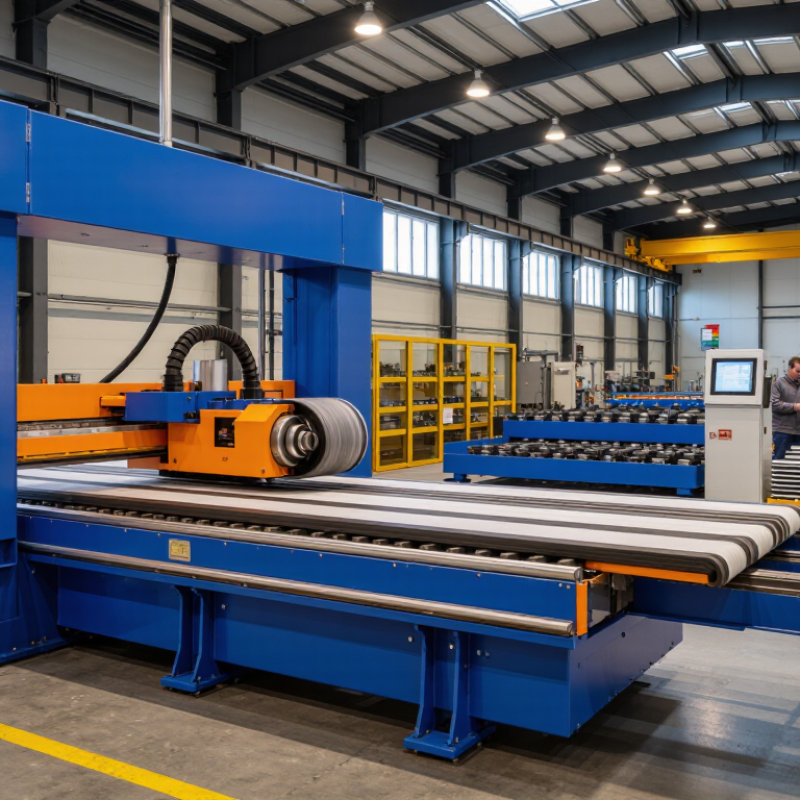
Understanding Beam Cutting Presses for Conveyor Belt Production
A beam cutting press uses a broad moving beam to drive a shaped die through layered rubber, fabric, or reinforcement sheet. In conveyor-belt production, it can cut splice materials, edge strips, and smaller belt components. The operator aligns the die, sets stroke and pressure, then checks the cut edge for fraying or compressed layers. Small details matter.
ISO 251:2012 specifies standard conveyor-belt widths from 300 to 2,400 mm, a useful range when sizing press beds and planning sheet layouts. ISO 14890:2013 sets requirements for rubber- or plastic-covered belts used in general applications. These references help manufacturers match cutting capacity to belt materials and dimensions; they do not replace trials on the actual production stack. A press that handles one thin sheet cleanly may deform a thicker, reinforced layup. That can be easy to miss. Measure finished parts, inspect cut edges, and record scrap rates across repeated runs. Real production is less tidy than a specification sheet.
How Conveyor Belt Beam Cutting Presses Operate
A conveyor belt beam cutting press feeds sheet material beneath a moving beam, which drives a shaped die through the material onto a cutting surface. The operator loads the roll or sheet, checks its alignment, and selects a cutting pattern. The conveyor advances the material in measured steps. Sensors or registration marks help keep each cut in position, though worn belts can still cause slight drift.
The beam then applies controlled force for a brief dwell. Pressure, die height, and feed speed depend on material thickness and density; foam and layered fabric do not behave alike. That matters. Before production, operators should test a sample and inspect cut edges for incomplete penetration or compression. Guards, interlocks, and two-hand controls vary by machine, so training must follow the machine’s own procedures. The U.S. Bureau of Labor Statistics reported 2.8 total recordable injury and illness cases per 100 full-time workers in manufacturing for 2023, in its Survey of Occupational Injuries and Illnesses. This is not a press-specific rate, but it underscores why safe feeding and clear access around moving beams deserve routine checks. One overlooked detail: scrap can build up beside the belt and disturb alignment.
How a Conveyor Belt Beam Cutting Press Operates
The chart shows the usual operating sequence: position the material and cutting die, lower the beam to make the cut, then raise the beam and remove the cut piece. The numbers indicate step order only; they do not represent measured cycle times, forces, or production rates. Actual press designs and operating procedures vary.
Key Technologies and Factory Manufacturing Processes
Beam-cutting press quality begins with stable frame geometry. Factories cut and weld the steel frame, then machine mounting faces to reduce misalignment. Servo-hydraulic or electric drives control ram movement and cutting force. Pressure sensors, guarded work zones, and two-hand controls support safer operation. Small alignment errors matter. They can leave rough edges or uneven cuts across a wide belt section.
Manufacturing typically moves from material inspection to frame fabrication, wiring, assembly, and load testing. Technicians check ram parallelism and repeatability using measured test cuts, not visual inspection alone. Automation is growing across manufacturing: the International Federation of Robotics reported 4,281,585 industrial robots in operation worldwide in 2023, in its World Robotics 2024 report. That figure describes industry-wide robot use, not press installations, but it shows the broader shift toward automated production. Still, automation cannot replace careful setup; worn blades and inconsistent material thickness can distort results.
Tips: Ask for cut samples from your own belt material. Check edge quality, repeatability, and the press’s rated working area. Keep a maintenance log. It may feel tedious, but missed checks often show up later.
Leading Beam Cutting Press Factories Across Global Markets
Leading beam cutting press factories serve very different production environments across global markets. Some support high-volume footwear plants, while others build systems for conveyor belt components and industrial sheet materials. Their strongest advantage is not simply cutting force. It is the ability to match pressure, bed size, and tooling to the material and daily output.
On a factory floor, useful details are easy to check. Watch how a press handles a thick belt sample, whether the cutting head stays stable, and how quickly operators can change dies. Ask for repeatability data and maintenance intervals, not just maximum pressure. A clean cut matters.
Manufacturers in different regions may offer different lead times, service coverage, and machine configurations. Buyers should confirm spare-part availability and training before placing an order. A polished brochure can still leave gaps. Even capable factories may underestimate setup time or noise around busy production lines. That deserves closer review. Comparing documented test results, operator feedback, and local support gives buyers a more grounded view of which factories can serve their market reliably.
How to Evaluate Manufacturers, Quality, and After-Sales Support
Choosing a beam cutting press factory requires more than comparing quoted tonnage. Ask for platen parallelism, stroke repeatability, and cutting-force calibration records. Request a live test using your material, die, and typical beam profile. Watch the operator load the sheet and inspect the cut edge for burrs or uneven depth. Ask how measurements are taken and how often instruments are recalibrated. A polished brochure cannot answer that.
The ISO Survey 2022 recorded more than 1.26 million ISO 9001 certificates across 189 countries. Certification can indicate a documented quality system, but it does not prove a press will meet your tolerances. A certificate is not proof. Review inspection reports, material traceability, and corrective-action records for the specific production line. The 2024 True Cost of Downtime report estimated that downtime costs the world’s largest companies about 11% of annual revenue. That figure makes maintenance planning a purchasing issue, not an afterthought.
Evaluate after-sales support with concrete questions. What is the response time for a stopped machine? Which wear parts are stocked locally? Can technicians diagnose faults remotely, and are service visits priced in writing? Ask for a sample maintenance schedule and operator-training plan. Ask for raw readings. Compare promised delivery times with recent service records, not only the contract. Some factories may provide strong engineering but weak follow-up; that gap is easy to overlook during a factory tour.