
Top 10 Metal Stamping Parts Manufacturers Worldwide
Metal stamping supports countless products, from automotive brackets and appliance panels to precision contacts inside electronic devices. Behind these parts are manufacturers balancing tooling accuracy, production speed, material control, and consistent quality. This guide, “Top 10 Metal Stamping Parts Manufacturers Worldwide,” introduces companies recognized for their manufacturing capabilities, technical experience, and service reliability across demanding industrial markets.
The evaluation considers practical factors such as press capacity, die design, progressive stamping, secondary operations, and inspection systems. It also examines how manufacturers handle materials like stainless steel, aluminum, copper, and high-strength steel. Strong suppliers usually provide clear engineering communication, stable production processes, and traceable quality records. Details matter. A poorly controlled burr, uneven bend, or small dimensional shift can cause costly assembly problems.
Public certifications and customer information offer useful evidence, but they do not tell the entire story. A company may operate advanced presses yet struggle with communication or delivery discipline. Another may be smaller but highly responsive to complex prototypes. This list therefore should not be treated as a permanent ranking. Supplier performance can change with leadership, equipment investment, and market pressure.
Readers can use these profiles as a starting point when comparing Metal Stamping Parts manufacturers. Request samples, review inspection reports, and confirm production tolerances before making a decision. The strongest partnership is not always the largest one. It is the manufacturer that understands your drawings, identifies risks early, and delivers dependable parts repeatedly.
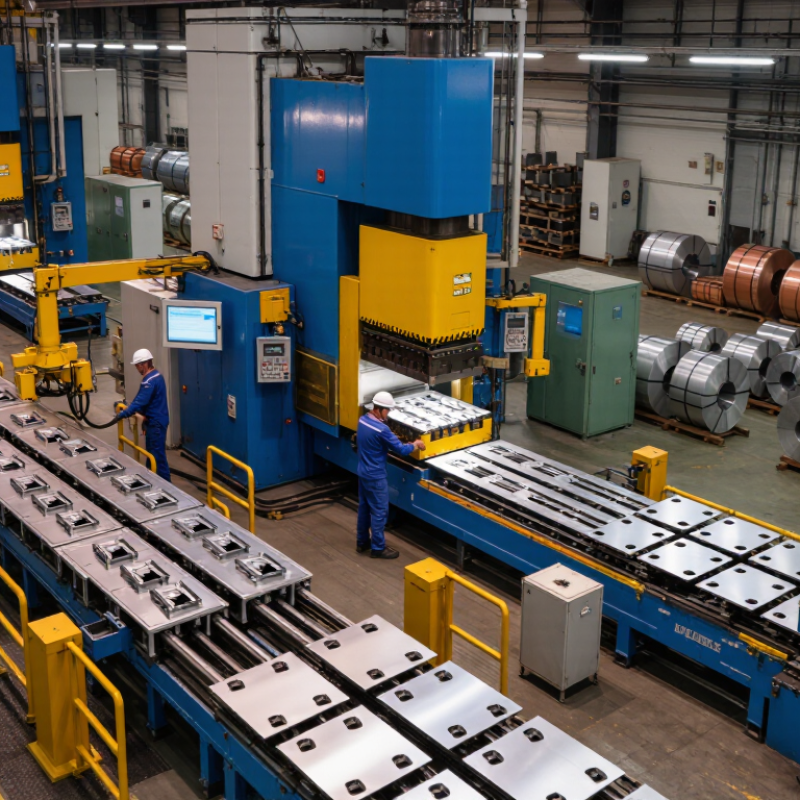
Metal Stamping Parts Manufacturing: Definition and Industry Scope
Metal stamping parts manufacturing converts sheet metal or coil stock into precise components through controlled pressing operations. A die shapes the material while a mechanical or servo press applies measured force. Common operations include blanking, piercing, bending, coining, and deep drawing.
The industry covers small clips, brackets, terminals, shields, housings, and structural components. Materials may include carbon steel, stainless steel, aluminum, copper, and selected alloys. Each material reacts differently to pressure, springback, heat, and lubrication. A practical manufacturer studies these factors before designing the tooling.
Production scale ranges from short prototype runs to millions of parts. Progressive dies can complete several operations during one press stroke. Transfer systems move larger parts between stations. Engineers check strip layout, grain direction, tolerances, and expected material waste. A part may look simple.
Quality control often includes dimensional gauges, optical inspection, hardness checks, and burr measurement. Traceable records help connect each batch with its material certificate and production settings. Tool maintenance also matters. A worn punch can create rough edges, distorted holes, or gradual size changes.
The process is not flawless. A drawing can hide difficult bends, and a low-cost die may increase later repairs. Experienced teams usually test samples, review failed features, and adjust clearances before full production. That extra review can prevent costly interruptions. Scrap rates, energy use, packaging, and worker safety also influence responsible manufacturing decisions worldwide.

Criteria for Ranking the Top 10 Global Manufacturers
Top 10 Metal Stamping Parts Manufacturers Worldwide
Criteria for Ranking the Top 10 Global Manufacturers
A credible ranking must measure evidence, not polished claims. Quality receives 25% of the score, supported by defect rates, corrective-action records, traceability, and customer audits. The ISO Survey 2023 reported more than 1.2 million ISO 9001 certificates worldwide, so certification alone cannot prove manufacturing excellence. It is only a starting point. Strong suppliers also show stable Cpk results, documented PPAP experience, and inspection data from real production lines.
Engineering capability accounts for 20%. Reviewers should examine press capacity, progressive-die design, material range, tolerance control, and tooling maintenance. Delivery reliability receives another 20%, using on-time shipment records, capacity planning, and verified lead times. This matters because global steel production reached about 1.89 billion tonnes in 2023, according to World Steel Association data. Material access is broad, but dependable conversion remains difficult.
Scalability and financial resilience each deserve careful review, while sustainability should include measurable energy, scrap, and recycling data. The remaining score should reflect customer retention and independent references. Site visits can reveal details spreadsheets miss, such as worn dies, crowded aisles, or weak labeling. No ranking is perfect. Regional freight risks and sector-specific requirements can distort results. A transparent scoring model should disclose these limits, refresh data annually, and separate verified performance from untested promises.
Profiles of the Top 10 Metal Stamping Parts Manufacturers
Top 10 Metal Stamping Parts Manufacturers Worldwide
Profiles of the Top 10 Metal Stamping Parts Manufacturers
The leading metal stamping parts manufacturers differ in equipment, materials, and quality systems. Their profiles should examine press capacity, die design, tolerances, and production experience. A 2024 Grand View Research report estimates the global metal stamping market at about USD 217.6 billion in 2023. This scale reflects demand from vehicles, electronics, appliances, and industrial machinery.
Strong manufacturers usually combine progressive dies, transfer presses, and automated inspection. Their facilities may process steel, aluminum, copper, and coated sheet materials. Press capacities can range from small precision machines to systems exceeding 1,000 tons. The World Steel Association reported global crude steel production of approximately 1.88 billion tonnes in 2023. That figure shows the broad material base supporting stamped components.
Each profile should also review delivery reliability, tool maintenance, traceability, and corrective-action methods. ISO-based quality systems help, but certificates alone prove little. Factory evidence matters more. Look for documented first-article inspection, statistical process control, and measured scrap rates. Environmental performance deserves attention too, especially energy use and metal recovery.
No ranking is flawless. Smaller specialists may outperform larger suppliers on difficult tolerances or short production runs. In my view, purchasing teams should compare verified samples, not polished brochures. That approach can reveal weaknesses early, although it requires more time and technical judgment.
Technologies, Materials, and Production Capabilities Compared
Top 10 Metal Stamping Parts Manufacturers Worldwide
A useful comparison of ten metal stamping manufacturers should examine technology, materials, and production capabilities. Progressive dies support high-volume parts with repeated accuracy. Transfer presses handle larger components and multiple forming stages. Servo presses offer flexible speed control and improved energy management.
Material expertise matters just as much. Steel, stainless steel, aluminum, copper, and brass each require different tooling strategies. Experienced manufacturers adjust tonnage, clearance, lubrication, and feed speed for each alloy. Some provide in-house tool design, simulation, prototyping, and inspection. Others rely heavily on outside suppliers. That difference can affect lead times and engineering control. Production scale also deserves careful review. A capable facility may combine small precision presses with heavy-duty lines, automated coil feeding, robotic handling, and vision inspection. However, impressive equipment lists do not always prove consistent quality. Real production records matter more.
Tips: Request sample inspection reports, material certificates, and tolerance data before approval. Ask how the supplier controls burrs, springback, tool wear, and surface damage. A factory visit can reveal practical details, such as organized die storage and clean material flow. Do not judge capability by press tonnage alone. Communication quality is another useful signal. Some suppliers promise everything, yet explain little. That should invite reflection. Ensure the manufacturer can support your expected volume, design changes, testing needs, and delivery schedule. The best choice may not be the largest facility.
Choosing the Right Metal Stamping Manufacturer for Your Project
Choosing a metal stamping manufacturer requires more than comparing unit prices. Grand View Research estimates the global metal stamping market at over USD 200 billion, with continued growth through 2030. That scale creates many options, but quality varies sharply between suppliers.
Start with process capability. Ask for press tonnage, material thickness ranges, die-maintenance records, and dimensional inspection methods. A suitable partner should provide traceable material certificates and documented corrective actions. ISO 9001 certification is useful, but it does not guarantee excellent parts. Review actual audit results, not only certificates. Measure twice.
Production data also deserves close attention. The 2024 Manufacturing Quality Benchmark Report by LNS Research emphasizes measurable performance, including first-pass yield, scrap rate, and on-time delivery. Request these figures for comparable projects. A supplier reporting 98% first-pass yield sounds strong, yet the definition may exclude reworked parts. Clarify everything.
I have found that engineering support often separates a reliable manufacturer from a cheap one. During sampling, examine burr height, springback, cracks near bends, and tool marks under consistent lighting. Ask whether the supplier performs design-for-manufacturing reviews before tooling begins. This can reduce later changes, although it may extend the initial schedule. That trade-off is easy to underestimate. A perfect supplier rarely exists. Your decision should balance technical evidence, communication speed, capacity, and realistic risk control.
Top 10 Metal Stamping Parts Manufacturers Worldwide
Choosing the Right Metal Stamping Manufacturer for Your Project
Regional steel production is a useful market indicator when evaluating metal stamping supply chains. Regions with larger steelmaking capacity may offer broader material availability, while supplier selection should also consider tooling expertise, press capacity, tolerances, quality systems, lead times, and logistics.
Data source: World Steel Association, World Steel in Figures 2024. Crude steel production by region, 2023, measured in million tonnes.
Article Source:
Get in touch with us,
We will contact you shortly!
What is the difference between Unline(Non-Epoxy Coated) or Lining(Epoxy Coated) Metal Drum?

Unline drums with internally bare metal surface is more susceptible to corrosion and rust while Lining drums are internally coated with Phenolic Epoxy Coating to provide a non-reactive barrier between the drum surface and your product, less risk of contamination. Note: Our Unline drums are coated with an anti-rust agent after washing to reduce risk of rust.
What are Unline(Non-Epoxy Coated) and Lining(Epoxy Coated) drums compatible with?

In Singapore, Recon Unline Drums are usually more costly than Recon Lining Drums. Hence, we recommend Recon Unline Drums to fill aromatics like Thinner, Xylene, Toulene& other solvents like Hexane, BA, CA, EA, MC, White spirit, etc.
We recommend the lower-priced Recon Lining Drums to fill hydrocarbons like IPA, Methanol, Ethanoland oil-based products like diesel, petrol, lubricants, engine, hydraulic, base, transmission fluid, additives, waste oil, etc.;
What is the difference between Grade A and Grade B Metal Drum ?

Grading of used drums are usually based on physical conditions like rustiness, deformities and residual contents. Grade A drums are totally free from internal rust, serious dents and are easy to clean. Grade B drums have different degrees of rust internally and aesthetically inferior compared to Grade A drums.
What content is suitable to fill in a Recon Grade A or Grade B Drum?

Recon Grade A drum is suitable to fill more costly virgin grade products while Recon Grade B drum is more suitable for recycled or waste products.
What is the difference between Open Top and Close Top Drums and their usage?

Closed top drums are for water and other liquid products. Open Top drums can be used for liquid too but are primarily for more viscous products. The Open Top (or open head with a lid) allows you to get in and out of the drum with your product easier.
What type of content are Metal or Plastic Drums suitable for?

Metal drums offer additional protection when dealing with potentially flammable substances. They provide superior fire resistance, impact protection, and longevity for storing class 1, 2, and 3 volatile chemicals.
Plastic HDPE Drums are suitable for corrosive chemicals like acids, alkaline and also water-based products.
Will there be any contamination in the reconditioned metal, plastic drums or IBC tanks?

All our reconditioned containers (metal/plastic drums, carboys, IBC tanks) are washed thoroughly with specially formulated cleaning agent, rinsed with clean water, dried, and tested for possible leakages during the recondition process. Stringent quality inspection is being conducted 100% on every reconditioned product before they are qualified for sale & delivery.
What is the drum gauge(thickness) and weight for reconditioned metal drums?

Reconditioned metal drums gauge can be 0.9mm to 1.0mm all round. Their weight can vary from 16 to 18kg.
Do you sell New Packaging Products too?

Yes, we are also a distributor for new pallets, metal drums, plastic drums, carboys, IBCs and stainless-steel tanks.
What additional services do you provide apart from selling reconditioned and new containers.?

We are an NEA licensed toxic industrial waste collector, who can collect and dispose of used toxic waste containers in Singapore.
Do you offer labelling and silkscreen on the containers ?

We can provide labelling and silk-screening on the containers.
Are you able to ship overseas ?

Yes, we can arrange export our products to any country in the world.
Leading the Way
to Carbon Neutrality