
Top 10 Geosynthetic Materials Suppliers Worldwide
The global Geo Synthetic Materials market is no longer a niche sector. Geotextiles, geomembranes, geogrids, geocells, and related products now support roads, railways, landfills, reservoirs, ports, and coastal defenses. Their value appears in practical details: a drainage layer beneath a highway, a textured liner holding contaminated water, or a reinforcement grid stabilizing weak soil.
Professor Jorge G. Zornberg, a respected geosynthetics researcher, has said, “Geosynthetics are not simply materials; they are engineered solutions.” This perspective matters when comparing the Top 10 Geosynthetic Materials Suppliers Worldwide. Scale alone does not prove technical leadership. Product consistency, polymer quality, testing capacity, installation support, and long-term field performance deserve closer attention.
This ranking examines suppliers through that practical lens. It considers manufacturing reach, research investment, certification practices, application diversity, and customer support. Some companies appear strong in large infrastructure projects. Others excel in drainage, containment, erosion control, or soil reinforcement. The boundaries are not always clear. A supplier may lead globally while performing unevenly in a particular region.
That is worth admitting. Market rankings can simplify a complicated industry. Local climate, soil conditions, contractor skill, and project specifications can change the final choice. Buyers should still verify technical data and independent test results. In geosynthetics, small differences matter. A seam, overlap, or puncture can decide whether a system performs for decades or fails early.
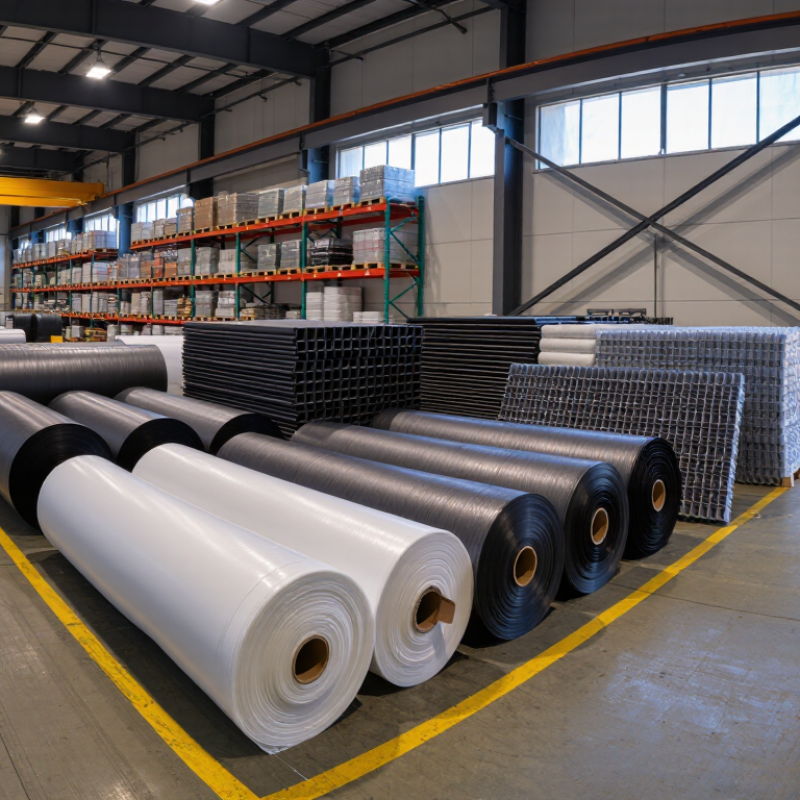
Geosynthetics Explained: Materials, Functions, and ASTM Classification
Geosynthetics are engineered products made mainly from polymers, minerals, or both. Common materials include geotextiles, geomembranes, geogrids, geonets, geocells, and geosynthetic clay liners. Their functions differ sharply. A woven geotextile may separate weak soil from aggregate beneath a road. A geomembrane can contain water, leachate, or process liquids. Geogrids reinforce soil by transferring tensile forces across their ribs.
ASTM terminology, especially ASTM D4439, helps define these product families consistently. However, ASTM does not provide one universal performance ranking for every geosynthetic. Project specifications usually combine material definitions with test methods and acceptance limits. Tensile strength, puncture resistance, permeability, seam quality, and chemical compatibility may all matter. ASTM D4759 also supports conformance evaluation, while other ASTM methods measure specific properties. The exact standard depends on the product and its intended use.
On site, installation often decides whether laboratory performance becomes real protection. Wrinkles, damaged edges, poor overlaps, or trapped stones can create failure points. I have seen a well-selected liner underperform because subgrade preparation was rushed. That experience is easy to underestimate. Engineers should review drainage paths, loading conditions, temperature, ultraviolet exposure, and long-term degradation before selecting a material. A thicker product is not automatically better. Sometimes, the specification is the weak link. Careful sampling, seam testing, and documented inspection make the final system more reliable.
Top 10 Geosynthetic Materials Suppliers Worldwide - Geosynthetics Explained: Materials, Functions, and ASTM Classification
| No. | Geosynthetic Material | Common Polymer / Structure | Primary Functions | Typical Applications | Key Engineering Properties | Relevant ASTM Test Methods / Classification References |
|---|---|---|---|---|---|---|
| 1 | Woven Geotextile | Polypropylene or polyester; interlaced yarns | Separation, reinforcement, filtration, and limited drainage | Road bases, railways, soft-soil improvement, working platforms, and retaining structures | High tensile strength, controlled aperture size, low elongation, and strong installation resistance | ASTM D4439, D4632, D4595, D4751, D4833, and D4491 |
| 2 | Nonwoven Geotextile | Polypropylene or polyester; mechanically bonded fibers | Filtration, separation, cushioning, and drainage | French drains, erosion control, landfill drainage, road separation, and protection layers | High permeability, multidirectional strength, puncture resistance, and conformability | ASTM D4439, D4632, D4491, D4751, D4833, and D5199 |
| 3 | Geogrid | Polyester, polypropylene, or polyethylene; integral or woven grid structure | Soil reinforcement, load distribution, and aggregate interlock | Pavement foundations, reinforced slopes, retaining walls, embankments, and haul roads | High tensile strength, junction integrity, aperture stability, and low creep for long-term loading | ASTM D4439, D6637, D7737, and D5262 |
| 4 | HDPE Geomembrane | High-density polyethylene; flexible polymeric sheet | Liquid and vapor containment, barrier protection, and environmental isolation | Landfill liners and caps, mining ponds, wastewater lagoons, canals, and aquaculture ponds | Very low permeability, chemical resistance, weldability, and strong environmental stress-crack resistance | ASTM D4439, D5199, D6693, D5820, D5885, D5397, and D7240 |
| 5 | PVC Geomembrane | Plasticized polyvinyl chloride; flexible sheet | Containment, waterproofing, and barrier protection | Decorative and irrigation ponds, secondary containment, tunnels, reservoirs, and water features | High flexibility, field weldability, good elongation, and adaptable performance at irregular subgrades | ASTM D4439, D5199, D6693, D638, D7466, and D8142 |
| 6 | Geosynthetic Clay Liner (GCL) | Bentonite clay between geotextile carriers | Hydraulic barrier, self-sealing, and composite liner support | Landfill liners and covers, secondary containment, canals, and wastewater facilities | Low hydraulic conductivity after hydration, swelling capacity, peel resistance, and internal shear strength | ASTM D4439, D5887, D5890, D6496, D6768, and D6243 |
| 7 | Geonet | High-density polyethylene; intersecting net ribs | In-plane drainage and fluid or gas transmission | Landfill leachate collection, landfill cover drainage, and foundation drainage | Transmissivity, compressive resistance, chemical stability, and dimensional consistency | ASTM D4439, D4716, D5199, D6364, and D7748 |
| 8 | Geocomposite Drainage Layer | Geonet or drainage core combined with one or more geotextiles | Drainage, filtration, separation, and protection | Retaining walls, green roofs, landfill covers, basement walls, and roadway drainage | In-plane flow capacity, filtration compatibility, compressive strength, and interface stability | ASTM D4439, D4716, D4491, D4751, D5199, and D6364 |
| 9 | Geocell | Textured high-density polyethylene; three-dimensional cellular confinement system | Lateral confinement, load distribution, erosion control, and surface stabilization | Unpaved roads, channel protection, slope stabilization, access roads, and shallow foundations | Weld or joint strength, cell dimensions, dimensional stability, and confinement efficiency | ASTM D4439, D5199, D638, D6693, and project-specific seam or joint testing |
| 10 | Geosynthetic Erosion-Control Blanket | Natural fibers, synthetic fibers, or permanent three-dimensional polymer matrix | Surface erosion control, soil retention, and vegetation establishment | Slopes, drainage channels, embankments, streambanks, and disturbed construction sites | Rainfall impact resistance, shear stress resistance, open area, tensile strength, and biodegradation rate | ASTM D4439, D6459, D6460, D6567, and D6525 |



Get in touch with us,
We will contact you shortly!
What is the difference between Unline(Non-Epoxy Coated) or Lining(Epoxy Coated) Metal Drum?

What are Unline(Non-Epoxy Coated) and Lining(Epoxy Coated) drums compatible with?
What is the difference between Grade A and Grade B Metal Drum ?
What content is suitable to fill in a Recon Grade A or Grade B Drum?
What is the difference between Open Top and Close Top Drums and their usage?
What type of content are Metal or Plastic Drums suitable for?
Will there be any contamination in the reconditioned metal, plastic drums or IBC tanks?
What is the drum gauge(thickness) and weight for reconditioned metal drums?
Do you sell New Packaging Products too?
What additional services do you provide apart from selling reconditioned and new containers.?
Do you offer labelling and silkscreen on the containers ?
Are you able to ship overseas ?
Leading the Way
to Carbon Neutrality