
China Top 10 Insulated Floor Tile Panel Suppliers
China’s insulated floor tile panel market serves warehouses, cold rooms, workshops, and modern commercial buildings. This guide introduces ten leading suppliers of Insulated Floor Tile Panels in China. It focuses on practical value, not promotional claims.
A reliable supplier should provide clear core-density data, thermal conductivity results, surface specifications, and load-bearing information. Product performance matters most under real site conditions. Uneven floors, heavy equipment, moisture, and temperature changes can expose weak designs. Factory experience also deserves attention. Established manufacturers often maintain documented production procedures, quality inspections, and traceable material records. However, company size alone cannot prove product quality.
The selection process should compare panel thickness, joint design, fire performance, customization ability, and delivery reliability. Independent test reports can support technical claims, while factory audits may reveal storage problems or inconsistent workmanship. Ask suppliers for samples. Check the edges, coating, rigidity, and fitting accuracy by hand. Small gaps can become expensive problems later.
This is not a permanent ranking. Market conditions change. Some suppliers may offer stronger technical support, while others compete through pricing or faster production. Buyers should verify current certifications, project references, warranty terms, and compliance requirements before signing contracts. A careful comparison reduces uncertainty and helps match each supplier with the project’s actual needs. Mistakes still happen. Good procurement leaves room for testing, questions, and revision.
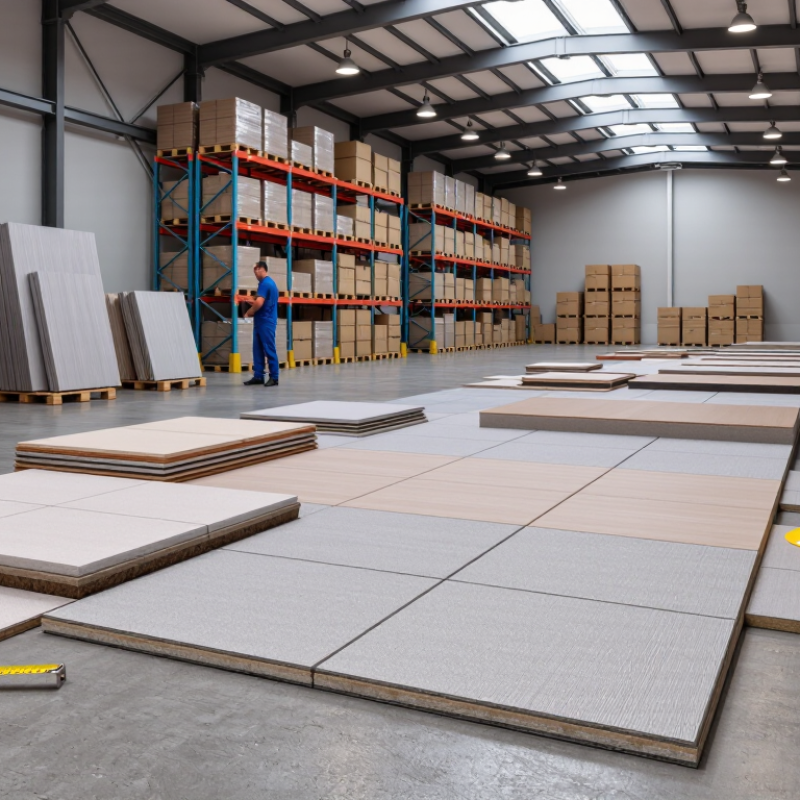
Insulated Floor Tile Panels: Definition, Structure, and Applications
Insulated floor tile panels are prefabricated building components that combine surface finishing with thermal insulation.
They reduce heat transfer through floors while providing a firm, tile-ready base. In practical projects, they can simplify installation and reduce cold bridging around room edges.
A typical panel includes a ceramic or porcelain tile layer, a bonding layer, rigid foam insulation, and a cement-based backing board.
Some designs also include a vapor-control film or reinforced mesh. The exact structure varies with load requirements, moisture exposure, and the intended floor covering. Higher-density insulation supports heavier equipment, while thinner panels suit residential renovations.
Check compressive strength carefully. It is often overlooked.
These panels work in bathrooms, kitchens, balconies, cold storage areas, and energy-efficient homes.
They can also support underfloor heating when the panel system allows controlled heat transfer. Installers should inspect the subfloor before placement. Dust, uneven surfaces, and trapped moisture may weaken the assembly.
In commercial spaces, suppliers should provide data on thermal conductivity, water absorption, fire performance, dimensional stability, and joint detailing.
From field experience, the weakest point is frequently the connection between panels.
Poorly sealed joints can create thermal gaps and allow moisture movement.
This is not a perfect system.
Careful cutting, compatible adhesives, and accurate layout still matter.
When comparing the top ten insulated floor tile panel suppliers, evaluate tested performance, installation guidance, replacement support, and documented quality control rather than appearance alone.



Get in touch with us,
We will contact you shortly!
What is the difference between Unline(Non-Epoxy Coated) or Lining(Epoxy Coated) Metal Drum?

What are Unline(Non-Epoxy Coated) and Lining(Epoxy Coated) drums compatible with?
What is the difference between Grade A and Grade B Metal Drum ?
What content is suitable to fill in a Recon Grade A or Grade B Drum?
What is the difference between Open Top and Close Top Drums and their usage?
What type of content are Metal or Plastic Drums suitable for?
Will there be any contamination in the reconditioned metal, plastic drums or IBC tanks?
What is the drum gauge(thickness) and weight for reconditioned metal drums?
Do you sell New Packaging Products too?
What additional services do you provide apart from selling reconditioned and new containers.?
Do you offer labelling and silkscreen on the containers ?
Are you able to ship overseas ?
Leading the Way
to Carbon Neutrality