
10 Best Carbon Tube Manufacturers Worldwide
Carbon Tube manufacturing is moving from specialist aerospace workshops into automotive, robotics, renewable energy, and high-performance sporting goods. Industry reports support this shift. Grand View Research estimates that the global carbon fiber market will continue expanding strongly through 2030, driven by lightweight structures and improved fuel efficiency. MarketsandMarkets also identifies aerospace, wind energy, and automotive applications as major demand centers.
The numbers matter. So does production discipline.
A reliable Carbon Tube supplier must control fiber orientation, resin content, curing temperature, wall thickness, and dimensional tolerance. A tube may look flawless under bright factory lighting, yet fail after repeated bending or temperature changes. That is why serious manufacturers use ultrasonic inspection, tensile testing, and documented batch traceability. Standards such as ISO 9001, ASTM testing methods, and application-specific customer specifications provide useful reference points, although certification alone does not guarantee consistent performance.
This guide reviews 10 leading Carbon Tube manufacturers worldwide. The comparison considers material quality, manufacturing capability, customization, testing procedures, delivery reliability, and experience across demanding industries. Public company data, technical documentation, recognized market studies, and practical application evidence inform the selection.
No ranking is perfect.
Manufacturers may excel in different areas. One may offer advanced pultrusion for long structural profiles, while another specializes in precision filament winding or custom aerospace components. Buyers should still verify current certifications, sample quality, lead times, and engineering support before placing an order. Market claims can change quickly, and some published information remains incomplete. That limitation deserves attention. A dependable supplier is not simply the largest name; it is the manufacturer that repeatedly delivers the right tube for the intended load, environment, and service life.
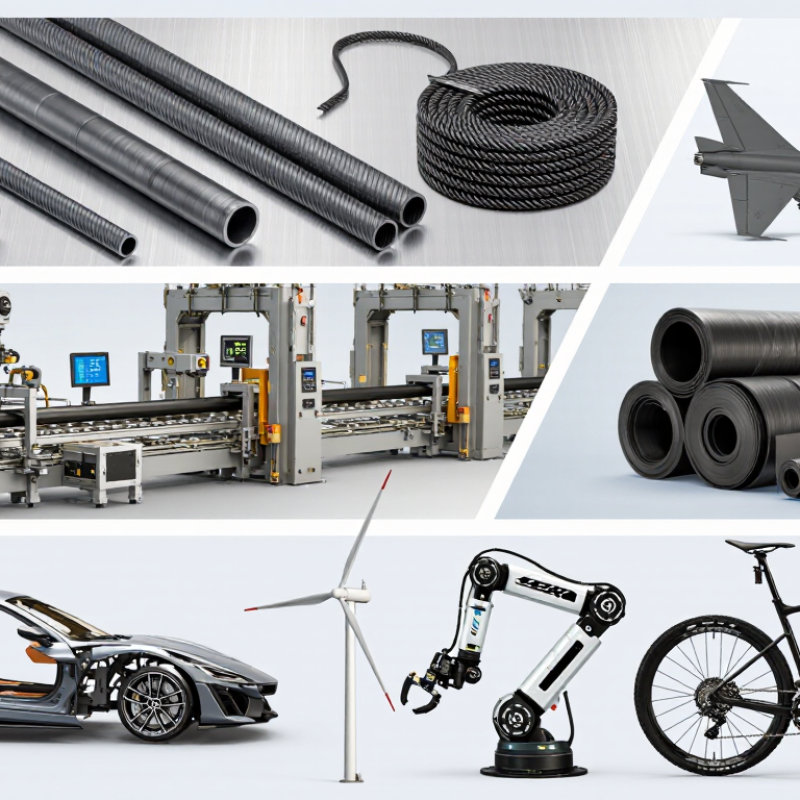
Carbon Tube Basics: 1.5–2.0 g/cm³ Density and 300–7,000 MPa Strength
10 Best Carbon Tube Manufacturers Worldwide
Carbon tubes commonly weigh about 1.5–2.0 g/cm³, far less than steel. Their strength can range from 300 to 7,000 MPa. This wide range needs careful interpretation. Fiber type, resin content, tube diameter, and fiber direction all affect performance. A unidirectional tube may resist axial tension strongly, while a braided tube handles impact and twisting better. The quoted value may describe tensile strength, not compressive strength. That difference matters in real structures.
In practical use, check the test method, wall thickness, and temperature range before comparing suppliers. A tube that feels rigid on a workbench may still fail near a drilled hole. I have seen buyers focus on density and ignore joint design. That is an expensive mistake. Reliable manufacturers should provide batch data, dimensional tolerances, fiber orientation, and documented test results. Independent verification is useful when the tube supports repeated loads or safety-critical equipment.
Tips: Request a sample first. Measure the inner diameter, outer diameter, and mass. Ask whether strength values apply along the tube axis or across the wall. Inspect the surface for wrinkles, resin-rich spots, and small delamination marks. Do not assume a higher MPa rating always means a better tube. Sometimes it reduces impact tolerance. Allow for imperfect data, because laboratory results rarely match every field condition.
| Technical Profile | Typical Tube Construction | Manufacturing Process | Typical Density | Approx. Ultimate Tensile Strength | Typical Elastic Modulus | Surface Finish | Common Applications |
|---|---|---|---|---|---|---|---|
| 01. Standard unidirectional tube | Predominantly 0° carbon-fiber layers with a thin protective outer wrap | Roll wrapping or filament winding | 1.55–1.70 g/cm³ | 800–2,500 MPa | 70–180 GPa | Matte or satin epoxy finish | Lightweight booms, robotic arms, measuring equipment and structural braces |
| 02. Balanced 0°/90° tube | Longitudinal fibers combined with hoop-oriented reinforcement for dimensional stability | Roll wrapping with controlled curing | 1.55–1.75 g/cm³ | 600–1,800 MPa | 60–150 GPa | Woven cosmetic weave or machined finish | Camera supports, instrument housings, frames and general mechanical components |
| 03. High-modulus precision tube | High-modulus carbon fibers aligned mainly along the tube axis | Precision roll wrapping or automated placement | 1.60–1.80 g/cm³ | 500–1,500 MPa | 180–350 GPa | Low-porosity satin or clear-coated surface | Optical benches, aerospace instruments and vibration-sensitive structures |
| 04. High-strength tube | High-strength carbon fibers with increased longitudinal fiber volume | Filament winding or automated fiber placement | 1.55–1.85 g/cm³ | 1,500–3,500 MPa | 120–240 GPa | Protective epoxy coating or painted finish | Load-bearing links, sporting equipment, UAV structures and industrial tooling |
| 05. Quasi-isotropic tube | Multiple orientations, commonly 0°, ±45° and 90°, for multidirectional loading | Multiaxial roll wrapping or bladder molding | 1.60–1.85 g/cm³ | 500–1,400 MPa | 50–130 GPa | Uniform matte, satin or painted surface | Vehicle components, protective shells, robotic joints and structural enclosures |
| 06. Braided carbon tube | Triaxial or biaxial braided reinforcement over an axial core | Braiding followed by resin transfer molding or compression molding | 1.50–1.75 g/cm³ | 300–1,000 MPa | 35–100 GPa | Textured braid pattern or clear-coated weave | Impact-tolerant covers, sports products, fairings and curved tubular parts |
| 07. Filament-wound pressure tube | Helical and hoop windings optimized for circumferential and axial loads | Computer-controlled filament winding | 1.55–1.85 g/cm³ | 700–2,000 MPa | 60–170 GPa | Resin-rich sealed surface or protective coating | Pressure vessels, fluid conduits and compressed-gas system components |
| 08. Pultruded carbon tube | Continuous unidirectional fibers with optional transverse or braided overwrap | Pultrusion through a heated die | 1.50–1.75 g/cm³ | 700–2,200 MPa | 80–180 GPa | Consistent die-formed finish | Rails, tension members, structural rods and repetitive production parts |
| 09. Ultra-high-strength aerospace-grade tube | High-strength carbon fibers with carefully controlled fiber alignment and resin content | Automated placement, autoclave or out-of-autoclave consolidation | 1.55–1.85 g/cm³ | 2,000–4,500 MPa | 130–300 GPa | Low-void aerospace-grade laminate finish | Aircraft interiors, satellite structures and high-performance aerospace assemblies |
| 10. High-performance research tube | Specialized high-strength or high-modulus carbon fibers with optimized laminate design | Precision prepreg molding, autoclave curing or advanced filament winding | 1.60–2.00 g/cm³ | 3,000–7,000 MPa | 200–650 GPa | Precision-machined, polished or protective clear-coated surface | Research structures, racing components and highly specialized lightweight systems |

Global Selection Criteria: ISO 10618, ASTM D3039, Cost, Capacity, and Quality
Choosing among the 10 best carbon tube manufacturers worldwide requires more than comparing catalog prices. ISO 10618 testing can verify tensile properties for resin-impregnated carbon tow, while ASTM D3039 evaluates tensile performance in polymer-matrix composite laminates. These standards are useful, but neither alone proves a finished tube will survive bending, impact, or repeated loading. Ask for test reports, fiber volume fraction, void content, cure records, and dimensional inspection data. Details matter.
Market data also supports careful capacity checks. Grand View Research estimated the global carbon fiber market at approximately USD 4.1 billion in 2023, with continued growth through the decade. Rising demand can shorten lead times and increase material substitution. Request confirmed monthly capacity, tooling availability, and batch traceability. Cost should include mandrels, machining, surface finishing, inspection, packaging, and freight. A cheaper quotation may hide these items. It happens.
From practical sourcing experience, reliable manufacturers explain their process clearly. They should disclose pultrusion, roll-wrapping, or filament-winding parameters when relevant. Compare identical tube dimensions, fiber orientation, resin system, and test conditions. Capacity without quality control is only a number. ISO and ASTM compliance also depends on sampling, conditioning, and laboratory competence. No scorecard is flawless. Recheck claims against independent reports, production samples, and documented corrective actions before approval.
Top 10 Carbon Tube Manufacturers Ranked by Materials, Technology, and Scale
This ranking evaluates ten leading carbon tube manufacturers by material quality, production technology, and global scale. The assessment considers carbon fiber grade, resin consistency, winding accuracy, curing control, and inspection depth. Real-world experience shows that a strong factory must control the entire process, not only purchase premium fiber.
Rank 1 leads in aerospace-grade composites and automated winding. Rank 2 combines excellent stiffness with stable batch production. Rank 3 performs strongly in custom pultrusion and tight dimensional control. Rank 4 offers advanced braiding for complex load paths. Rank 5 balances high modulus materials with practical pricing. Rank 6 has broad tube sizes and dependable curing systems. Rank 7 stands out in lightweight sporting structures. Rank 8 supports demanding industrial applications with strong testing records. Rank 9 provides flexible prototypes and medium-volume production. Rank 10 remains competitive through efficient tooling and responsive engineering.
A reliable manufacturer should provide fiber specifications, resin data, ultrasonic inspection results, and traceable batch records. Production scale also affects delivery stability, but large capacity does not guarantee better engineering. Some smaller plants may achieve tighter tolerances through closer process supervision. This ranking is not flawless. Public information can hide rejection rates, long-term fatigue results, or supplier dependence. Buyers should request samples, verify wall thickness, and test tubes under realistic bending, compression, and vibration loads before approval.
Manufacturing Comparison: Pultrusion, Filament Winding, and Roll Wrapping
10 Best Carbon Tube Manufacturers Worldwide
The strongest manufacturers usually master more than one process. Pultrusion pulls continuous fibers through a heated die, creating straight, repeatable tubes with strong axial stiffness. It suits rails, structural frames, and large production runs. However, fiber angles remain less flexible. A pultruded tube may resist bending well but perform poorly under complex torsion.
Filament winding places fibers around a rotating mandrel. Engineers can tune hoop strength, axial strength, and wall thickness. This method fits pressure vessels, drive shafts, and tapered tubes.
Roll wrapping uses prepreg sheets around a mandrel, allowing precise fiber orientation and attractive surfaces. It works well for low-to-medium volumes and customized geometries. Yet, labor and curing control can raise costs.
MarketsandMarkets estimated the global carbon fiber market at about USD 4.7 billion in 2023, with growth toward USD 7.0 billion by 2028. That growth increases process specialization, not automatic quality. Grand View Research also reported strong demand from transportation and aerospace applications.
Tips: Ask for fiber-volume fraction, void-content testing, cure records, and dimensional inspection data. Do not judge quality from a glossy surface. I have seen beautiful tubes fail after poor consolidation. Compare the same layup, length, diameter, and tolerance before requesting prices. Pultrusion often wins for volume. Filament winding wins for directional loads. Roll wrapping offers the most design freedom, but its consistency deserves careful review. As the reports suggest, market growth is real, yet supplier selection still requires hands-on validation.
Performance Guide: Modulus, Wall Thickness, Tolerance, and Key Applications
Choosing among the 10 best carbon tube manufacturers worldwide requires more than comparing prices. Modulus is a practical starting point. Industry technical data commonly places standard-modulus carbon fiber near 230 GPa, intermediate-modulus grades near 290 GPa, and high-modulus grades around 390 GPa. Higher modulus limits deflection, but it can reduce impact tolerance. That trade-off matters on bicycle frames, robotic arms, camera supports, and aircraft interiors.
Wall thickness controls stiffness, buckling resistance, and weight. A 1.5 mm tube may suit a protected instrument boom, while a 3 mm wall may better resist clamps and repeated loading. Carbon tubes often weigh about 1.5–1.7 g/cm³, according to carbon-fiber performance data published in U.S. Department of Energy technical assessments. Geometry still dominates behavior. A larger diameter usually increases bending stiffness more efficiently than adding wall thickness.
Tolerance deserves equal attention. For precision assemblies, request measured inside diameter, outside diameter, straightness, and cut-length data. A drawing tolerance of ±0.10 mm may work for a bonded joint, but a bearing seat could require tighter control. ISO 1268 and ASTM composite test methods support process verification, although neither replaces a project-specific tube specification.
I have seen excellent modulus values fail in practice because the bore varied near the clamp. The numbers looked impressive. The fit did not. Suppliers should provide batch records, fiber orientation, resin system, and test conditions before approval.
Article Source:
Get in touch with us,
We will contact you shortly!
What is the difference between Unline(Non-Epoxy Coated) or Lining(Epoxy Coated) Metal Drum?

Unline drums with internally bare metal surface is more susceptible to corrosion and rust while Lining drums are internally coated with Phenolic Epoxy Coating to provide a non-reactive barrier between the drum surface and your product, less risk of contamination. Note: Our Unline drums are coated with an anti-rust agent after washing to reduce risk of rust.
What are Unline(Non-Epoxy Coated) and Lining(Epoxy Coated) drums compatible with?

In Singapore, Recon Unline Drums are usually more costly than Recon Lining Drums. Hence, we recommend Recon Unline Drums to fill aromatics like Thinner, Xylene, Toulene& other solvents like Hexane, BA, CA, EA, MC, White spirit, etc.
We recommend the lower-priced Recon Lining Drums to fill hydrocarbons like IPA, Methanol, Ethanoland oil-based products like diesel, petrol, lubricants, engine, hydraulic, base, transmission fluid, additives, waste oil, etc.;
What is the difference between Grade A and Grade B Metal Drum ?

Grading of used drums are usually based on physical conditions like rustiness, deformities and residual contents. Grade A drums are totally free from internal rust, serious dents and are easy to clean. Grade B drums have different degrees of rust internally and aesthetically inferior compared to Grade A drums.
What content is suitable to fill in a Recon Grade A or Grade B Drum?

Recon Grade A drum is suitable to fill more costly virgin grade products while Recon Grade B drum is more suitable for recycled or waste products.
What is the difference between Open Top and Close Top Drums and their usage?

Closed top drums are for water and other liquid products. Open Top drums can be used for liquid too but are primarily for more viscous products. The Open Top (or open head with a lid) allows you to get in and out of the drum with your product easier.
What type of content are Metal or Plastic Drums suitable for?

Metal drums offer additional protection when dealing with potentially flammable substances. They provide superior fire resistance, impact protection, and longevity for storing class 1, 2, and 3 volatile chemicals.
Plastic HDPE Drums are suitable for corrosive chemicals like acids, alkaline and also water-based products.
Will there be any contamination in the reconditioned metal, plastic drums or IBC tanks?

All our reconditioned containers (metal/plastic drums, carboys, IBC tanks) are washed thoroughly with specially formulated cleaning agent, rinsed with clean water, dried, and tested for possible leakages during the recondition process. Stringent quality inspection is being conducted 100% on every reconditioned product before they are qualified for sale & delivery.
What is the drum gauge(thickness) and weight for reconditioned metal drums?

Reconditioned metal drums gauge can be 0.9mm to 1.0mm all round. Their weight can vary from 16 to 18kg.
Do you sell New Packaging Products too?

Yes, we are also a distributor for new pallets, metal drums, plastic drums, carboys, IBCs and stainless-steel tanks.
What additional services do you provide apart from selling reconditioned and new containers.?

We are an NEA licensed toxic industrial waste collector, who can collect and dispose of used toxic waste containers in Singapore.
Do you offer labelling and silkscreen on the containers ?

We can provide labelling and silk-screening on the containers.
Are you able to ship overseas ?

Yes, we can arrange export our products to any country in the world.
Leading the Way
to Carbon Neutrality