
What Is a Thermoforming Mold Assembly?

A Thermoforming Mold Assembly is more than a shaped metal block. It is a coordinated system that forms heated plastic sheet through controlled heat, vacuum, pressure, cooling, and release. Its design influences wall thickness, surface detail, cycle time, and product consistency. In practical production, small decisions matter. A poorly positioned vent may leave a shallow corner unfinished. Uneven cooling may create warping near the flange.

Peter Schwarzmann, author of Thermoforming: A Practical Guide, states, “The mold is the heart of the thermoforming process.” This observation remains highly practical. The mold must guide the sheet while managing heat transfer and air removal. It also needs durable surfaces, accurate trimming references, and reliable connections for cooling channels. Those details become visible on every finished part.

This article explains what a Thermoforming Mold Assembly contains and how its components work together. It will examine mold bodies, vacuum ports, cooling circuits, plug assists, heaters, and trimming interfaces. The discussion also considers aluminum, epoxy, and composite tooling choices. Each material brings benefits and compromises. Aluminum transfers heat efficiently, but it can increase tooling cost. Composite molds may reduce expense, yet their thermal behavior requires closer monitoring.

The process is not perfectly predictable. Even experienced engineers may adjust vent locations after testing. That is normal. Real performance depends on sheet material, geometry, temperature, and machine settings. Understanding these interactions helps manufacturers build safer, more stable, and more repeatable thermoforming operations.
What Is a Thermoforming Mold Assembly?

Definition and Purpose of a Thermoforming Mold Assembly

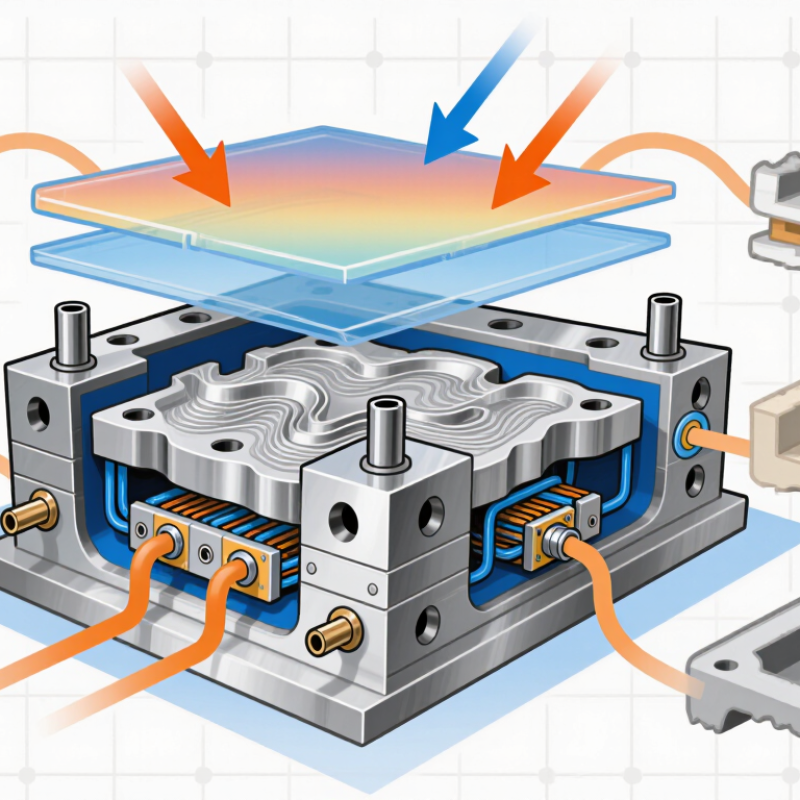
A thermoforming mold assembly is the complete tooling system that shapes a heated plastic sheet. It normally includes the mold body, support frame, vacuum passages, cooling channels, and alignment features. During production, the sheet softens above its forming temperature. Vacuum or air pressure then pulls it against the mold surface. The assembly controls the product’s dimensions, wall thickness, surface texture, and release behavior.

Its purpose is practical: repeatable forming with controlled cycle time. A well-designed mold removes heat evenly, prevents webbing around corners, and supports clean trimming. Cooling channels matter greatly. Uneven cooling can create warpage, thin spots, or difficult ejection.

According to Grand View Research’s 2024 thermoforming plastics market report, the global market was valued at approximately 16 billion U.S. dollars in 2023. That scale increases pressure for stable tooling and lower material waste. The Smithers report, The Future of Thermoforming to 2028, also identifies automation and process efficiency as important development areas.

The assembly is not always a single solid block. It may combine machined metal parts, porous inserts, interchangeable sections, and sealing components. Small details matter. A blocked vacuum port can leave a soft, incomplete corner. A poorly supported frame may distort after repeated heating cycles.

In my experience, early prototypes often expose these weaknesses faster than drawings do. The definition is clear, but the design decisions remain imperfect. Engineers should verify airflow, cooling balance, draft angles, and maintenance access before production begins.


Main Components and Their Functions

What Is a Thermoforming Mold Assembly?
Main Components and Their Functions

A thermoforming mold assembly is the tooling system that shapes heated plastic sheet into a precise part. Its mold body provides the structural foundation and resists repeated forming pressure. The forming surface defines dimensions, corners, ribs, and visible textures. A small radius can affect material flow significantly. That detail matters.

Vacuum ports and channels remove air between the sheet and mold surface. Their spacing must support even contact, especially around deep draws and narrow ribs. Cooling passages carry water through the mold body, controlling cycle time and part stability. The mold base connects the tool to the machine and helps maintain alignment. Clamps, locating pins, and fasteners prevent movement during forming. Vent inserts may improve air removal in difficult areas. They are often overlooked.

A reliable assembly also needs a practical release strategy. Draft angles, polished zones, and suitable surface finishes help the formed part separate without stretching or scuffing. Temperature sensors can reveal uneven cooling, while pressure or vacuum readings expose blocked passages. In production trials, technicians often inspect corners first because thinning appears there quickly. I have seen a sound design fail because one vent was too small. Mold maintenance should include cleaning channels, checking seals, and measuring critical surfaces. No assembly stays perfect forever. Design reviews should question assumptions, not merely confirm drawings.

How a Thermoforming Mold Assembly Works

A thermoforming mold assembly shapes a heated plastic sheet into a precise three-dimensional part. It usually includes the mold, support frame, vacuum channels, cooling lines, and clamping hardware. Each element must work together. A small leak can leave thin corners or soft details.

The process starts when a plastic sheet reaches its forming temperature. The clamping frame holds it above the mold. As the mold rises, vacuum pulls the flexible sheet against its surface. Some assemblies also use air pressure to improve contact around ribs, grooves, and sharp edges.

Tiny vent holes release trapped air. Cooling channels then remove heat from the mold and part. Once the plastic becomes firm, the mold lowers, and the formed piece moves toward trimming.

Practical adjustment matters. An operator checks sheet temperature, vacuum timing, cooling flow, and release angle. A mold may appear accurate on a drawing but still create wrinkles during production. That detail is easy to underestimate. Uneven cooling can also cause warping several minutes later. Designers therefore add rounded corners, suitable draft angles, and replaceable wear components. Trial runs reveal problems that calculations may miss. The first sample is rarely perfect. Careful inspection of wall thickness, surface marks, and dimensions helps refine the assembly before regular production begins.

Common Mold Types and Material Choices

Thermoforming Mold Assembly: Common Mold Types and Material Choices

A thermoforming mold assembly shapes heated plastic over a cavity. It usually includes the mold, frame, vacuum ports, cooling channels, and trimming references. The mold type changes cycle stability, surface detail, and maintenance effort.

Male molds stretch the sheet over a positive form. They suit deeper parts and controlled wall distribution, but corners may become thin. Female molds pull the sheet into a cavity. They usually reproduce external detail more clearly. Matched molds can control both surfaces, although tooling costs and alignment demands rise.

A 2024 Thermoforming Market report from MarketsandMarkets projects market growth from about USD 15.8 billion in 2023 to USD 21.3 billion by 2028. This expansion increases pressure for repeatable, efficient tooling. Yet market growth does not make every mold choice correct.

Material Choices and Design Considerations

Aluminum molds transfer heat quickly and support shorter cooling cycles. They are practical for production runs and detailed surfaces. Epoxy or resin molds reduce initial cost and can work well for prototypes. Their thermal stability is weaker. Steel offers durability, but its weight and machining time can complicate changes. Porous aluminum can improve vacuum flow, while drilled channels may provide simpler maintenance.

A useful design review should test draft angles, vent placement, shrinkage, and sheet thickness together. I have seen “low-cost” tooling become expensive after repeated rework. That risk deserves attention.

Tips:

Confirm the material’s forming temperature before selecting mold construction. Add generous vents near deep corners. Run a small trial, measure wall thickness, and revise the design before full production.

Design, Maintenance, and Quality Considerations

What Is a Thermoforming Mold Assembly?

A thermoforming mold assembly shapes heated plastic over a tool using vacuum, pressure, or both. Its design controls wall thickness, cooling speed, trimming accuracy, and cycle stability. A practical assembly may include the forming tool, cooling channels, vacuum paths, clamping surfaces, and trimming references.

Maintenance starts with small details. Blocked vacuum holes can leave shallow corners, webbing, or uneven surfaces. Poor cooling can create warpage after demolding. Technicians should inspect vent openings, seals, ejector movement, and temperature readings during every planned service. Grand View Research’s 2024 thermoforming market assessment projects continued growth through 2030, increasing pressure for reliable, repeatable tooling. Yet, a perfect first trial is uncommon. Mold adjustments often reveal assumptions that drawings failed to show.

Tips: Keep a signed maintenance log. Record cycle time, mold temperature, vacuum level, and defect location. Clean vents with approved tools, not sharp objects that enlarge them. Check cooling-water flow before changing forming settings. Use dimensional sampling after warm-up, because the first parts may not represent stable production.

Quality Depends on Measurable Evidence

Quality depends on measurable evidence. Inspect critical dimensions with calibrated equipment, and compare results against approved specifications. ISO 20457 provides useful guidance for plastics moulded parts, while process capability studies help separate tool variation from machine variation.

Industry reports often emphasize efficiency, but scrap data deserves equal attention. A faster cycle is not a success if trimming waste rises.

One overlooked weakness is operator feedback; recurring marks near corners may indicate a design problem, not careless handling.

Get in touch with us,
We will contact you shortly!

Get in touch with us by filling up the enquiry form. We will contact you shortly!

    What is the difference between Unline(Non-Epoxy Coated) or Lining(Epoxy Coated) Metal Drum?

    What are Unline(Non-Epoxy Coated) and Lining(Epoxy Coated) drums compatible with?

    What is the difference between Grade A and Grade B Metal Drum ?

    What content is suitable to fill in a Recon Grade A or Grade B Drum?

    What is the difference between Open Top and Close Top Drums and their usage?

    What type of content are Metal or Plastic Drums suitable for?

    Will there be any contamination in the reconditioned metal, plastic drums or IBC tanks?

    What is the drum gauge(thickness) and weight for reconditioned metal drums?

    Do you sell New Packaging Products too?

    What additional services do you provide apart from selling reconditioned and new containers.?

    Do you offer labelling and silkscreen on the containers ?

    Are you able to ship overseas ?

    Leading the Way
    to Carbon Neutrality

    Drumming sustainability into every aspect of our operations, we strive to create a greener and more conscious future for generations to come.
    Contact Us
    WhatsApp
    Email
    Join Our Newsletter

    Sign up for our newsletter for exclusive discounts and latest news of new launches!

      Logo Logo Logo Logo Logo
      Scroll to Top