
How to Choose a Powerline Transformer in 2026?
Choosing a Powerline Transformer in 2026 is not just a matter of matching voltage and capacity. The right choice affects safety, operating costs, reliability, and future expansion. A unit that looks suitable on a specification sheet may still struggle with peak loads, harmonics, harsh weather, or limited installation space.
The wider grid outlook makes careful selection more important. The International Energy Agency’s 2023 report, Electricity Grids and Secure Energy Transitions, says the world may need to add or replace 80 million kilometres of grids by 2040. It also estimates annual grid investment must rise above USD 600 billion by 2030. These are global figures, not a forecast for every project. Still, they underline why transformer capacity, efficiency, cooling, insulation, and maintainability deserve close review.
IEA Executive Director Fatih Birol described grids as “the backbone of secure and sustainable energy systems.” That perspective matters when evaluating a Powerline Transformer: it is one component in a larger system, not a standalone purchase. Start with verified load data, including motor starts and expected growth. Check the applicable standards, site conditions, protection scheme, and supplier test records with qualified engineers. Look closely at the nameplate and connection details.
Small details matter.
This guide will compare key specifications, transformer types, efficiency, and lifecycle costs. It will also point out where project data may be incomplete. That gap is worth admitting; a confident estimate is not a substitute for measured load information. Use the guidance as a practical starting point, then confirm the final selection against local requirements and site-specific engineering.
Define the Transformer’s Role in the Powerline Network
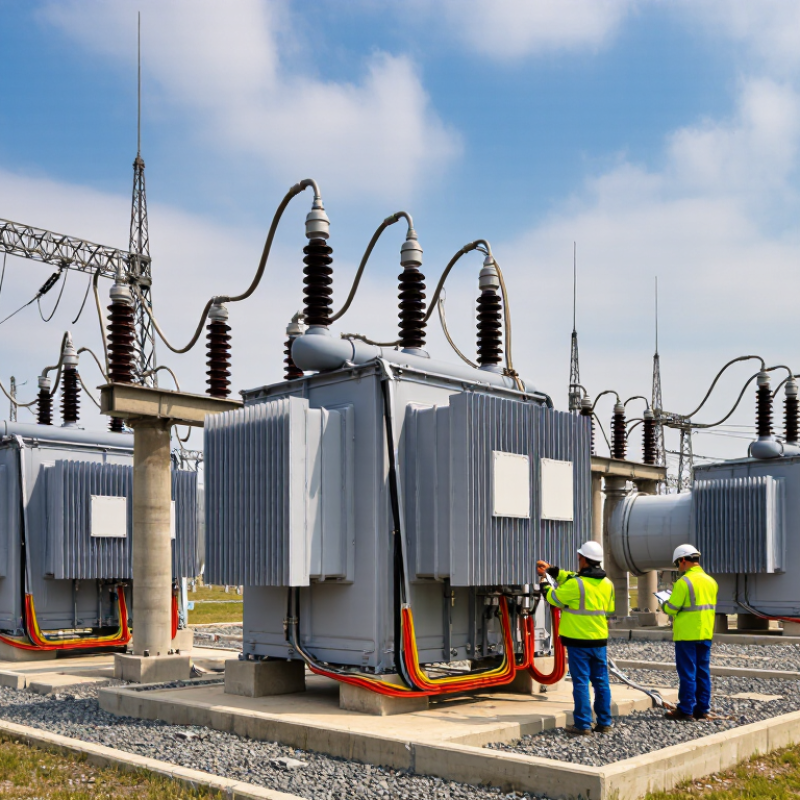
Before comparing transformer ratings, define the unit’s role in the powerline network. A distribution transformer typically steps medium-voltage feeder power down to a usable service voltage for homes, shops, or equipment. It provides the voltage interface between two parts of the system. Small detail, big impact. A substation transformer may serve an entire feeder, while a pole-mounted unit may supply only a few properties.
Record the primary and secondary voltages, phase arrangement, grounding method, and expected load before choosing a kVA rating. Check motor starting currents and seasonal peaks, not just average demand. An undersized transformer can overheat during sustained use; an oversized one may cost more and waste energy through no-load losses. These trade-offs matter. Confirm protection and fault levels at the connection point, because the transformer must coordinate with the feeder.
At the site, note line distance, mounting conditions, ventilation, and exposure to salt, dust, or flooding. These details affect cooling, insulation, and maintenance access. Load estimates are rarely perfectly clean; revise them when measured data disagrees. A spreadsheet can miss a compressor that starts every few minutes. Have a qualified power engineer or utility planner verify network data and technical requirements before procurement.

Assess Voltage, Capacity, and Load Requirements
Choosing a powerline transformer starts with matching its rated voltage to the supply and the equipment it will serve. Check primary and secondary voltage, phase, frequency, and connection type against actual site requirements. A mismatch can damage equipment or prevent it from operating correctly. Check carefully.
Capacity, measured in kilovolt-amperes (kVA), should reflect the expected load rather than a rough guess. List connected equipment, then estimate which items will run at the same time. Motors, pumps, and compressors can draw much higher current during startup than during normal operation. Allow for these surges, likely future additions, and site conditions such as high ambient temperature. Undersizing risks overheating; excessive oversizing can add cost and may reduce efficiency under light loads.
Load patterns matter, too. A workshop with brief, heavy motor starts needs a different assessment from a site with steady lighting and electronics. Review equipment nameplates and, where possible, record demand during a representative operating period. One estimate is rarely perfect; schedules change, and measured use may reveal surprises. Confirm calculations, protection, grounding, and installation conditions with a qualified electrical professional or utility provider before selecting a unit.
Compare Transformer Types and Key Specifications
How to Choose a Powerline Transformer in 2026?
Compare transformer types before comparing prices. Distribution transformers serve local loads, stepping medium-voltage supply down for homes, workshops, or commercial buildings. Larger power transformers handle higher capacities within substations. Pole-mounted units suit overhead lines and limited ground space; pad-mounted units sit in secure enclosures near underground networks. Fit matters.
Oil-immersed designs often suit outdoor service and higher capacities, while dry-type units can be appropriate indoors where fluid containment is a concern. The right choice depends on location, ventilation, fire planning, maintenance access, and environmental conditions. A damp site or salty coastal air can change the specification. “Outdoor rated” alone is not enough.
Check rated power in kVA, primary and secondary voltages, phase configuration, frequency, impedance, and tap range. Match these to the measured load and expected growth, not just today’s peak. Review temperature rise, cooling method, insulation class, and efficiency or no-load and load losses; small losses continue around the clock. Confirm that protection, grounding, and connections suit the network, with a qualified engineer checking the design and applicable standards. A spreadsheet can miss real operating conditions, and load forecasts are imperfect. Leave room for uncertainty without oversizing blindly.
How to Choose a Powerline Transformer in 2026? - Compare Transformer Types and Key Specifications
| Transformer type | Typical capacity | Common primary voltage | Common secondary voltage | Typical configuration | Best suited for | Key selection considerations |
|---|---|---|---|---|---|---|
| Pole-mounted, single-phase | About 5–167 kVA | Commonly 2.4–34.5 kV, depending on the distribution system | Often 120/240 V; other secondary voltages are available | Single-phase, overhead installation; usually liquid-immersed | Individual homes, small rural loads, and overhead distribution branches | Check calculated demand, load growth, primary grounding, mounting limits, lightning protection, and local utility requirements. |
| Pole-mounted, three-phase | About 15–500 kVA | Commonly 4.16–34.5 kV | Commonly 208Y/120 V, 480Y/277 V, or other specified three-phase voltages | Three-phase bank or integrated unit; overhead installation | Small commercial, agricultural, and light industrial overhead loads | Confirm phase and connection, unbalanced-load tolerance, available pole structure capacity, and required fault-current withstand. |
| Pad-mounted distribution | About 75 kVA–5 MVA | Commonly up to 34.5 kV | Often 208Y/120 V or 480Y/277 V; project-specific options are available | Usually three-phase, liquid-immersed, tamper-resistant enclosure for ground-level installation | Underground residential subdivisions, commercial sites, and campuses | Verify enclosure access and clearances, loop-feed or radial design, compartment layout, site drainage, and applicable environmental requirements. |
| Substation distribution transformer | About 2.5–100 MVA | Commonly 34.5–138 kV | Often 4.16–34.5 kV, according to the downstream network | Three-phase, usually liquid-immersed; may include on-load tap changing | Utility substations and large industrial or institutional distribution systems | Assess load profile, parallel operation, impedance, tap range, protection coordination, cooling, transport limits, and site-specific sound limits. |
| Network transformer | Often about 300–2,500 kVA | Commonly 4.16–34.5 kV | Commonly 208Y/120 V or 480Y/277 V | Three-phase, typically vault-type, designed for interconnected secondary networks | Dense urban areas and facilities requiring high service continuity | Check network protector compatibility, reverse-power conditions, vault ventilation and flooding risk, and the utility’s network design rules. |
Typical ranges are indicative, not universal. Actual ratings, voltage combinations, construction, and applicable standards vary by utility, country, installation, and project specification. Confirm final requirements with the serving utility and a qualified electrical engineer.
Verify Safety, Efficiency, and Regulatory Compliance
Choosing a powerline transformer in 2026 means checking more than its rated capacity. Start with the nameplate: confirm primary and secondary voltages, kVA rating, frequency, insulation class, and temperature rise against the actual site conditions. Then review the installation drawings. Clearances, grounding, protective devices, and access for maintenance all affect safety. Small details matter. A cable route that looks tidy on paper may complicate inspection later.
Ask for documented test results and evidence that the unit meets applicable standards and local utility requirements. Requirements can differ by region, so do not treat a supplier’s general compliance statement as enough. Check what it covers. For efficiency, compare no-load and load losses using the expected operating profile, not only the highest demand figure. A transformer running lightly for long periods may make no-load losses especially relevant.
For liquid-filled equipment, review fluid specifications, leak controls, and site containment needs. For dry-type units, consider ventilation and dust exposure. Keep records of inspections and operating conditions; they help identify changes before they become failures. A comparison table helps, though it cannot replace an engineer’s review. That part is easy to underestimate.
Evaluate Installation, Maintenance, and Lifecycle Costs
Choosing a powerline transformer in 2026 means comparing more than purchase prices. Installation can change the budget quickly. A unit’s weight, access road, lifting points, and foundation requirements affect crane time and crew hours. Check whether existing poles, clearances, and cable connections can be reused; assumptions here often prove optimistic. At a rural site, a long delivery route or soft ground may require extra equipment. Ask the installer for a site-specific estimate that separates labor, transport, civil work, testing, and outage coordination. Small details matter.
Maintenance costs depend on design, loading, environment, and how easily technicians can inspect the unit. Dust, salt, heat, or frequent overloads can shorten service intervals. Compare recommended inspections, spare-part availability, monitoring options, and expected repair response—not just the warranty period. A simple inspection log and periodic temperature checks can reveal trends before they become urgent work. Lifecycle cost should include energy losses, planned servicing, likely repairs, and eventual removal or replacement. Use realistic load forecasts and local labor rates, then test a higher-demand scenario. Forecasts are imperfect. I would not treat a spreadsheet total as certainty; it is a decision aid, not a promise. Choose verified ratings that suit the site and support maintainable operation over time.
Article Source:
Get in touch with us,
We will contact you shortly!
What is the difference between Unline(Non-Epoxy Coated) or Lining(Epoxy Coated) Metal Drum?

Unline drums with internally bare metal surface is more susceptible to corrosion and rust while Lining drums are internally coated with Phenolic Epoxy Coating to provide a non-reactive barrier between the drum surface and your product, less risk of contamination. Note: Our Unline drums are coated with an anti-rust agent after washing to reduce risk of rust.
What are Unline(Non-Epoxy Coated) and Lining(Epoxy Coated) drums compatible with?

In Singapore, Recon Unline Drums are usually more costly than Recon Lining Drums. Hence, we recommend Recon Unline Drums to fill aromatics like Thinner, Xylene, Toulene& other solvents like Hexane, BA, CA, EA, MC, White spirit, etc.
We recommend the lower-priced Recon Lining Drums to fill hydrocarbons like IPA, Methanol, Ethanoland oil-based products like diesel, petrol, lubricants, engine, hydraulic, base, transmission fluid, additives, waste oil, etc.;
What is the difference between Grade A and Grade B Metal Drum ?

Grading of used drums are usually based on physical conditions like rustiness, deformities and residual contents. Grade A drums are totally free from internal rust, serious dents and are easy to clean. Grade B drums have different degrees of rust internally and aesthetically inferior compared to Grade A drums.
What content is suitable to fill in a Recon Grade A or Grade B Drum?

Recon Grade A drum is suitable to fill more costly virgin grade products while Recon Grade B drum is more suitable for recycled or waste products.
What is the difference between Open Top and Close Top Drums and their usage?

Closed top drums are for water and other liquid products. Open Top drums can be used for liquid too but are primarily for more viscous products. The Open Top (or open head with a lid) allows you to get in and out of the drum with your product easier.
What type of content are Metal or Plastic Drums suitable for?

Metal drums offer additional protection when dealing with potentially flammable substances. They provide superior fire resistance, impact protection, and longevity for storing class 1, 2, and 3 volatile chemicals.
Plastic HDPE Drums are suitable for corrosive chemicals like acids, alkaline and also water-based products.
Will there be any contamination in the reconditioned metal, plastic drums or IBC tanks?

All our reconditioned containers (metal/plastic drums, carboys, IBC tanks) are washed thoroughly with specially formulated cleaning agent, rinsed with clean water, dried, and tested for possible leakages during the recondition process. Stringent quality inspection is being conducted 100% on every reconditioned product before they are qualified for sale & delivery.
What is the drum gauge(thickness) and weight for reconditioned metal drums?

Reconditioned metal drums gauge can be 0.9mm to 1.0mm all round. Their weight can vary from 16 to 18kg.
Do you sell New Packaging Products too?

Yes, we are also a distributor for new pallets, metal drums, plastic drums, carboys, IBCs and stainless-steel tanks.
What additional services do you provide apart from selling reconditioned and new containers.?

We are an NEA licensed toxic industrial waste collector, who can collect and dispose of used toxic waste containers in Singapore.
Do you offer labelling and silkscreen on the containers ?

We can provide labelling and silk-screening on the containers.
Are you able to ship overseas ?

Yes, we can arrange export our products to any country in the world.
Leading the Way
to Carbon Neutrality