
How to Choose the Best Pneumatic Pressure Calibrator 2026?
Choosing the right Pneumatic Pressure Calibrator in 2026 requires more than comparing display resolution and purchase price. A reliable choice must fit the pressure range, medium, accuracy target, and working environment. In a calibration laboratory, a stable 7 bar reference may be essential. On a production floor, fast stabilization and impact resistance may matter more. Small differences can affect inspection results, maintenance decisions, and product release.
Industry guidance supports a measurement-focused approach. NIST Technical Note 1297 explains how measurement uncertainty should be evaluated and reported. That principle remains central when comparing calibrator specifications. EURAMET cg-17 also highlights practical requirements for pressure calibration, including reference standards, leak control, traceability, and environmental influences. Meanwhile, market analyses from MarketsandMarkets and Grand View Research show continued growth in industrial measurement and pressure-sensing applications. These reports suggest stronger demand for portable, connected, and higher-accuracy calibration equipment.
Real-world details deserve attention. A calibrator may look precise on a clean datasheet, yet perform poorly with unstable air supply or worn fittings. Check generation speed, fine adjustment, overpressure protection, battery life, and compatible adapters. Review calibration certificates carefully. ISO/IEC 17025 accreditation can strengthen confidence in laboratory traceability, but it does not automatically make every instrument suitable. That distinction is easy to miss. I have seen product comparisons focus heavily on resolution while overlooking uncertainty, maintenance intervals, and operator training. That is not a perfect method. Buyers should question advertised accuracy, test repeatability at working points, and confirm support availability before purchase. A thoughtful selection balances technical evidence with actual field conditions.
What Is a Pneumatic Pressure Calibrator and How Does It Work?
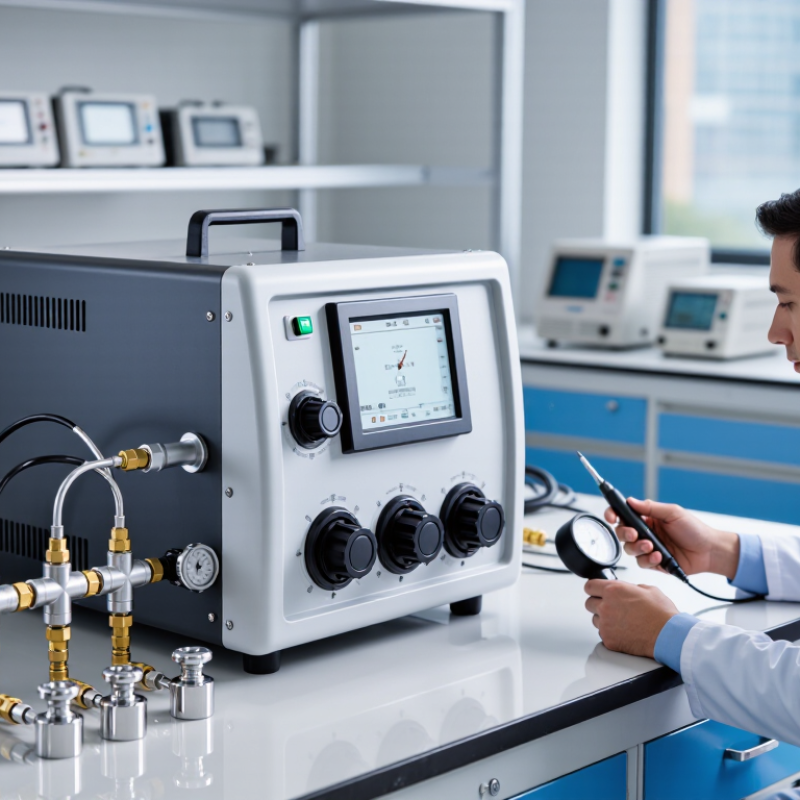
A pneumatic pressure calibrator generates and measures controlled air pressure for testing pressure instruments. It usually combines a pressure source, regulator, fine adjustment valve, reference sensor, and display. The operator connects a device under test, such as a gauge or transmitter, then applies selected pressure points. Readings from both instruments are compared.
The working process is practical. A hand pump or external air supply creates pressure inside a sealed circuit. The regulator reduces excessive input, while the fine adjustment controls small changes. For example, an engineer may set 100 kPa, wait for stabilization, and record both values. A small leak can make the reading drift. That detail is easy to miss.
When choosing a 2026 model, check the pressure range, accuracy, resolution, and pressure medium. The calibrator should match the instrument being tested without operating near its maximum limit. Temperature compensation matters in workshops that move between cold storage rooms and warm production floors. A documented calibration certificate also supports traceability to recognized measurement standards.
Hands-on use often reveals more than a specification sheet. A stiff valve can slow testing, even when accuracy looks excellent. I once underestimated hose flexibility; the connection pulled slightly on a portable gauge. The result was repeatable, but not fully trustworthy. Look for leak testing, overpressure protection, clear controls, and replaceable seals. Portability helps, but a lighter case may sacrifice stability. That trade-off deserves careful review.

Which Pressure Range and Accuracy Should You Choose?
Choosing a pneumatic pressure calibrator starts with the pressure range, not the display resolution.
Record the lowest and highest pressures your process actually uses. A calibrator rated far above those values may appear safer, but its percentage-of-full-scale error can reduce practical accuracy. A 0–10 bar instrument may be a poor choice for checking a 1 bar transmitter.
Keep normal readings near the useful middle of the range. Leave enough headroom for spikes, but avoid excessive capacity. Then compare the calibrator’s total uncertainty with the device under test. A 4:1 test uncertainty ratio is a useful starting point, not a universal law. NIST Technical Note 1297 states that coverage factor k=2 represents approximately 95% coverage. That matters when a specification lists expanded uncertainty rather than basic accuracy. EURAMET Calibration Guide 17 also emphasizes range-dependent uncertainty in pressure calibration. Read the fine print.
For demanding work, calculate the uncertainty budget, including temperature, resolution, repeatability, leakage, and reference stability. A 0.05% full-scale specification can look impressive. It may still be unsuitable at the bottom of the range. In field testing, I would rather use a smaller, well-matched range than a larger instrument with impressive marketing numbers. That preference is not always convenient. It does, however, expose a common mistake: confusing more range with better measurement confidence.
How Do Calibration Media and Pressure Generation Methods Differ?
How to Choose the Best Pneumatic Pressure Calibrator in 2026?
Calibration media directly affects cleanliness, stability, and measurement risk. Dry air suits routine pneumatic work and avoids liquid contamination. However, it may leak through small seals more easily. Nitrogen can improve cleanliness and reduce moisture, especially in controlled laboratory environments. Never assume the media are interchangeable. Their compressibility, viscosity, and temperature response differ.
Pressure generation methods also create different workloads. A hand pump is portable but tiring near the upper range. A pneumatic controller delivers steadier pressure and supports repeatable automated testing. A comparison report from the International Energy Agency notes that industrial facilities increasingly prioritize automation and measurement efficiency, though it does not replace uncertainty analysis. That distinction matters. NIST Technical Note 1297 recommends reporting expanded uncertainty with coverage factor k=2, representing approximately 95% coverage under stated assumptions. ISO/IEC 17025 also expects traceable results, competent procedures, and suitable environmental controls. During field work, I watch the pressure settle beside a small digital display before recording data. Temperature drift can quietly change the result. I still see technicians choosing speed over stabilization. That shortcut deserves reconsideration. A calibrator with excellent resolution may perform poorly when its generation method, medium, and reference uncertainty are mismatched. Evaluate leak tightness, control resolution, required pressure range, and the permitted test medium together.
How to Choose the Best Pneumatic Pressure Calibrator 2026? - How Do Calibration Media and Pressure Generation Methods Differ?
| Calibration Medium | Pressure Generation Method | Typical Working Range | Typical Accuracy Capability | Main Advantages | Common Limitations | Suitable Applications |
|---|---|---|---|---|---|---|
| Clean, dry air | Manual hand pump with fine adjustment and volume control | Vacuum to approximately 40 bar (600 psi), depending on design | About 0.05% to 0.25% of reading or full scale for complete systems | Portable, self-contained, low operating cost, and clean for pneumatic instruments | Manual effort; pressure stability depends on operator technique and leakage control | Field calibration of pressure transmitters, switches, gauges, and low-to-medium pressure sensors |
| Clean, dry air | Pneumatic comparator using a regulated external air supply | Typically from low pressure to approximately 100 bar (1,500 psi) | Often about 0.025% to 0.1% of full scale when paired with a suitable reference | Fast pressure generation, good repeatability, and reduced operator effort | Requires a clean, dry, stable supply and suitable filtration | Workshop calibration, production-line testing, and repeated instrument verification |
| Clean, dry air | Motorized or electrically driven pneumatic pump | Commonly vacuum to 20–70 bar (300–1,000 psi), depending on pump configuration | About 0.01% to 0.05% of full scale with a high-quality reference sensor | Rapid generation, automated test sequences, and reduced fatigue during multiple-point calibration | Needs electrical power; pump noise, heat, and pulsation may require filtering or stabilization | Automated test benches, high-throughput maintenance, and multi-point calibration routines |
| Nitrogen or other dry inert gas | Gas regulator, precision pressure controller, or gas booster | From low pressure to several hundred bar; equipment-specific | Approximately 0.01% to 0.1% of full scale, depending on the controller and reference | Very dry, clean, and chemically inert; suitable where moisture or oxygen is undesirable | Gas cylinders require handling, storage, and ventilation controls; operating cost is higher than ambient air | Moisture-sensitive devices, oxygen-sensitive processes, and high-accuracy laboratory calibration |
| Hydraulic oil or other compatible liquid | Hand-operated or motorized hydraulic pump with fine adjustment | Typically 0 to 700 bar (0 to 10,000 psi); higher ranges are possible with specialized equipment | About 0.01% to 0.05% of full scale for complete calibration systems | Liquid has low compressibility, enabling high pressure and stable readings | Potential contamination, cleanup requirements, temperature effects, and incompatibility with some sensors | High-pressure gauges, transmitters, safety valves, and industrial hydraulic equipment |
| Distilled or deionized water | Water-operated hand pump or hydraulic pressure controller | Usually low to medium hydraulic pressure; commonly up to approximately 700 bar | Often about 0.02% to 0.1% of full scale, depending on system design | Low contamination risk for compatible equipment and easier disposal than oil | Can promote corrosion, may freeze, and is unsuitable for devices that must remain completely dry | Water-compatible pressure instruments and applications requiring a low-residue medium |
| Air or inert gas | Pressure controller with closed-loop electronic regulation | Commonly vacuum to 20–100 bar; range depends on the control module | Approximately 0.005% to 0.025% of full scale in laboratory-grade systems | Excellent repeatability, programmable setpoints, automatic stabilization, and data logging | Higher acquisition cost; requires power, configuration, and periodic verification | Calibration laboratories, automated production testing, and digitally documented procedures |
Note: Ranges and accuracy figures are typical engineering values rather than universal specifications. Actual performance depends on the pressure range, reference sensor, temperature stability, leakage, medium cleanliness, and calibration procedure.
Which Features Improve Safety, Portability, and Measurement Efficiency?
A good pneumatic pressure calibrator should protect both the technician and the measurement. In field audits, I look for overpressure protection, a vent valve, and clear pressure isolation. A large display helps when hoses vibrate or lighting changes. Non-slip controls matter too. Small details prevent expensive mistakes.
Portability directly affects calibration efficiency. Choose a compact unit with a strong case, accessible battery charging, and fittings that resist repeated connection. A lightweight calibrator reduces wrist strain during ladder or plant inspections. However, lighter is not always better. Weak pumps may increase adjustment time and operator fatigue. I have learned this the hard way.
Measurement quality depends on traceability, resolution, and stable pressure generation. NIST Technical Note 1297 explains that expanded uncertainty commonly uses coverage factor k=2, representing about 95% coverage under typical assumptions. Ask suppliers to state accuracy conditions, not only headline accuracy. ISO/IEC 17025 principles also support documented calibration records and traceable references. Some field units offer data logging and wireless transfer, which can reduce transcription errors. Yet wireless features may add setup delays. A simple interface can outperform a smarter one when technicians work under pressure. Before purchase, compare the calibrator’s pressure range with actual instruments, hose volume, ambient temperature, and required tolerance. Small mismatches create large doubts.
How to Choose the Best Pneumatic Pressure Calibrator in 2026?
Compare representative pneumatic pressure ranges used in common calibration and testing applications. The best model should cover the required test points while maintaining suitable accuracy, pressure protection, portability, and data-logging efficiency.
Low-pressure leak testing typically needs a compact, highly sensitive instrument, while process calibration and valve testing require higher pressure capability. When selecting a calibrator, check the full-scale accuracy, overpressure protection, pressure relief control, battery runtime, weight, fittings, and automatic measurement logging—not pressure range alone.
How Can You Compare, Verify, and Maintain a 2026 Calibrator?
Choosing a 2026 pneumatic pressure calibrator starts with practical comparison, not a glossy specification sheet. Match its pressure range to daily work, leaving headroom without sacrificing low-pressure resolution. Compare accuracy, stability, display readability, pump effort, fitting compatibility, battery life, and data logging. A unit reaching 1,000 kPa may still perform poorly near 10 kPa. Check stated measurement uncertainty, not only the largest accuracy percentage. My first comparison missed connector quality.
Verification should use a reference standard with documented traceability and a suitable uncertainty ratio. Let both instruments reach room temperature before testing. Inspect hoses, seals, and fittings for cracks or contamination. Generate several pressure points, both rising and falling. Record errors, repeatability, and zero return. A slow pressure drop often reveals a damaged seal or loose connection. Do not force a result. If readings disagree, repeat the test with another reference or an independent technician. Photograph the display and preserve raw readings. Memory is unreliable.
Maintenance depends on disciplined routine. Keep ports capped, remove dust from seals, and store the calibrator in a dry case. Relieve pressure after use and follow approved procedures for unknown or contaminated media. Inspect pump valves, tubing, batteries, and fittings at defined intervals. Schedule recalibration according to drift, workload, environment, and quality-system requirements, rather than habit alone. A missed inspection can invalidate an otherwise careful measurement. That is an uncomfortable lesson.
Get in touch with us,
We will contact you shortly!
What is the difference between Unline(Non-Epoxy Coated) or Lining(Epoxy Coated) Metal Drum?

Unline drums with internally bare metal surface is more susceptible to corrosion and rust while Lining drums are internally coated with Phenolic Epoxy Coating to provide a non-reactive barrier between the drum surface and your product, less risk of contamination. Note: Our Unline drums are coated with an anti-rust agent after washing to reduce risk of rust.
What are Unline(Non-Epoxy Coated) and Lining(Epoxy Coated) drums compatible with?

In Singapore, Recon Unline Drums are usually more costly than Recon Lining Drums. Hence, we recommend Recon Unline Drums to fill aromatics like Thinner, Xylene, Toulene& other solvents like Hexane, BA, CA, EA, MC, White spirit, etc.
We recommend the lower-priced Recon Lining Drums to fill hydrocarbons like IPA, Methanol, Ethanoland oil-based products like diesel, petrol, lubricants, engine, hydraulic, base, transmission fluid, additives, waste oil, etc.;
What is the difference between Grade A and Grade B Metal Drum ?

Grading of used drums are usually based on physical conditions like rustiness, deformities and residual contents. Grade A drums are totally free from internal rust, serious dents and are easy to clean. Grade B drums have different degrees of rust internally and aesthetically inferior compared to Grade A drums.
What content is suitable to fill in a Recon Grade A or Grade B Drum?

Recon Grade A drum is suitable to fill more costly virgin grade products while Recon Grade B drum is more suitable for recycled or waste products.
What is the difference between Open Top and Close Top Drums and their usage?

Closed top drums are for water and other liquid products. Open Top drums can be used for liquid too but are primarily for more viscous products. The Open Top (or open head with a lid) allows you to get in and out of the drum with your product easier.
What type of content are Metal or Plastic Drums suitable for?

Metal drums offer additional protection when dealing with potentially flammable substances. They provide superior fire resistance, impact protection, and longevity for storing class 1, 2, and 3 volatile chemicals.
Plastic HDPE Drums are suitable for corrosive chemicals like acids, alkaline and also water-based products.
Will there be any contamination in the reconditioned metal, plastic drums or IBC tanks?

All our reconditioned containers (metal/plastic drums, carboys, IBC tanks) are washed thoroughly with specially formulated cleaning agent, rinsed with clean water, dried, and tested for possible leakages during the recondition process. Stringent quality inspection is being conducted 100% on every reconditioned product before they are qualified for sale & delivery.
What is the drum gauge(thickness) and weight for reconditioned metal drums?

Reconditioned metal drums gauge can be 0.9mm to 1.0mm all round. Their weight can vary from 16 to 18kg.
Do you sell New Packaging Products too?

Yes, we are also a distributor for new pallets, metal drums, plastic drums, carboys, IBCs and stainless-steel tanks.
What additional services do you provide apart from selling reconditioned and new containers.?

We are an NEA licensed toxic industrial waste collector, who can collect and dispose of used toxic waste containers in Singapore.
Do you offer labelling and silkscreen on the containers ?

We can provide labelling and silk-screening on the containers.
Are you able to ship overseas ?

Yes, we can arrange export our products to any country in the world.
Leading the Way
to Carbon Neutrality