
What Is the Best Automated Forklift in 2026?
What Is the Best Automated Forklift in 2026? The answer depends less on a flashy feature list than on the work happening on your floor. An Automated Forklift may move pallets smoothly in a wide aisle yet struggle with mixed traffic, uneven surfaces, or frequent changes in load size. Small details matter. Think of a tight turn beside a staging area, a pallet with a damaged base, or a shift change that interrupts traffic. These are ordinary moments, but they reveal whether automation fits daily operations.
Lean manufacturing expert Taiichi Ohno is widely associated with the principle, “Where there is no standard, there can be no kaizen.” That idea is useful here: buyers need a clear picture of routes, loads, handoffs, and exceptions before comparing models. A practical evaluation should consider payload and lift height, navigation method, safety features, integration needs, service support, and the time required to adapt workflows. Ask vendors to demonstrate realistic tasks, not just a polished route. No model wins everywhere.
This guide explores how to compare leading options in 2026 and match them to different warehouse needs. It also looks beyond purchase price to deployment effort, uptime, and ongoing support. A specification sheet cannot show every awkward corner. Nor can a short demo predict every shift. That uncertainty deserves attention. The strongest choice is the one that performs reliably in your actual environment, with measurable goals and a plan for handling exceptions—not simply the model with the boldest claims.
How Automated Forklifts Work and Where They Are Used
What Is the Best Automated Forklift in 2026?
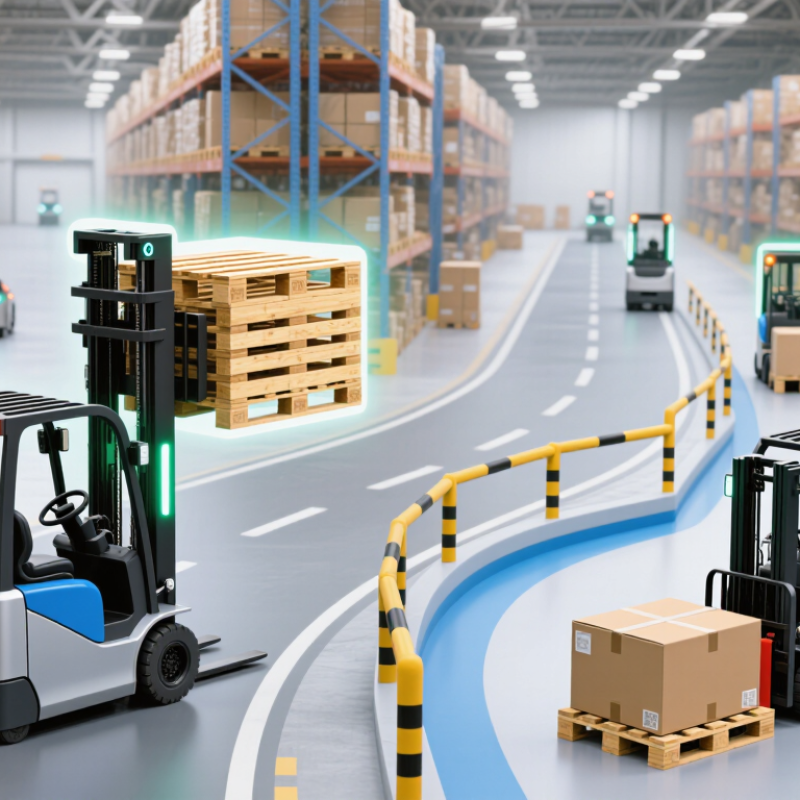
Automated forklifts use sensors, cameras, laser scanners, and software to move loads without continuous human steering. Their control system maps aisles, detects obstacles, and selects routes from warehouse data. Some models follow magnetic paths, while newer systems navigate dynamically. MHI’s 2024 Annual Industry Report found that 43% of surveyed supply-chain organizations already use robotics and automation. Adoption is growing, but “best” depends on floor layout, pallet weight, traffic, and integration needs.
These vehicles work well in distribution centers, manufacturing plants, cold storage rooms, and high-volume warehouses. They can transfer pallets between docks, storage racks, production lines, and charging areas. In narrow aisles, navigation accuracy matters more than headline speed. IFR reported 541,302 industrial robots were installed worldwide in 2023, showing broader automation momentum. However, forklift-specific performance still requires site testing. A clean digital map may fail after temporary racks, damaged pallets, or poor lighting appear.
Tips: Measure travel distance, loading height, aisle width, and daily pallet movements before choosing equipment. Test emergency stops and mixed human traffic. Ask for maintenance records and operator training details. Do not assume full autonomy removes supervision. One overlooked pedestrian route can expose a serious design weakness. Pilot the system during a normal shift, not only in a controlled demonstration. Keep manual fallback procedures available, because real warehouses are rarely perfect.
| Automated Forklift Type | Typical Operating Method | Typical Load Capacity | Typical Lift Height | Typical Travel Speed | Best-Fit Applications | Key Selection Considerations |
|---|---|---|---|---|---|---|
| Automated Pallet Truck | Moves pallets at floor level using onboard sensors, mapping software and warehouse-management-system instructions. | Approximately 1,000–2,500 kg | Floor-level transport; limited or no high-level lifting | Approximately 1.5–2.5 m/s, depending on load and site conditions | Horizontal pallet movement, staging areas, dock-to-storage transfers and production-line replenishment | Best where repetitive transport routes are predictable and pallet presentation is consistent. |
| Automated Counterbalance Forklift | Uses cameras, laser scanners, inertial sensors or combinations of these technologies to navigate without a fixed guide path. | Approximately 1,500–3,500 kg | Approximately 3–6 m | Approximately 1.5–2.5 m/s | General pallet handling, truck loading and unloading, manufacturing warehouses and mixed-use distribution areas | Requires adequate turning space, floor quality, pedestrian controls and accurate pallet detection. |
| Automated Reach Truck | Combines autonomous navigation with a reach mechanism for depositing and retrieving pallets in narrow storage aisles. | Approximately 1,000–2,000 kg | Approximately 6–11 m | Approximately 1.0–2.0 m/s | High-density pallet storage, narrow aisles and distribution centers with tall racking | Suitable rack geometry, aisle width, rack condition and load-center requirements are critical. |
| Automated Very-Narrow-Aisle Truck | Operates in narrow aisles with precise localization, aisle guidance and automated pallet placement. | Approximately 1,000–2,000 kg | Approximately 8–16 m | Approximately 0.8–1.5 m/s in narrow aisles | High-bay warehouses where storage density is more important than flexible aisle access | Needs carefully planned rack spacing, consistent pallet dimensions and reliable floor flatness. |
| Automated Stacker Crane Forklift | Travels along dedicated storage aisles and uses a mast or load-handling device to place pallets into fixed rack locations. | Approximately 500–2,000 kg per load | Approximately 10–25 m, depending on system design | System-specific; generally optimized for controlled, dedicated aisles | Automated storage and retrieval systems, cold stores, high-bay warehouses and controlled inventory environments | Offers high storage density but requires significant infrastructure and a stable warehouse layout. |
| Towing Automated Forklift | Pulls one or more carts or trailers along programmed routes using autonomous navigation and obstacle detection. | Trailer-dependent; often several tonnes of total train load | Not applicable; transports floor-level carts | Approximately 1.0–2.0 m/s | Line-side delivery, kitting, waste collection and repeated movement of materials between work areas | Route width, trailer coupling, stopping distance and traffic rules must be designed for the full train length. |
| Hybrid Automated Forklift | Supports autonomous operation while allowing supervised manual control for exceptions, unusual loads or maintenance tasks. | Approximately 1,000–3,500 kg | Approximately 3–8 m | Approximately 1.0–2.5 m/s | Warehouses with variable workflows, changing layouts or a gradual transition from manual to automated handling | Useful when flexibility is important, but operator training and clear operating modes are essential. |
| Navigation Technology | Common methods include laser-based mapping, camera-based perception, inertial measurement, wheel odometry, magnetic guidance and QR or reflective markers. | Not applicable | Not applicable | Determined by vehicle type, traffic density and safety limits | Navigation choice depends on whether the site needs flexible routing, fixed paths or high positional accuracy. | Consider lighting, dust, reflective surfaces, changing obstacles, map maintenance and localization reliability. |
| Safety and Control Functions | Typical functions include obstacle detection, protective fields, emergency stopping, speed reduction, audible or visual alerts and controlled interaction with pedestrians. | Not applicable | Not applicable | Reduced automatically in high-risk zones or near people | All facilities where automated vehicles share space with employees, visitors or manually operated equipment | Safety design should be validated through a site risk assessment and applicable machinery-safety requirements. |
| Battery and Charging | Electric drive systems commonly use lead-acid or lithium-ion batteries with scheduled, opportunity or automated charging. | Not applicable | Not applicable | Performance may vary with battery state and payload | Multi-shift warehouses, manufacturing sites and operations requiring predictable vehicle availability | Compare shift length, charging windows, battery replacement needs, temperature range and charging-room requirements. |
| Integration Requirements | Fleet software can exchange job requests, inventory status and traffic information with warehouse-management or manufacturing-execution systems. | Not applicable | Not applicable | Depends on task queues, traffic management and system response time | Facilities seeking coordinated transport, traceability and fewer manual dispatch decisions | Evaluate interface compatibility, cybersecurity, data ownership, exception handling and system scalability. |
| Best Overall Selection Criteria for 2026 | Choose the vehicle type that matches the material flow rather than selecting solely by rated capacity or advertised speed. | Must exceed the heaviest routine load with an appropriate safety margin | Must match rack height, pallet dimensions and required clearance | Should support required throughput without compromising safe stopping distances | Sites with repetitive, measurable workflows and stable material-handling rules generally provide the strongest automation case. | Assess total cost of ownership, safety validation, uptime, serviceability, integration effort, facility changes and future scalability. |



Get in touch with us,
We will contact you shortly!
What is the difference between Unline(Non-Epoxy Coated) or Lining(Epoxy Coated) Metal Drum?

What are Unline(Non-Epoxy Coated) and Lining(Epoxy Coated) drums compatible with?
What is the difference between Grade A and Grade B Metal Drum ?
What content is suitable to fill in a Recon Grade A or Grade B Drum?
What is the difference between Open Top and Close Top Drums and their usage?
What type of content are Metal or Plastic Drums suitable for?
Will there be any contamination in the reconditioned metal, plastic drums or IBC tanks?
What is the drum gauge(thickness) and weight for reconditioned metal drums?
Do you sell New Packaging Products too?
What additional services do you provide apart from selling reconditioned and new containers.?
Do you offer labelling and silkscreen on the containers ?
Are you able to ship overseas ?
Leading the Way
to Carbon Neutrality