
Best Glass Window Manufacturers in China for Global Buyers
For global buyers, choosing a Glass Window manufacturer in China is not only a price comparison. It is a decision about performance, consistency, and communication across borders. Chinese suppliers offer varied product ranges, from insulated units for residential projects to large façade panels. Yet product photos rarely show edge quality, spacer alignment, or how carefully glass is packed. Details matter.
The International Energy Agency’s Global Status Report for Buildings and Construction 2024 states that buildings and construction account for about 32% of global energy demand and 34% of energy-related CO₂ emissions. These figures cover the wider sector, not windows alone. Still, they explain why glazing specifications deserve close review. Buyers should compare U-values, solar heat gain, acoustic ratings, and stated test methods. A lower quoted price may not represent the same performance or scope.
This guide examines manufacturers through practical questions: What products do they make? Can they provide current test reports and traceable specifications? How do they manage samples, packaging, and delivery updates? Ask for evidence, not only promises. A polished catalogue can look convincing; a sample may tell another story. That is worth remembering. No single supplier suits every project, and published claims can be difficult to compare when methods differ. Use the shortlist as a starting point, then confirm requirements directly with each manufacturer before placing an order.
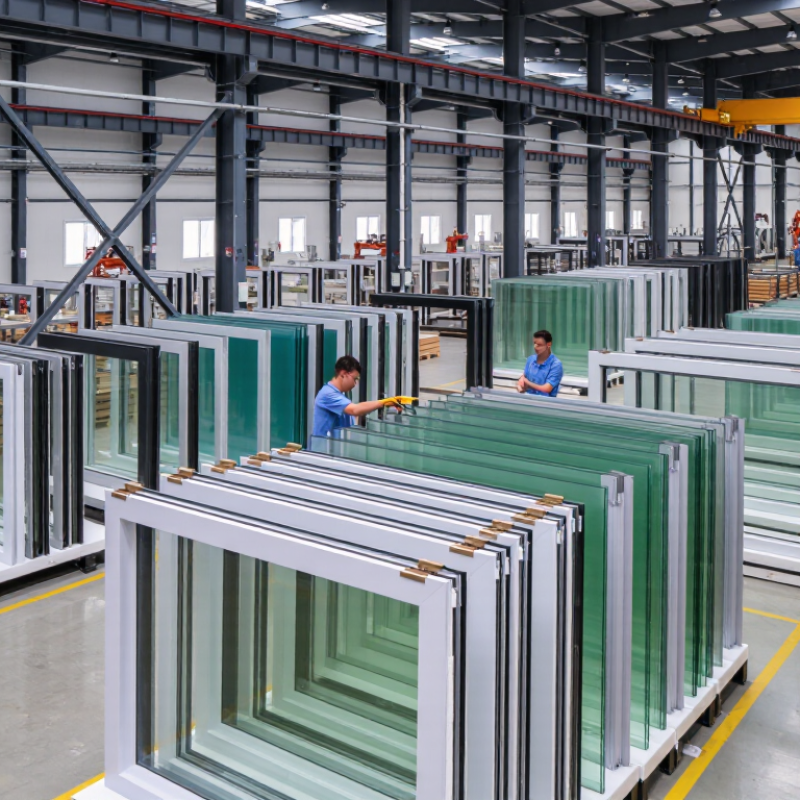
What Defines a Reliable Glass Window Manufacturer in China
A reliable glass window manufacturer in China should be able to explain how each unit is made, not just show polished showroom photos. Ask how glass thickness, coating, spacer bars, frame profiles, and sealants are specified for your project. Clear answers help buyers compare quotations that may look similar but include different components. Small details matter.
Request recent test reports and production records for the window type you plan to order. Check whether the documents match the proposed glass build-up and frame system. A supplier should also describe its inspection process, including checks for scratches, edge damage, dimensions, and hardware operation. Ask for evidence. If possible, review a sample and confirm how it is packed; corner protection and separated glass surfaces can reduce transit damage.
Communication is part of quality. A dependable team confirms drawings, opening directions, dimensions, finishes, and delivery milestones in writing. It should flag unclear specifications before production, rather than silently make assumptions. That gap matters. I have seen a small mismatch in a drawing create delays that careful checking could have prevented. No factory is flawless, so ask how defects are logged, investigated, and corrected. Look for specific answers, realistic lead times, and consistent documentation—not promises that everything will be perfect.
Best Glass Window Manufacturers in China for Global Buyers - What Defines a Reliable Glass Window Manufacturer in China
Use these criteria to compare suppliers. Performance requirements depend on the destination market, building design, window size, and project specifications; verify claims against reports for the proposed product configuration.
| Evaluation Area | Practical Benchmark | Evidence to Request | Why It Matters to Global Buyers |
|---|---|---|---|
| Product and market compliance | Products should be assessed against the standards and building-code requirements applicable in the destination market. For example, EN 14351-1 covers performance characteristics for windows and external pedestrian doorsets in its scope. | Applicable test reports, declarations or certification documents, with the product type, configuration, and issuing laboratory clearly identified. | Requirements differ by country. A document for one market or product configuration may not establish compliance for another. |
| Thermal performance | Compare the whole-window thermal transmittance (U-factor or U-value) and, where relevant, solar heat gain data with project requirements. Values depend on glazing, frame, spacers, and window size. | Tested or calculated performance data for the specified glass build-up and frame. For the United States, check whether ratings are supported by NFRC procedures and documentation. | Thermal ratings help buyers evaluate energy performance and avoid comparing glass-only figures with whole-window figures. |
| Air leakage | Request a reported air-leakage result tested to the relevant market method, such as ASTM E283 where applicable. Acceptance limits should follow the project specification or local code. | Test report stating the test method, specimen dimensions, operating type, and measured leakage rate. | Air leakage can affect comfort, energy use, and indoor moisture control; results are meaningful only when the test conditions are clear. |
| Water penetration | Confirm the required pressure and pass criteria for the project. ASTM E331 is one method used to evaluate water penetration under uniform static air pressure difference. | Report showing the test method, pressure, duration, specimen details, and observed water penetration. | Rain exposure and wind conditions vary by location, so buyers should set a project-appropriate target rather than rely on a generic claim. |
| Structural performance | Check that the proposed window can meet the design wind loads and deflection criteria for the project. ASTM E330 is a structural performance test method used for exterior windows, doors, skylights, and curtain walls. | Test results or engineering calculations for the relevant frame, glass thickness, hardware, dimensions, and support conditions. | A result for a smaller or differently configured specimen may not represent a larger project window or a different installation. |
| Insulating glass unit (IGU) durability | For markets using European standards, EN 1279 addresses insulating glass units. Confirm that the proposed unit construction and applicable parts of the standard match the project requirements. | IGU test documentation, glass and spacer specifications, sealant details, production identification, and any applicable conformity documents. | Sealed-unit durability depends on the complete assembly and manufacturing process, not just the glass panes. |
| Materials and finish | Specifications should identify the frame material and relevant dimensions, glazing build-up, hardware, seals, and surface finish. Suitability should be assessed for the intended exposure and use. | Product drawings, material specifications, finish details, hardware schedules, and approved samples where color or appearance is important. | Clear specifications reduce substitutions and help buyers check compatibility with the building design and local environment. |
| Quality management and production control | A documented quality-management system, such as one certified to ISO 9001, can support consistent processes; certification alone does not prove that a particular window meets project performance requirements. | Current certificate scope and validity, inspection procedures, production records, and records for the ordered product batch. | Buyers need both process controls and product-specific evidence to assess consistency and traceability. |
| Inspection and traceability | Orders should have identifiable product configurations and documented checks for dimensions, appearance, operation, and packing before dispatch. | Inspection plan, measurement records, photographs or inspection reports, and labels linking units to order or batch records. | Traceability makes it easier to resolve defects, confirm the delivered configuration, and manage replacements. |
| Packaging and export readiness | Packaging should be appropriate for the window size, glass type, handling method, route, and expected storage conditions. | Packing specifications, loading plan, handling instructions, and confirmation of shipping marks and order quantities. | Glass can be damaged during handling and transport; packaging and loading details should be agreed before production is complete. |
| Commercial terms and after-sales support | Written terms should clearly state product scope, tolerances, inspection arrangements, lead time, warranty coverage, exclusions, and the process for reporting issues. | Quotation, approved drawings, purchase-order specifications, warranty document, and a named service contact or documented claim process. | Clear written commitments reduce misunderstandings across languages, time zones, and international shipping arrangements. |



Get in touch with us,
We will contact you shortly!
What is the difference between Unline(Non-Epoxy Coated) or Lining(Epoxy Coated) Metal Drum?

What are Unline(Non-Epoxy Coated) and Lining(Epoxy Coated) drums compatible with?
What is the difference between Grade A and Grade B Metal Drum ?
What content is suitable to fill in a Recon Grade A or Grade B Drum?
What is the difference between Open Top and Close Top Drums and their usage?
What type of content are Metal or Plastic Drums suitable for?
Will there be any contamination in the reconditioned metal, plastic drums or IBC tanks?
What is the drum gauge(thickness) and weight for reconditioned metal drums?
Do you sell New Packaging Products too?
What additional services do you provide apart from selling reconditioned and new containers.?
Do you offer labelling and silkscreen on the containers ?
Are you able to ship overseas ?
Leading the Way
to Carbon Neutrality












