
China Best Biodegradable Containers Suppliers for Global Buyers
Choosing reliable Biodegradable Containers suppliers requires more than comparing prices and attractive product photos. Global buyers must examine material composition, factory experience, production consistency, and verified environmental claims. A container made from PLA, bagasse, bamboo fiber, or recycled paper performs differently under heat, moisture, and transport pressure. Small details matter. A weak lid can ruin an otherwise excellent shipment.
During supplier evaluations, experienced purchasing teams should request samples, food-contact documentation, compostability certificates, and factory quality records. They should also inspect sealing strength, stacking performance, printing safety, and packaging conditions. Biodegradable Containers are not automatically compostable in every environment. Industrial composting may be required. Local waste systems can change the final environmental result.
Dr. Michael Braungart, co-founder of the Cradle to Cradle concept, famously said, “Waste equals food.” This idea encourages manufacturers to design materials for responsible biological or technical cycles. It also creates a practical question: Can the container return safely to a suitable system after use?
This guide evaluates leading suppliers for international buyers. It considers material innovation, production capacity, customization, export experience, and transparent certification. Some suppliers appear impressive online but provide limited technical evidence. That is a warning sign. No supplier is flawless, and sustainability claims deserve careful testing. Better decisions come from comparing documents, samples, factory responses, and real delivery performance. The goal is not simply to find green-looking packaging. It is to find dependable Biodegradable Containers that protect products, meet applicable requirements, and support measurable environmental progress.
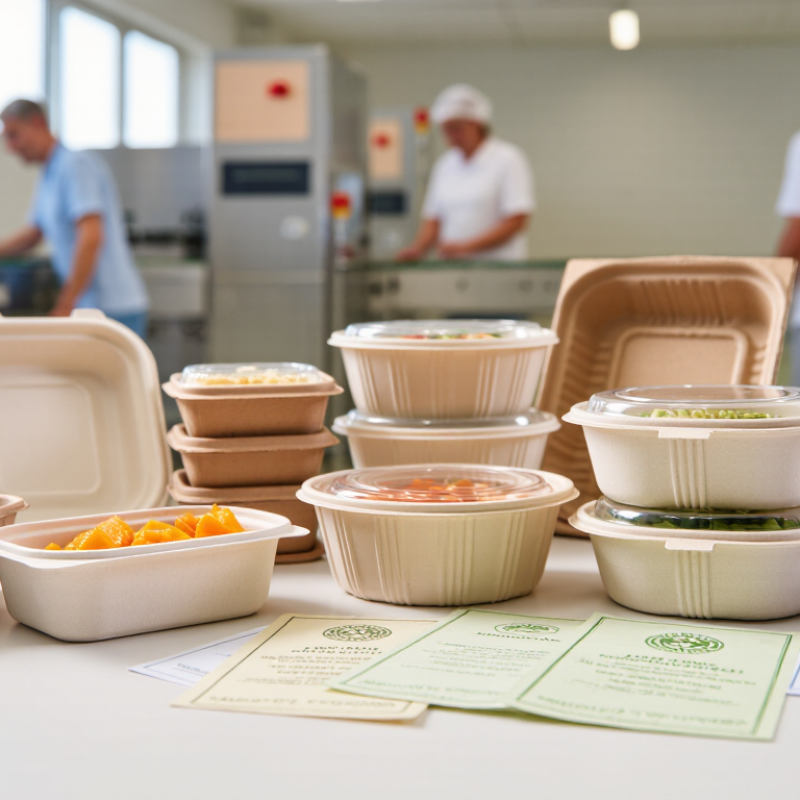
What Biodegradable Containers Are and Why They Matter
Biodegradable containers are designed to break down through natural biological activity. Microorganisms, moisture, oxygen, and temperature all influence that process. Common materials include bagasse, paper fiber, bamboo fiber, and certain plant-based polymers. The material alone does not tell the whole story. Conditions matter.
A container labeled biodegradable may need an industrial composting facility. It may not break down quickly in a backyard pile, landfill, or ocean environment. Buyers should request material specifications, food-contact test reports, and verified decomposition claims. Check the container’s performance with hot soup, oily meals, and refrigerated foods. A weak lid can create leaks before disposal even becomes relevant.
In sourcing work, I have seen buyers focus on unit price and overlook storage conditions. Moisture can soften fiber containers during long warehouse periods. Samples should remain stacked for several days before approval. Suppliers should explain production controls, packaging methods, and applicable regional requirements. Claims must be clear, measurable, and supported by documents. Marketing language can sound impressive. Evidence is more useful. A practical specification may include wall thickness, temperature range, leakage resistance, and expected disposal conditions. Even careful testing has limits, because local composting systems vary widely. That uncertainty deserves honest discussion.

Key Materials Used in China’s Biodegradable Container Manufacturing
China’s biodegradable container manufacturers commonly use sugarcane bagasse, bamboo fiber, recycled paper pulp, PLA, and compostable polymer blends. Bagasse comes from pressed sugarcane waste. Its short fibers create sturdy trays with a natural, lightly textured surface. Bamboo fiber can improve rigidity, but its performance depends on fiber length and processing control.
Molded pulp suits bowls, food trays, and protective inserts. Manufacturers shape wet pulp in heated molds, then remove moisture through controlled drying. Small temperature changes can cause curling. I have seen trial samples that looked strong but softened after holding hot soup. This is why buyers should request moisture, heat, and compression test data.
PLA and PBAT blends PLA, made from plant-based sources, gives containers a cleaner appearance and better clarity. However, it may lose strength under high heat. PBAT blends can add flexibility, while paper-based containers often need water-based coatings for leak resistance. Coatings matter more than many buyers expect. A poor coating can ruin an otherwise reliable structure.
Material selection should match the application, packing line, and disposal conditions. Ask suppliers about fiber ratios, additives, coating composition, and batch inspection records. Third-party testing can verify food-contact suitability and composting claims. No material is perfect. Better results come from testing the actual container, not only reviewing a material description.
Types of Chinese Biodegradable Container Suppliers
Chinese biodegradable container suppliers generally fall into four practical types. Integrated manufacturers compound materials, form sheets, and produce finished containers under one roof. They suit buyers needing stable volumes and traceable production. Specialized converters focus on molded fiber, bagasse, PLA, or starch-based products. Their strength is material expertise, though product ranges may be narrower.
Custom molders develop containers around a buyer’s dimensions, stacking method, and filling temperature. They are useful for food-service projects requiring a close fit. Export-oriented trading companies offer mixed catalogs and consolidated shipping. They can simplify purchasing for smaller importers, but buyers should verify the actual factory, test reports, and production ownership. A polished catalog proves little.
The market is expanding, but “biodegradable” needs careful checking. European Bioplastics and nova-Institute estimated global bioplastics production capacity at about 2.18 million tonnes in 2023, with capacity projected to reach roughly 7.43 million tonnes by 2028. The figures cover multiple applications, not containers alone. That distinction matters. Buyers should request resin or fiber specifications, food-contact documentation, migration testing, and disposal guidance. The Ellen MacArthur Foundation also emphasizes that packaging systems need reuse, recycling, or credible composting pathways, rather than material claims alone. In factory audits, check drying rooms, mold storage, sealing samples, and batch records. A cheaper quote may exclude testing or moisture control. I have found this easy to miss. Suppliers should also disclose whether additives, coatings, or mixed materials affect end-of-life performance. Ask difficult questions early. Reliability is built through samples, repeat testing, and clear shipment records.
China Best Biodegradable Container Suppliers for Global Buyers
Typical material categories offered by Chinese biodegradable container suppliers, compared by representative maximum food-use temperature.
Values are representative technical ranges for commonly available container materials. Actual performance depends on formulation, coating, wall thickness, and product design.
How Global Buyers Can Evaluate Supplier Quality and Reliability
Global buyers should assess Chinese biodegradable container suppliers through evidence, not attractive product photos. The OECD Global Plastics Outlook reports that global plastic waste reached 353 million tonnes in 2019, while only 9% was recycled. This pressure increases demand, but it also encourages vague environmental claims. Ask for full material specifications, including fiber source, additives, coating, thickness, and intended disposal conditions.
Request recent laboratory reports from an ISO/IEC 17025-accredited facility. Test results should cover food-contact safety, migration, temperature resistance, leakage, and biodegradation performance. EN 13432 and ASTM D6400 may support compostability claims, but certification only applies under defined conditions. A container that decomposes in an industrial composting facility may remain unchanged in soil or a home compost bin. The wording matters.
Reliability appears in operational details. Review three production batches, not one perfect sample. Check sealing consistency, container weight, odor, surface finish, and carton protection during transport. Ask how the supplier handles rejected units and raw-material shortages. European Bioplastics reported global bioplastics production capacity at approximately 2.18 million tonnes in 2023, showing a rapidly expanding supply base. Yet capacity figures do not prove stable quality. I have seen promising samples fail after humid storage. That weakness deserves attention. Audits, retained samples, clear inspection standards, and a small pilot order can reveal more than a long sales presentation.
| Evaluation Dimension | What Global Buyers Should Check | Reliable Supplier Benchmark | Recommended Evidence | Suggested Weight | Assessment Status |
|---|---|---|---|---|---|
| Material Composition | Confirm whether the container is made from bagasse, paper, bamboo fiber, PLA, or another specified material, and verify additives, coatings, inks, and adhesives. | The material formula is clearly documented and consistent with the buyer’s intended end use. | Material specification sheet, ingredient declaration, technical data sheet, and production batch records. | 15% | Required |
| Food-Contact Compliance | Check compliance with the destination market’s food-contact requirements, including restrictions on migration, heavy metals, chemicals, and recycled content. | Valid, product-specific test reports are available from an independent laboratory and match the supplied product. | Food-contact test report, declaration of compliance, migration testing, and product labeling documentation. | 20% | Critical |
| Compostability Claims | Distinguish between industrial compostability, home compostability, biodegradability, and disintegration. Verify that claims apply to the complete product, including coatings and accessories. | Claims are supported by recognized test methods and clearly state the required composting conditions. | Third-party certification, test standard, certificate scope, product identification, and claim language. | 15% | Critical |
| Product Performance | Evaluate leakage resistance, oil resistance, heat tolerance, stackability, dimensional stability, and suitability for hot or cold food. | Performance results meet the buyer’s technical specification under realistic storage, filling, and transport conditions. | Internal quality test records, third-party test results, sample approval report, and completed pilot-order feedback. | 15% | Required |
| Quality Management | Review incoming-material inspection, in-process controls, finished-product inspection, defect classification, and corrective-action procedures. | A documented quality-management system controls critical dimensions, appearance, strength, hygiene, and packaging. | Quality manual, inspection checklist, calibration records, nonconformance reports, and corrective-action logs. | 10% | Required |
| Production Capacity | Confirm actual monthly capacity, available production lines, tooling capability, peak-season capacity, and allocation for export orders. | Capacity figures are supported by production records and can meet the buyer’s forecast without compromising lead time. | Capacity statement, production schedule, machine list, factory audit, and recent shipment history. | 10% | Required |
| Lead-Time Reliability | Measure sample lead time, mass-production lead time, on-time shipment rate, and the supplier’s response to urgent changes. | Lead times are stated in writing, monitored against actual performance, and supported by a clear escalation process. | Purchase-order records, shipment performance reports, production milestones, and agreed service-level terms. | 8% | Required |
| Traceability | Determine whether finished goods can be traced to raw materials, production dates, operators, inspection results, and shipment batches. | Each production batch has a traceable code and can be linked to relevant quality and material records. | Batch coding procedure, traceability exercise, packing-list records, and recall procedure. | 5% | Recommended |
| Packaging and Logistics | Review export carton strength, moisture protection, pallet configuration, container utilization, labeling, and shipping-document accuracy. | Packaging protects products during international transit and is designed to minimize damage and unnecessary material use. | Packaging specification, carton test results, loading photos, pallet plan, and logistics checklist. | 5% | Recommended |
| Sustainability Transparency | Assess renewable-material content, responsible sourcing, water and energy management, waste handling, and the accuracy of environmental claims. | Environmental information is measurable, product-specific, and supported by verifiable records rather than broad marketing language. | Environmental policy, material sourcing records, energy data, waste records, life-cycle information, and audit results. | 4% | Recommended |
| Commercial Reliability | Check quotation clarity, payment terms, tooling ownership, change-control rules, warranty terms, complaint handling, and after-sales support. | Commercial terms are transparent, responsibilities are defined, and quality complaints receive documented corrective action. | Signed quotation, supply agreement, quality agreement, complaint procedure, and corrective-action response time. | 3% | Recommended |
Export, Certification, and Compliance Considerations for Buyers
When sourcing biodegradable containers from China, global buyers should verify the export pathway before comparing prices. A capable supplier should provide a commercial invoice, packing list, material specification, and accurate HS classification. Import requirements differ by destination, even for similar food containers. Confirm duties, labeling rules, and customs documentation with a qualified local broker.
Certification needs careful reading. “Biodegradable” is not a complete compliance claim. Buyers should distinguish industrially compostable, home-compostable, and merely degradable materials. For food-contact use, request migration test reports and declarations of compliance for the destination market. Compostability evidence may reference standards such as EN 13432, ASTM D6400, or ISO 17088. Reports should come from laboratories accredited to ISO/IEC 17025, with matching product codes and recent production samples.
Audit the factory, not only the paperwork. Check resin storage, forming temperatures, ink control, hygiene procedures, and batch traceability. Ask whether the tested sample matches the final container, lid, and coating. It often does not. Packaging claims must also be reviewed for environmental advertising restrictions, recycling symbols, and extended producer responsibility duties. A certificate alone cannot guarantee border clearance or legal marketing. Samples can pass testing, while later batches vary because production settings change. Buyers should retain sealed samples, approve artwork in writing, and schedule periodic testing. Small gaps here become expensive delays.
Article Source:
Get in touch with us,
We will contact you shortly!
What is the difference between Unline(Non-Epoxy Coated) or Lining(Epoxy Coated) Metal Drum?

Unline drums with internally bare metal surface is more susceptible to corrosion and rust while Lining drums are internally coated with Phenolic Epoxy Coating to provide a non-reactive barrier between the drum surface and your product, less risk of contamination. Note: Our Unline drums are coated with an anti-rust agent after washing to reduce risk of rust.
What are Unline(Non-Epoxy Coated) and Lining(Epoxy Coated) drums compatible with?

In Singapore, Recon Unline Drums are usually more costly than Recon Lining Drums. Hence, we recommend Recon Unline Drums to fill aromatics like Thinner, Xylene, Toulene& other solvents like Hexane, BA, CA, EA, MC, White spirit, etc.
We recommend the lower-priced Recon Lining Drums to fill hydrocarbons like IPA, Methanol, Ethanoland oil-based products like diesel, petrol, lubricants, engine, hydraulic, base, transmission fluid, additives, waste oil, etc.;
What is the difference between Grade A and Grade B Metal Drum ?

Grading of used drums are usually based on physical conditions like rustiness, deformities and residual contents. Grade A drums are totally free from internal rust, serious dents and are easy to clean. Grade B drums have different degrees of rust internally and aesthetically inferior compared to Grade A drums.
What content is suitable to fill in a Recon Grade A or Grade B Drum?

Recon Grade A drum is suitable to fill more costly virgin grade products while Recon Grade B drum is more suitable for recycled or waste products.
What is the difference between Open Top and Close Top Drums and their usage?

Closed top drums are for water and other liquid products. Open Top drums can be used for liquid too but are primarily for more viscous products. The Open Top (or open head with a lid) allows you to get in and out of the drum with your product easier.
What type of content are Metal or Plastic Drums suitable for?

Metal drums offer additional protection when dealing with potentially flammable substances. They provide superior fire resistance, impact protection, and longevity for storing class 1, 2, and 3 volatile chemicals.
Plastic HDPE Drums are suitable for corrosive chemicals like acids, alkaline and also water-based products.
Will there be any contamination in the reconditioned metal, plastic drums or IBC tanks?

All our reconditioned containers (metal/plastic drums, carboys, IBC tanks) are washed thoroughly with specially formulated cleaning agent, rinsed with clean water, dried, and tested for possible leakages during the recondition process. Stringent quality inspection is being conducted 100% on every reconditioned product before they are qualified for sale & delivery.
What is the drum gauge(thickness) and weight for reconditioned metal drums?

Reconditioned metal drums gauge can be 0.9mm to 1.0mm all round. Their weight can vary from 16 to 18kg.
Do you sell New Packaging Products too?

Yes, we are also a distributor for new pallets, metal drums, plastic drums, carboys, IBCs and stainless-steel tanks.
What additional services do you provide apart from selling reconditioned and new containers.?

We are an NEA licensed toxic industrial waste collector, who can collect and dispose of used toxic waste containers in Singapore.
Do you offer labelling and silkscreen on the containers ?

We can provide labelling and silk-screening on the containers.
Are you able to ship overseas ?

Yes, we can arrange export our products to any country in the world.
Leading the Way
to Carbon Neutrality