
What Are the Best Types of Plastic Tarpaulin in 2026?
Plastic Tarpaulin is often judged by thickness alone, but that number rarely tells the whole story. In 2026, buyers will still need to weigh fabric type, coating, reinforcement, and the conditions a cover must face. A tarp stretched across a sunny garden shed has different demands from one covering equipment through repeated rain and wind.
The useful question is practical: where will the sheet sit, and how often will it move? Polyethylene tarps are commonly chosen for lightweight, general-purpose coverage. PVC options are typically heavier, while woven polypropylene products may suit applications where low weight matters. Construction varies by manufacturer, so check product specifications rather than assuming two tarps with similar labels perform alike. Look closely at edge hems, grommet spacing, and reinforced corners; these details become noticeable when a tarp is tied down in gusty weather.
Small details matter.
A careful comparison should also consider UV exposure, water resistance, tear strength, and storage needs. There is no single best type for every buyer. The right choice depends on the job, expected service life, and handling conditions. A useful editorial principle is: “Choose for exposure, construction, and handling—not price alone.” No named expert quotation was supplied or independently verified for this introduction, so that line is not attributed to a real person. A published expert quote should be checked against its original source. That caution may feel less polished, but accuracy matters when product advice can shape purchasing decisions.
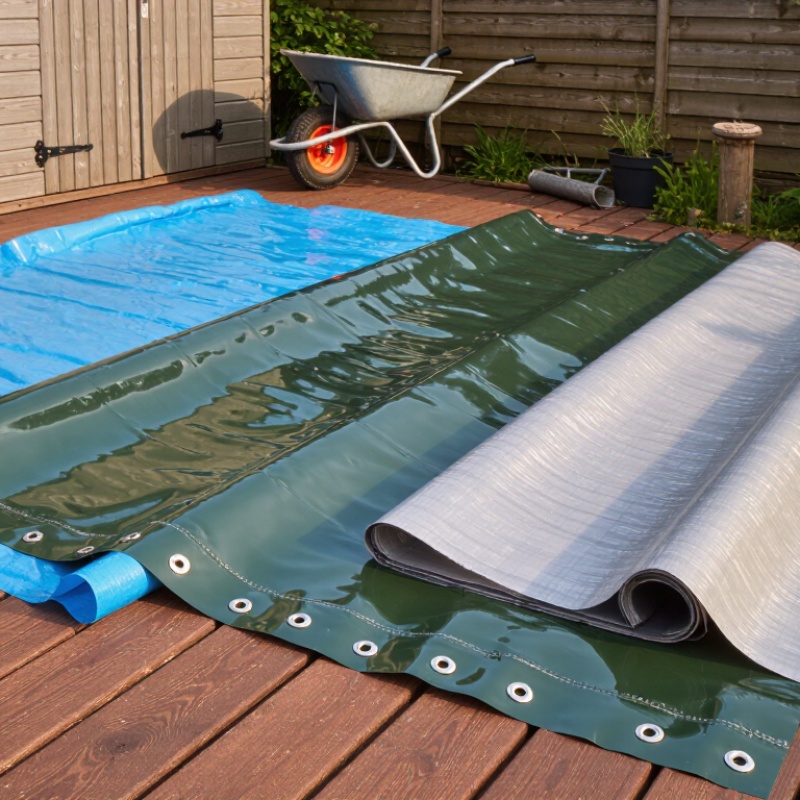
What Materials and Construction Methods Define Plastic Tarpaulins?
Plastic tarpaulins are commonly made from polyethylene or polyvinyl chloride, and each suits different working conditions.
Polyethylene tarps usually use woven plastic strips with a thin laminated coating. They are light, easy to fold, and practical for covering garden equipment or building materials. PVC tarps are generally heavier, with a coated fabric structure that can resist abrasion and repeated handling. Neither material is best for every job.
Construction affects performance as much as the base plastic. A woven scrim—the grid of reinforcing threads inside many tarps—helps resist tearing when wind pulls at the surface. Lamination or coating seals the weave against water.
Look closely at hems, corners, and eyelets; these areas often take the greatest strain. Details matter. Heat-welded seams can create a continuous bond, while poorly finished edges may fray or leak over time.
For outdoor use, check whether the tarp has UV protection, since prolonged sunlight can make some plastics brittle. Cold weather matters too: a stiff tarp may crack when folded, even if it feels strong in warm conditions. Not always. Match thickness and reinforcement to the load, exposure, and frequency of use. A heavier tarp can last longer under rough handling, but it is harder to position and store. Specifications help, though real service life still depends on installation and care.

Which Performance Features Matter When Comparing Tarpaulins?
When comparing plastic tarpaulins, look beyond thickness. PlasticsEurope’s Plastics—the Fast Facts 2023 reported 400.3 million tonnes of global plastics production in 2022, but material volume alone says little about a sheet’s outdoor life. Compare polyethylene and PVC by weight, flexibility, coating, and intended exposure. Ask for measured tensile and tear strength, seam strength, and water resistance—not just “heavy-duty” claims.
ASTM D751 provides test methods for coated fabrics, while ISO 4892-3 covers accelerated UV exposure. Results matter more than a sales adjective.
UV stability is critical if a tarp will sit over a boat, lumber, or garden equipment through summer. Check whether the stated UV protection has a test duration and method; accelerated aging helps compare samples, but does not perfectly predict years outdoors. Also inspect hems and grommets. A reinforced corner can still fail if stitching or welds are weak. No single feature wins. Fit and installation matter, too.
What Are the Main Types of Plastic Tarpaulin in 2026?
Plastic tarpaulins mainly use polyethylene (PE), polyvinyl chloride (PVC), or polypropylene (PP). Woven PE tarps typically have a high-density polyethylene scrim with a low-density polyethylene coating. They are light, easy to fold, and suited to covering equipment, building materials, or garden supplies. Laminated PE versions are often more economical, but thin ones can tear around eyelets in strong wind.
PVC-coated polyester tarps have a woven polyester base with PVC on both sides. They are heavier and generally resist abrasion better, making them useful for repeated outdoor or transport use. PP tarps are another woven option, often laminated for water resistance; check the coating, not just the fabric name. Small detail, big difference. GSM indicates fabric weight, but does not prove strength by itself. Look for reinforced hems, secure eyelets, and stated UV resistance.
For context, the OECD’s Global Plastics Outlook (2022) estimates that global plastic production reached 460 million tonnes in 2019, while plastic waste reached 353 million tonnes. Those figures cover plastics broadly, not tarpaulins specifically. Still, they make service life and end-of-use handling worth considering. A thicker tarp may last longer, but it can also be harder to handle and store. No single type suits every job.
What Are the Best Types of Plastic Tarpaulin in 2026? — Main Types Compared
| Tarpaulin type | Typical construction | Indicative weight or thickness | Key characteristics | Common applications | Main considerations |
|---|---|---|---|---|---|
| PE woven tarpaulin | Woven high-density polyethylene (HDPE) fabric, usually laminated with low-density polyethylene (LDPE) on one or both sides | Commonly about 70–250 g/m²; heavier grades are available | Lightweight, flexible, water-resistant, and generally economical; may include reinforced hems and eyelets | Temporary outdoor covers, garden use, construction materials, and general storage | UV resistance and service life vary by formulation and thickness; seams and edges can be the first areas to fail |
| PVC-coated polyester tarpaulin | Polyester reinforcement fabric coated with polyvinyl chloride (PVC) | Often about 300–900 g/m², depending on the intended duty | Strong, flexible, waterproof, and suitable for heat-welded seams; heavier grades can resist abrasion and repeated handling | Truck and trailer covers, industrial curtains, shelters, and reusable heavy-duty covers | Heavier and less compact than lightweight PE; cold-weather flexibility, fire performance, and chemical resistance depend on the specification |
| PP woven tarpaulin | Woven polypropylene fabric, sometimes coated or laminated to improve water resistance | Varies by weave and coating; check the product’s stated g/m² | Lightweight and easy to handle; performance depends strongly on coating, weave density, and UV stabilizers | Packaging, temporary covers, agricultural use, and light-duty protection | Uncoated woven fabric is not fully waterproof; confirm coating and outdoor-weathering suitability before use |
| Clear PVC tarpaulin | Transparent or translucent flexible PVC sheet; some versions have reinforced edges or embedded fabric | Typically specified by thickness, often around 0.15–0.50 mm for flexible sheet products | Allows light through while providing a barrier against rain and wind; can be cut and sealed for custom covers | Shelter windows, patio enclosures, greenhouse side panels, and equipment covers requiring visibility | May scratch, crease, or become less flexible over time; clarity and low-temperature performance vary by grade |
| Reinforced PE tarpaulin | PE film or laminated fabric with reinforcing mesh or scrim between layers | Varies widely; compare stated weight, mesh construction, and finished thickness | Reinforcement can improve tear resistance and help limit damage from a small puncture spreading | Temporary roofing, greenhouse covers, construction enclosures, and larger outdoor covers | Reinforcement does not make the cover puncture-proof; installation tension and edge reinforcement still matter |
Note: Weight, thickness, UV resistance, and service life vary by construction and manufacturer. For outdoor or load-bearing use, check the product specification and secure the tarp with suitable supports and fixings.
How Do Different Tarpaulin Types Suit Specific Applications?
Lightweight polyethylene tarpaulins suit short-term ground covers, garden equipment, and building materials. Their woven core resists everyday tearing, while the laminated surface sheds rain. Choose reinforced edges and sealed eyelets where ropes may pull hard. For dusty, sheltered storage, a lighter sheet may be enough. In exposed sites, thin material can disappoint.
For trucks, machinery, or repeated outdoor use, consider PVC-coated polyester. It is heavier and easier to clean, with a tougher surface for abrasion and frequent handling. Check the stated tear strength, coating weight, and temperature range rather than judging by thickness alone. ASTM D751 describes tests for coated fabrics, including tensile strength, tear resistance, and coating adhesion. These measurements help compare construction, but do not guarantee a particular service life.
Mesh tarpaulins are useful over loads or plants when airflow matters more than full rain protection. They reduce direct sun and let wind pass through, though rain can still penetrate. The WHO, WMO, and UNEP Global Solar UV Index guide classifies UVI values of 8–10 as very high. That is a useful exposure warning, not a tarp lifespan estimate. I would match UV-stabilized material to local sun exposure, then inspect seams and corners after storms; those details often fail first.
How Can You Choose the Best Plastic Tarpaulin for Your Needs?
Choosing a plastic tarpaulin starts with the job, not the color or lowest price. For a garden pile covered through one rainy week, a lightweight polyethylene sheet may be enough. For a trailer exposed to wind and sun, look for reinforced edges, strong seams, and stated UV resistance. A coated woven tarp is usually tougher, but can be heavier and less flexible in cold weather. Check the product’s weight in grams per square metre, yet do not treat that number as a strength guarantee. Fabric weave, coating, and seam construction matter too.
Ask how long the tarp must last and what it will face: standing water, sharp corners, repeated folding, or daily movement. A waterproof claim does not automatically mean the seams stay dry. Inspect sample stitching and grommet spacing, and leave room to secure the sheet without pulling hard on one point. Plastics Europe’s 2024 report, Plastics—The Fast Facts, estimates global plastics production at 413.8 million tonnes in 2023. That scale makes choosing a reusable, repairable cover sensible where conditions allow. Still, no specification captures every site.
I would not choose by GSM alone; it is an easy shortcut, and often the wrong one.
Article Source:
Get in touch with us,
We will contact you shortly!
What is the difference between Unline(Non-Epoxy Coated) or Lining(Epoxy Coated) Metal Drum?

Unline drums with internally bare metal surface is more susceptible to corrosion and rust while Lining drums are internally coated with Phenolic Epoxy Coating to provide a non-reactive barrier between the drum surface and your product, less risk of contamination. Note: Our Unline drums are coated with an anti-rust agent after washing to reduce risk of rust.
What are Unline(Non-Epoxy Coated) and Lining(Epoxy Coated) drums compatible with?

In Singapore, Recon Unline Drums are usually more costly than Recon Lining Drums. Hence, we recommend Recon Unline Drums to fill aromatics like Thinner, Xylene, Toulene& other solvents like Hexane, BA, CA, EA, MC, White spirit, etc.
We recommend the lower-priced Recon Lining Drums to fill hydrocarbons like IPA, Methanol, Ethanoland oil-based products like diesel, petrol, lubricants, engine, hydraulic, base, transmission fluid, additives, waste oil, etc.;
What is the difference between Grade A and Grade B Metal Drum ?

Grading of used drums are usually based on physical conditions like rustiness, deformities and residual contents. Grade A drums are totally free from internal rust, serious dents and are easy to clean. Grade B drums have different degrees of rust internally and aesthetically inferior compared to Grade A drums.
What content is suitable to fill in a Recon Grade A or Grade B Drum?

Recon Grade A drum is suitable to fill more costly virgin grade products while Recon Grade B drum is more suitable for recycled or waste products.
What is the difference between Open Top and Close Top Drums and their usage?

Closed top drums are for water and other liquid products. Open Top drums can be used for liquid too but are primarily for more viscous products. The Open Top (or open head with a lid) allows you to get in and out of the drum with your product easier.
What type of content are Metal or Plastic Drums suitable for?

Metal drums offer additional protection when dealing with potentially flammable substances. They provide superior fire resistance, impact protection, and longevity for storing class 1, 2, and 3 volatile chemicals.
Plastic HDPE Drums are suitable for corrosive chemicals like acids, alkaline and also water-based products.
Will there be any contamination in the reconditioned metal, plastic drums or IBC tanks?

All our reconditioned containers (metal/plastic drums, carboys, IBC tanks) are washed thoroughly with specially formulated cleaning agent, rinsed with clean water, dried, and tested for possible leakages during the recondition process. Stringent quality inspection is being conducted 100% on every reconditioned product before they are qualified for sale & delivery.
What is the drum gauge(thickness) and weight for reconditioned metal drums?

Reconditioned metal drums gauge can be 0.9mm to 1.0mm all round. Their weight can vary from 16 to 18kg.
Do you sell New Packaging Products too?

Yes, we are also a distributor for new pallets, metal drums, plastic drums, carboys, IBCs and stainless-steel tanks.
What additional services do you provide apart from selling reconditioned and new containers.?

We are an NEA licensed toxic industrial waste collector, who can collect and dispose of used toxic waste containers in Singapore.
Do you offer labelling and silkscreen on the containers ?

We can provide labelling and silk-screening on the containers.
Are you able to ship overseas ?

Yes, we can arrange export our products to any country in the world.
Leading the Way
to Carbon Neutrality








