Where to Buy the Best Steel Drums in China?
Choosing where to buy the best steel drums in China starts with a practical question: can a supplier prove consistent quality, not just offer a low price? China’s manufacturing base is substantial. The World Steel Association reported that the country produced about 1,005 million tonnes of crude steel in 2024. That figure describes upstream capacity, not steel-drum quality. Not by itself.
For buyers, the details are closer to the shop floor. A reliable manufacturer should state drum capacity, steel thickness, closure type, coating, and intended contents clearly. Ask for current product specifications and inspection records. Check weld seams, lid fit, and interior coating samples where relevant. A neat catalogue is useful, but it cannot replace evidence from the actual production line. This part is sometimes overlooked.
Trade data can also help frame supplier research. The United Nations Comtrade database records international trade in metal containers under HS code 7310, a category that includes several kinds of containers rather than steel drums alone. Use it as broad market context, not as a direct ranking of Chinese drum makers.
This guide will help readers compare manufacturers, trading companies, and sourcing platforms in China. It will focus on verifiable credentials, product consistency, communication, and after-sales support. Requesting a sample and confirming specifications in writing may take extra time. Still, that small step can reveal problems a price sheet cannot. No single supplier suits every buyer; the best choice depends on the drum’s application, required capacity, and delivery needs.
Understanding Steel Drums and Key Buying Requirements
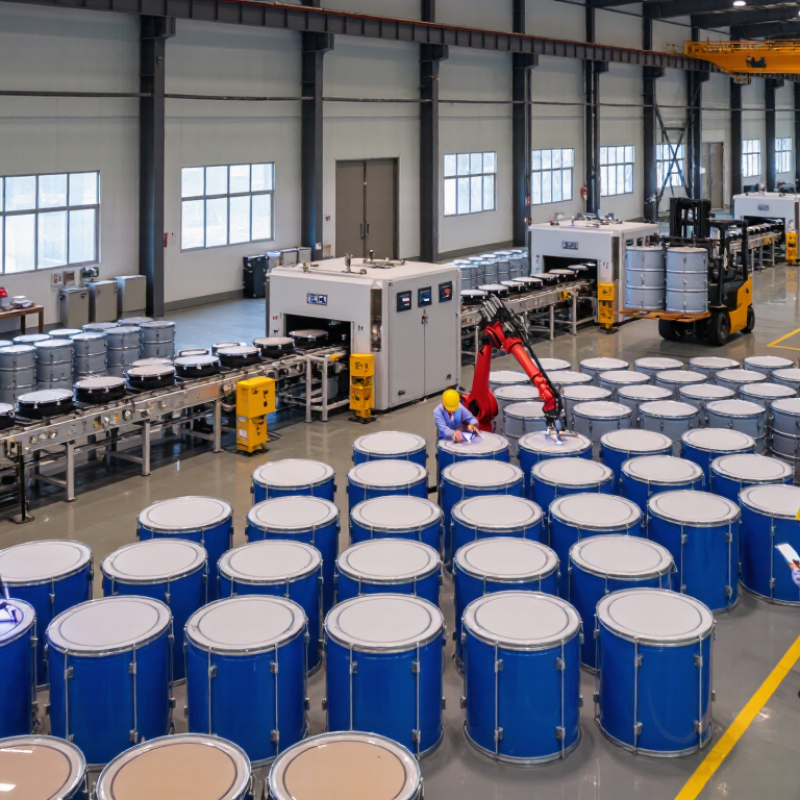
Steel drums are rigid containers commonly made from carbon steel, with sizes and closures suited to different products. A tight head has fixed ends and is often chosen for liquids; an open head has a removable lid for solids or thicker contents. The right choice depends on the material being packed, filling method, storage conditions, and handling equipment. Small details matter.
Before requesting a quote, specify capacity, steel thickness, inner and outer coating, closure type, and required surface finish. Ask how the drum is tested for leaks and dimensional consistency, and request inspection records for the production batch. For transport, confirm that the packaging meets the requirements that apply to the product and route.
A sample can reveal coating flaws, rough seams, or a lid that does not seat evenly. It is easy to overvalue a polished sample, though; repeatability across an order matters more. Not always obvious. Compare samples with written specifications, and clarify tolerance ranges before production.
A low unit price may not reflect freight, protective packaging, or the cost of rejected drums. A careful buyer checks the full delivery plan, not just the first quote.
Major Steel Drum Manufacturing Regions in China
China’s steel drum production is concentrated across several industrial belts, not one single city. The Yangtze River Delta, including parts of Jiangsu and Zhejiang, has dense metalworking networks, reliable transport links, and access to major ports. Buyers may find factories producing tight-head and open-head drums, alongside services for coatings, printing, and pallet packing. These connections can simplify sourcing, but they do not guarantee consistent workmanship.
The Bohai Rim, including Shandong and Hebei, offers established steel-processing and logistics infrastructure. Guangdong and other southern manufacturing centers may suit buyers who value export coordination and port access. Details matter. When comparing regions, request production photos, material-thickness records, weld and leak-test procedures, closure samples, and recent inspection reports. Confirm that tests cover your exact drum size and coating. A factory’s location is only a starting point. It is easy to assume coastal suppliers are automatically better, but capacity, quality control, and communication vary within every region. An independent pre-shipment inspection can reveal problems that a polished catalogue may miss.
Where to Buy the Best Steel Drums in China? — Major Steel Drum Manufacturing Regions in China
Regional sourcing guide. The areas below are industrial and logistics regions to consider, not a guarantee that every locality has steel drum manufacturers. Confirm product specifications, production capacity, and certifications directly with prospective suppliers.
| Region | Representative Industrial Areas | Potential Sourcing Fit | Logistics Considerations | Buyer Checks |
|---|---|---|---|---|
| Jiangsu | Yangtze River Delta, including areas around Suzhou, Wuxi, and Nantong | Worth comparing for industrial packaging and access to a broad manufacturing supply chain. | Connected to the Yangtze River shipping network and major East China export gateways. | Check drum dimensions, steel thickness, lining options, and delivery terms for the intended destination. |
| Zhejiang | Ningbo, Taizhou, and other manufacturing areas in the province | A practical region to investigate when export shipping and supplier access in the Yangtze River Delta matter. | Ningbo is a major seaport; confirm the actual factory location and inland transport costs. | Request packing details, container-loading plans, and samples or inspection records where appropriate. |
| Shandong | Qingdao, Weifang, and other industrial areas across the province | Consider for buyers comparing suppliers serving manufacturing and chemical-industry customers. | Qingdao provides an international port option; inland distance varies across the province. | Verify compatibility between the drum’s coating or lining and the material to be packaged. |
| Guangdong | Pearl River Delta, including areas around Guangzhou, Foshan, and Dongguan | Useful to explore when sourcing alongside the Pearl River Delta’s diverse manufacturing and export supply chains. | Access to major South China port facilities; compare port, trucking, and consolidation costs. | Confirm whether the supplier makes the drums or trades them, and clarify lead time and order quantity. |
| Hebei | Industrial areas within the Beijing–Tianjin–Hebei region, including areas around Tangshan and Cangzhou | A region to include in a wider supplier search, particularly when comparing northern China production options. | Can connect to northern transport corridors and nearby Tianjin port; confirm routing from the factory. | Compare delivered cost, transport distance, corrosion protection, and quality-control procedures. |
Before placing an order: Specify capacity, drum type (open-head or tight-head), closure, material and thickness, internal coating, test requirements, applicable UN performance certification for regulated dangerous goods, quantity, and destination. Certification and transport rules depend on the product and intended use; request current documentation and verify it independently.
Where to Find Steel Drum Suppliers in China
China’s steel drum suppliers are easiest to shortlist through industrial directories, packaging trade fairs, and regional manufacturing associations. Ask whether each contact operates its own production line or brokers orders. Start with proof. Request a current factory video, business registration details, and a sample showing the seam, lid, and interior coating. These details reveal more than a polished catalog.
World Steel Association’s World Steel in Figures 2025 reports 1,005.1 million tonnes of crude steel production in China in 2024. That was roughly 53% of global output. This scale supports a broad supplier base, but it does not certify drum quality. Then check the metal. Compare quoted thickness, capacity, weld consistency, coating coverage, and closure dimensions against your written specification. Ask for documented leak or pressure-test results where relevant.
Before a large order, inspect a pre-production sample and confirm how defects are handled. Clarify minimum order quantity, tooling charges, lead time, and export packing in writing. An independent inspection can catch thin spots or rough seams before shipment. Directories are useful starting points, not endorsements. A sample may still differ from the production batch.
How to Evaluate Manufacturers and Product Quality
Where to Buy the Best Steel Drums in China?
How to Evaluate Manufacturers and Product Quality
China’s production scale is substantial: World Steel Association’s World Steel in Figures 2024 reports 1,005.1 million tonnes of crude steel output in 2023, about 53.3% of the global total. That figure describes the steel industry, not the quality of any drum maker. Scale is not proof. Ask manufacturers for traceable material certificates, drum drawings, and inspection records tied to the exact production site. Then compare the stated steel thickness with measurements from a sample, including the body, ends, and seams.
Inspect the details. Look for even welds, clean closures, consistent coatings, and no sharp edges or visible dents. Ask how the factory checks leaks and maintains test equipment, and request recent batch records rather than a polished presentation. Ask for evidence. Match the drum’s design and lining to the material it will hold, and confirm the manufacturer can repeat the same specifications across orders. A factory audit or independent pre-shipment inspection can help verify what documents alone cannot. One easy mistake is judging only by price and sample quality; production batches may differ. I would still want clear answers on rejected drums and corrective actions before placing a large order.
Ordering, Shipping, and Importing Steel Drums from China
Before placing an order, define the drum’s capacity, steel thickness, coating, closure type, and intended use. Ask the supplier for a written specification sheet and recent inspection records. Confirm whether the quoted price includes export packing and loading. Request clear photos of the drum seams, lid, and pallet condition. Small details matter.
For shipping, compare the full landed cost, not just the unit price. Sea freight may be economical for large orders, but port charges and inland delivery can change the calculation. Agree on the shipping term, shipment date, and who handles each transport stage. Ask how drums will be secured inside the container and protected from moisture. A few loading photos can help identify problems before the container leaves.
Prepare the commercial invoice, packing list, and bill of lading details with your customs broker before dispatch. Check the correct tariff classification, duties, and import requirements for your destination; these can vary by country and drum specification. If a drum needs a particular certification, verify the paperwork independently rather than relying on a sales claim. A weak point in many plans is leaving these checks until the cargo arrives. I would build in extra time, because one missing document can delay delivery.
Where to Buy Steel Drums in China? Compare Common Capacities
These illustrative nominal capacities—60 L, 120 L, and 200 L—are common steel-drum options, not a complete specification. When requesting quotes from Chinese suppliers, confirm actual capacity, dimensions, material, closures, and any required UN certification. Check packing and container-loading details before arranging shipping or import.
Related Posts
-
How to Choose the Right Steel Barrels for Global Shipping?
-
2025 Guide: How to Choose the Best Open Top Steel Drums for Your Needs
-
How to Choose the Best Steel Drums for Your Storage and Shipping Needs
-
Top Steel Drums Benefits Uses and Maintenance Tips?
-
Unveiling the Secrets of Drum Barrels: Essential Guide for Eco-Friendly Storage Solutions
-
How to Choose the Right Open Top Steel Drums for Storage?

Get in touch with us,
We will contact you shortly!
What is the difference between Unline(Non-Epoxy Coated) or Lining(Epoxy Coated) Metal Drum?

Unline drums with internally bare metal surface is more susceptible to corrosion and rust while Lining drums are internally coated with Phenolic Epoxy Coating to provide a non-reactive barrier between the drum surface and your product, less risk of contamination. Note: Our Unline drums are coated with an anti-rust agent after washing to reduce risk of rust.
What are Unline(Non-Epoxy Coated) and Lining(Epoxy Coated) drums compatible with?

In Singapore, Recon Unline Drums are usually more costly than Recon Lining Drums. Hence, we recommend Recon Unline Drums to fill aromatics like Thinner, Xylene, Toulene& other solvents like Hexane, BA, CA, EA, MC, White spirit, etc.
We recommend the lower-priced Recon Lining Drums to fill hydrocarbons like IPA, Methanol, Ethanoland oil-based products like diesel, petrol, lubricants, engine, hydraulic, base, transmission fluid, additives, waste oil, etc.;
What is the difference between Grade A and Grade B Metal Drum ?

Grading of used drums are usually based on physical conditions like rustiness, deformities and residual contents. Grade A drums are totally free from internal rust, serious dents and are easy to clean. Grade B drums have different degrees of rust internally and aesthetically inferior compared to Grade A drums.
What content is suitable to fill in a Recon Grade A or Grade B Drum?

Recon Grade A drum is suitable to fill more costly virgin grade products while Recon Grade B drum is more suitable for recycled or waste products.
What is the difference between Open Top and Close Top Drums and their usage?

Closed top drums are for water and other liquid products. Open Top drums can be used for liquid too but are primarily for more viscous products. The Open Top (or open head with a lid) allows you to get in and out of the drum with your product easier.
What type of content are Metal or Plastic Drums suitable for?

Metal drums offer additional protection when dealing with potentially flammable substances. They provide superior fire resistance, impact protection, and longevity for storing class 1, 2, and 3 volatile chemicals.
Plastic HDPE Drums are suitable for corrosive chemicals like acids, alkaline and also water-based products.
Will there be any contamination in the reconditioned metal, plastic drums or IBC tanks?

All our reconditioned containers (metal/plastic drums, carboys, IBC tanks) are washed thoroughly with specially formulated cleaning agent, rinsed with clean water, dried, and tested for possible leakages during the recondition process. Stringent quality inspection is being conducted 100% on every reconditioned product before they are qualified for sale & delivery.
What is the drum gauge(thickness) and weight for reconditioned metal drums?

Reconditioned metal drums gauge can be 0.9mm to 1.0mm all round. Their weight can vary from 16 to 18kg.
Do you sell New Packaging Products too?

Yes, we are also a distributor for new pallets, metal drums, plastic drums, carboys, IBCs and stainless-steel tanks.
What additional services do you provide apart from selling reconditioned and new containers.?

We are an NEA licensed toxic industrial waste collector, who can collect and dispose of used toxic waste containers in Singapore.
Do you offer labelling and silkscreen on the containers ?

We can provide labelling and silk-screening on the containers.
Are you able to ship overseas ?

Yes, we can arrange export our products to any country in the world.
Leading the Way
to Carbon Neutrality