10 Best Electronic Pouring Sealants for Buyers
Electronic Pouring Sealants help protect circuit boards, connectors, sensors, and other components from moisture, dust, vibration, and chemical exposure. The right product depends on the assembly, not just its advertised strength. Buyers should compare material compatibility, viscosity, working time, cure conditions, hardness, and thermal performance. A sealant that flows smoothly into a narrow gap may be difficult to remove later. That trade-off matters.
This guide reviews ten options and explains what their specifications mean in practical terms. It considers application method, packaging, curing requirements, and the clarity of each manufacturer’s technical documentation. Check the product data sheet before purchase, especially for temperature limits and compatibility with plastics, metals, or existing coatings. When possible, test a small sample on representative parts. Small tests help.
No single formula suits every design. A flexible compound may absorb movement, while a rigid one may better support certain assemblies; actual performance depends on the product and application. Rankings can simplify a crowded market, but they cannot replace careful evaluation of your own operating conditions. Even a promising choice may take longer to apply than expected. Use the comparisons as a starting point, then confirm the details with reliable product documentation and your assembly requirements.
Define Electronic Pouring Sealants and Their Role in Assembly Protection
10 Best Electronic Pouring Sealants for Buyers
Define Electronic Pouring Sealants and Their Role in Assembly Protection
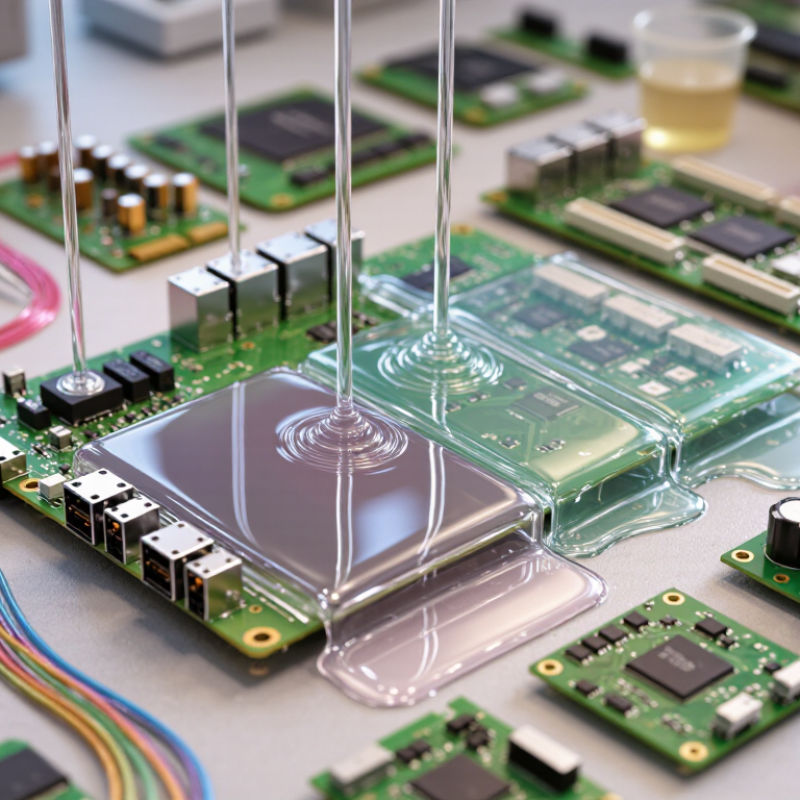
Electronic pouring sealants are flowable materials applied around or over electronic components. After curing, they form a protective layer or fill gaps inside an assembly. Common chemistries include silicone, polyurethane, and epoxy, each with different flexibility, temperature tolerance, and chemical resistance. The term is not perfectly standardized, so product descriptions deserve a close read.
Their role is to help shield circuits from moisture, dust, vibration, and accidental contact. A cured layer around a small sensor board, for example, can limit exposure to damp air and moving parts. Some formulations provide electrical insulation or conduct heat, but these properties depend on verified product specifications. Protection is not automatic.
Good results start before pouring. Surfaces should be clean and dry, and connectors or service points may need masking. Buyers should check cure time, viscosity, working temperature, and compatibility with nearby plastics. A compound that cures too rigidly can stress delicate components during temperature changes. Small test pours help reveal trapped bubbles or poor adhesion. They are easy to skip, and that can be a mistake.
10 Best Electronic Pouring Sealants for Buyers: Types and Assembly Protection
Electronic pouring sealants, also called potting compounds, are materials poured around electronic components and cured to help protect them from moisture, dust, vibration, and electrical contamination.
The chart compares indicative operating-temperature ranges for common potting-material families. Actual limits vary by formulation and application; check the material datasheet and assembly requirements before selecting a sealant.
Compare 10 Sealant Types by Viscosity, Cure Time, and Service Temperature
Electronic potting compounds differ sharply in flow, cure schedule, and heat tolerance. The ranges below are representative published technical-data-sheet values, not guaranteed ratings. ASTM D2196 specifies rotational methods for measuring non-Newtonian viscosity; compare readings only at stated temperatures and spindle settings.
Neutral-cure RTV silicone
1,000–100,000 mPa·s; 24–72 hours; roughly −50 to 200°C.
Two-part addition-cure silicone
500–50,000 mPa·s; 1–24 hours; about −50 to 200°C.
General epoxy
1,000–100,000 mPa·s; 2–24 hours; around −40 to 150°C.
Flexible epoxy
2,000–80,000 mPa·s; 4–24 hours; around −40 to 120°C.
Polyurethane
500–50,000 mPa·s; 2–24 hours; around −40 to 120°C. Moisture-cure polyurethane may skin over before its center sets.
UV-curable acrylate
100–10,000 mPa·s; seconds under suitable light; about −40 to 120°C.
Acrylic
500–20,000 mPa·s; minutes to hours; around −40 to 120°C.
Thermally conductive silicone
5,000–100,000 mPa·s; 1–24 hours; roughly −50 to 200°C.
Thermally conductive epoxy
5,000–100,000 mPa·s; 2–24 hours; around −40 to 150°C.
Flame-retardant silicone
2,000–100,000 mPa·s; 1–24 hours; roughly −50 to 200°C.
IEC 60068-2-14 provides temperature-change testing guidance, but a service-temperature claim alone does not prove cycling endurance. Test a small assembly: trapped air and shadowed regions can undermine an otherwise tidy pour.
Assess Hardness with ASTM D2240 and Thermal Resistance with ASTM D5470
For electronic pouring sealants, hardness and heat transfer answer different questions. ASTM D2240 measures indentation hardness using a specified durometer scale, such as Shore A or Shore D. Match the scale to the cured material; a reading without its scale is incomplete. A harder sealant may support components firmly, but hardness alone does not prove impact resistance or long-term reliability.
ASTM D5470 evaluates thermal transmission through a specimen under controlled conditions. Results can help compare thermal resistance, but thickness, test pressure, temperature, and contact between the specimen and test plates all matter. Ask for test conditions alongside the reported value. A thin sample may appear more conductive than a thick poured section. Real assemblies can behave differently. That detail is easy to overlook.
Tips: Compare D2240 results only when the scale and cure conditions match. For D5470, check specimen thickness and test temperature. Then test a representative cured sample. Small setup differences can change the result.
10 Best Electronic Pouring Sealants for Buyers — Assess Hardness with ASTM D2240 and Thermal Resistance with ASTM D5470 | No. | Sealant Material Type | Indicative Hardness Range
(ASTM D2240) | Indicative Thermal Conductivity
(ASTM D5470, W/m·K) | Estimated Thermal Resistance at 1 mm
(m²·K/W) | Typical Characteristics | Common Electronic Uses |
| 1 | General-purpose two-part silicone potting compound | 20–60 Shore A | 0.2–0.6 | 0.00167–0.00500 | Flexible after cure; useful where vibration accommodation and a broad service-temperature capability are priorities. | Sensors, connectors, and general electronic assemblies |
| 2 | Thermally conductive silicone potting compound | 40–75 Shore A | 1.0–3.0 | 0.00033–0.00100 | Combines elastomeric compliance with improved heat transfer compared with unfilled silicone. | Power modules, LED assemblies, and heat-generating components |
| 3 | Soft silicone gel encapsulant | 10–50 Shore 00 | 0.2–0.8 | 0.00125–0.00500 | Very soft and compliant; can reduce mechanical stress on delicate components. | Optical sensors, wire bonds, and sensitive circuit assemblies |
| 4 | Higher-hardness silicone potting compound | 60–85 Shore A | 0.3–0.8 | 0.00125–0.00333 | More shape-retaining than soft silicone while retaining some elastomeric flexibility. | Connectors and assemblies requiring added physical support |
| 5 | Flexible polyurethane potting compound | 30–80 Shore A | 0.15–0.5 | 0.00200–0.00667 | Available in flexible formulations; moisture resistance and temperature limits depend on formulation. | Coils, transformers, and general-purpose electronic encapsulation |
| 6 | Thermally conductive polyurethane potting compound | 60–90 Shore A | 0.8–2.5 | 0.00040–0.00125 | Filled formulation designed to improve heat transfer while retaining more compliance than many rigid epoxies. | Power supplies, control units, and thermal management assemblies |
| 7 | General-purpose rigid epoxy potting compound | 70–90 Shore D | 0.2–0.7 | 0.00143–0.00500 | Rigid, adherent encapsulation; assess cure shrinkage and component stress for the specific application. | Transformers, sensors, and assemblies needing rigid encapsulation |
| 8 | Thermally conductive epoxy potting compound | 75–90 Shore D | 1.0–3.0 | 0.00033–0.00100 | Thermally filled, rigid material; thermal performance and processability depend on filler loading. | Power electronics and components needing a heat-transfer path |
| 9 | Highly filled alumina-based epoxy potting compound | 80–95 Shore D | 1.5–4.0 | 0.00025–0.00067 | High filler loading can increase thermal conductivity and viscosity; check that the compound can fill the assembly. | Heat-generating modules and larger electronic assemblies |
| 10 | Lower-modulus epoxy potting compound | 60–80 Shore D | 0.3–0.9 | 0.00111–0.00333 | Designed to be less rigid than conventional epoxy grades; confirm modulus and thermal cycling performance from the supplier. | Assemblies with mixed materials or stress-sensitive components |
Selection note: Values are indicative screening ranges for material classes, not certified results for a particular product. ASTM D2240 hardness depends on the specified Shore scale, specimen, and test conditions. ASTM D5470 is used to measure thermal transmission properties; the estimated resistance ranges above are calculated for a uniform 1 mm layer using R = thickness ÷ thermal conductivity. Actual assembly resistance also depends on bond-line thickness, contact resistance, voids, and test conditions. Verify current test data and operating limits with the material supplier.
Verify Fire Performance Using UL 94 and IEC 60695 Test Ratings
10 Best Electronic Pouring Sealants for Buyers
Electronic pouring sealants protect components from moisture, dust, and vibration, but fire performance also matters. Check test evidence before comparing products. UL 94 classifies how materials burn under specified conditions. Its V-0 rating means a tested specimen stopped burning within set limits; it does not mean the sealant is fireproof. Results can depend on specimen thickness and test orientation. A rating at one thickness may not apply to a thinner layer inside your enclosure.
IEC 60695 is a series of fire-hazard test methods, not one universal sealant rating. Relevant reports may include glow-wire tests, which examine ignition or flame spread under defined conditions. Match the test to the equipment’s likely heat exposure. Ask for a report covering the exact cured formulation, thickness, and relevant production specification.
Not interchangeable. A UL 94 result and an IEC 60695 result answer different questions.
Tips: Check the full test report, not just a sales sheet. Confirm the tested sample matches the sealant you plan to pour. Review operating temperature, cure conditions, and substrate details too. Paper ratings help, but they cannot predict every enclosure design. That distinction is easy to miss.
Match Sealant Chemistry to Substrate, Repair Needs, and Production Volume
10 Best Electronic Pouring Sealants for Buyers
Match Sealant Chemistry to Substrate, Repair Needs, and Production Volume
Electronic pouring sealants, often called potting compounds, should be selected by the job—not by price alone. Epoxy can provide rigid protection around components, but rigidity may complicate rework. Silicone stays flexible and handles temperature changes well; polyurethane offers a middle ground, though moisture and mixing conditions matter. Check compatibility on actual substrate samples, especially with plastics, solder masks, and wire insulation. A small test beats an expensive surprise.
Production volume changes the calculation. A slow-curing material may suit repair benches, where careful manual filling matters more than cycle time. High-throughput lines need predictable dispensing, workable cure schedules, and repeatable viscosity. MarketsandMarkets’ 2023 Potting Compound Market report projected growth from USD 3.2 billion in 2023 to USD 4.2 billion by 2028. That growth signals wider use, not a universal “best” chemistry. Buyers should compare data sheets under their own conditions.
Repair needs deserve equal attention. A sealed control board may need moisture protection, yet permanent encapsulation can make component replacement difficult. Think about that trade-off before approval. Grand View Research valued the global adhesives and sealants market at USD 77.5 billion in 2023 and forecast 5.4% annual growth through 2030. Market scale cannot replace practical testing. Record cure time, adhesion, voids, and rework results across pilot batches. One detail is easy to miss: a neat surface does not prove the material filled beneath tall components.