
What Is the Best China Bathroom Basin Tap for Buyers?
Choosing the best Bathroom Basin Tap is rarely about appearance alone. A bright chrome finish may look impressive under showroom lights, yet daily use reveals more important details. Buyers need reliable water control, comfortable handling, suitable dimensions, and simple maintenance. This guide examines these points with practical buying experience in mind.
A strong basin tap usually combines a durable body, a dependable ceramic cartridge, and a finish suited to the bathroom environment. Check the product specifications carefully. Materials, water pressure requirements, mounting size, and included fittings can differ between models. A tap that fits one basin may not suit another. Measure the hole diameter and counter space before ordering. It prevents an expensive mistake.
Details matter. The handle should move smoothly without resistance. The spout should direct water into the basin, not onto its rear edge. A water-saving aerator can reduce splashing and unnecessary consumption when properly designed. Look for clear warranty terms, responsive supplier support, and evidence of quality testing. Independent certifications may also support a more informed decision, depending on your market.
No tap is perfect. A matte black surface can hide fingerprints but may show mineral deposits. A low-cost model may appear attractive, but replacement parts could be difficult to find later. Even expert recommendations need context. Your water hardness, installation style, budget, and household habits should influence the final choice. The best Bathroom Basin Tap is the one that performs reliably in your actual bathroom, not merely the one with the most attractive product photograph.
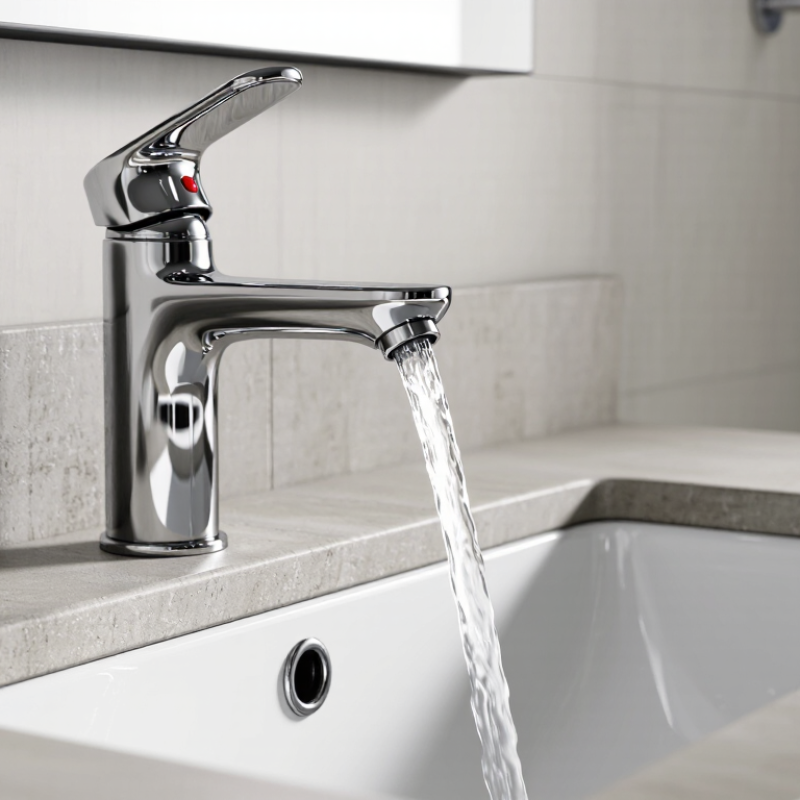
What Makes a China Bathroom Basin Tap Different?
A China bathroom basin tap can differ through its manufacturing process, material choices, and level of quality control. Many factories use advanced casting, machining, and polishing equipment. This allows buyers to find varied shapes, finishes, and handle designs at competitive prices. However, production quality is not identical across suppliers.
The most important difference is often internal. A reliable tap should use a durable ceramic cartridge, stable seals, and corrosion-resistant metal. Ask for material details instead of trusting a polished appearance. Check the inlet size, mounting thickness, water-pressure range, and included accessories. These details affect installation more than the outer style. I once focused too much on the finish and overlooked the cartridge specification. That caused unnecessary replacement work. A better evaluation includes sample testing, leakage checks, and clear inspection records.
Tips: Request a real product sample before placing a large order. Run the tap repeatedly and inspect the handle movement. Compare water flow, surface consistency, packaging, and installation instructions. Confirm that the product meets the standards required in your market. Low pricing can be useful, but unclear specifications create risk. A small flaw matters. Look closely.

Which Basin Tap Types Are Available from China?
China offers a wide range of bathroom basin tap types for different sink designs and budgets. Single-hole mixer taps are common in modern homes. They combine hot and cold water controls in one compact body.
Two-handle taps provide separate flow control and a more traditional appearance. Their installation usually requires more space around the basin.
Wall-mounted basin taps create a clean, open countertop. They need accurate pipe positioning before wall finishing. Vessel basin taps have taller bodies and longer spouts. They help water reach raised bowls without excessive splashing. Widespread taps use separate handles and a separate spout. This layout suits larger basins, although cleaning around three fittings takes more time.
Touchless sensor taps are available for hotels, offices, and hygiene-focused bathrooms. They require batteries or a power connection. Some Chinese suppliers also provide thermostatic and pull-out basin tap designs, but these options need careful testing.
Ceramic cartridge mixers generally offer smooth operation and better leak resistance. Brass and stainless steel bodies are both available. Surface finishes may include chrome, brushed metal, matte black, or other custom treatments.
One detail is easy to miss. A beautiful tap may not match the basin hole, water pressure, or local connection size. Request dimensional drawings, cartridge specifications, pressure-test records, and material information before purchasing.
I would also inspect sample units personally. Finish quality can vary between production batches. That risk is easy to underestimate. Check operating feel, spout reach, drainage clearance, and installation instructions rather than judging appearance alone.
How to Assess Tap Materials, Design, and Build Quality
What Is the Best China Bathroom Basin Tap for Buyers?
A reliable basin tap starts with its materials, not its appearance. Solid brass offers useful weight and stable threads, while stainless steel can resist corrosion in damp bathrooms. Check whether the water-contact parts are clearly identified as lead-free. Do not trust a shiny finish alone. Inspect the coating around the spout, handle base, and hidden joints. Uneven color or tiny bubbles may reveal weak finishing. A practical quality check includes the cartridge, seals, fixing kit, and flexible hoses.
Design should match daily use. A single-lever tap is convenient when hands are wet, but its handle needs enough clearance from the basin wall. The spout should reach the bowl without creating excessive splash. Ask about water pressure requirements and connection sizes before ordering. Certified testing documents, installation instructions, and a clear warranty show stronger manufacturing control. Still, paperwork cannot replace inspection. A beautiful sample may hide poor internal machining, which is easy to overlook.
Tips: Lift the tap and feel its balance. Turn the handle slowly. It should feel smooth, not loose or gritty. Check the aerator for easy removal and cleaning. Compare the actual dimensions with your basin. This small step prevents awkward installation. I would also request photos of the underside and internal cartridge, although some sellers may not provide them. That limitation deserves careful consideration.
What Features Should Buyers Compare Before Purchasing?
Choosing the best China bathroom basin tap starts with comparing measurable features, not polished photographs. The U.S. EPA WaterSense specification limits certified lavatory faucets to 1.5 gallons per minute. That is 30% lower than the common 2.2-gpm standard. The EPA estimates that an average family can save about 700 gallons annually with efficient faucets. Check the actual flow rate, pressure range, and aerator performance. A weak stream is not genuine efficiency.
Material and durability need closer inspection. Ask for the body material, cartridge type, surface-finish testing, and factory inspection records. Ceramic cartridges should operate smoothly without grinding or dripping. Request cycle-test results, but question vague claims. Test evidence without laboratory details is only decoration. For water-contact components, review relevant conformity documents, such as NSF/ANSI/CAN 61 where applicable, and standards required in the destination market. ISO 3822 testing can also help compare operating noise.
Installation details are easy to overlook. Measure the basin hole, spout reach, deck thickness, and hot-cold connection spacing before ordering. A tap that looks elegant may splash water onto the counter. The 2024 NKBA bathroom trends report highlights water efficiency, wellness, and accessible design as continuing priorities. That supports comparing lever resistance, handle clearance, and temperature control. I would not choose the cheapest quotation automatically. A slightly higher cost may reflect thicker plating, better machining, and documented testing, but only inspection can confirm it.
What Is the Best China Bathroom Basin Tap for Buyers? - What Features Should Buyers Compare Before Purchasing?
Comparison of typical basin tap specifications and practical buying considerations. Actual values should be confirmed in the supplier's technical datasheet.
| Comparison Feature | Standard Single-Lever Tap | Water-Saving Tap | Tall Vessel-Basin Tap | Sensor-Operated Tap |
|---|---|---|---|---|
| Recommended Basin Type | Standard inset or countertop basin | Standard basin in homes, hotels, and public facilities | Above-counter vessel basin | Commercial, healthcare, and high-traffic washrooms |
| Installation Method | Single-hole deck mounted | Single-hole deck mounted | Single-hole deck mounted | Single-hole deck mounted; some versions use a separate control box |
| Typical Overall Height | 130–180 mm | 130–180 mm | 250–350 mm | 140–220 mm |
| Typical Spout Reach | 90–120 mm | 90–120 mm | 150–220 mm | 100–150 mm |
| Water Flow Rate | 5–8 L/min at approximately 3 bar | 3.8–5.7 L/min with flow regulator | 5–8 L/min at approximately 3 bar | 2–6 L/min, depending on sensor and aerator settings |
| Water Temperature Control | Manual ceramic cartridge | Manual ceramic cartridge with flow restriction | Manual ceramic cartridge | Preset or manual mixing; some models provide temperature-limit control |
| Cartridge or Valve | 35–40 mm ceramic cartridge | 35–40 mm ceramic cartridge with water-saving aerator | 35–40 mm ceramic cartridge | Solenoid valve, usually combined with an electronic sensor |
| Minimum Recommended Pressure | 0.5 bar for basic operation | 0.5 bar; confirm performance at low pressure | 0.5 bar; higher pressure may be needed for a strong flow | 0.5–1.0 bar, depending on the valve and sensor system |
| Connection Size | Commonly G1/2 water-supply connection | Commonly G1/2 water-supply connection | Commonly G1/2 water-supply connection | Commonly G1/2 connection; verify the hot and cold inlet arrangement |
| Main Body Material | Brass or stainless steel | Brass or stainless steel | Brass or stainless steel | Brass or stainless steel with electronic components |
| Surface Finish Options | Chrome, brushed nickel, matte black, or PVD finish | Chrome, brushed nickel, or other tested decorative finish | Chrome, brushed nickel, matte black, or PVD finish | Chrome, brushed nickel, or other corrosion-resistant finish |
| Finish Durability to Request | Uniform coating, corrosion resistance, and adhesion test results | Uniform coating, corrosion resistance, and adhesion test results | Uniform coating, corrosion resistance, and adhesion test results | Uniform coating plus resistance to frequent cleaning chemicals |
| Water-Saving Performance | Moderate; depends on aerator design | High; aerator normally limits flow without excessive splashing | Moderate; select an aerator suited to the taller outlet | High; automatic shut-off reduces unnecessary running time |
| Ease of Installation | High; suitable for most single-hole basin layouts | High; similar to a standard single-lever tap | Medium; basin height and splash clearance must be checked | Medium to low; may require batteries, power, or a control box |
| Maintenance Requirements | Replace cartridge or aerator when required | Clean the aerator regularly and replace the cartridge when required | Clean the aerator and inspect connections for leaks | Clean the sensor window, filter, solenoid valve, and power components |
| Typical Service Life Consideration | Choose a tested cartridge and robust handle mechanism | Choose a durable cartridge and a replaceable aerator | Choose a strong cartridge and reinforced mounting hardware | Confirm sensor, solenoid-valve, battery, and spare-parts availability |
| Best Buying Advantage | Balanced price, simple operation, and easy servicing | Lower water consumption and reduced operating cost | Correct ergonomic height for vessel basins | Improved hygiene and reduced touch points |
| Potential Limitation | May use more water than restricted-flow models | Flow may feel weak if the building has low water pressure | Incorrect height or reach can cause splashing | Higher complexity, installation cost, and electronic maintenance |
| Documents Buyers Should Request | Technical drawing, material declaration, cartridge data, and test reports | Flow-rate test, aerator specification, technical drawing, and test reports | Technical drawing showing height and reach, material declaration, and test reports | Sensor range, power details, valve data, wiring diagram, and test reports |
| Overall Suitability | ★★★★★ General-purpose choice | ★★★★★ Best for water efficiency | ★★★★☆ Best for vessel basins | ★★★★☆ Best for hygiene-focused projects |
Note: Flow rates are commonly measured at approximately 3 bar, while actual performance varies with water pressure, aerator design, inlet restrictions, and local plumbing conditions. Buyers should confirm applicable local requirements, potable-water compliance, leak testing, pressure testing, and finish-corrosion testing before purchase.
How to Verify Suppliers, Standards, Prices, and After-Sales Support
What Is the Best China Bathroom Basin Tap for Buyers?
A reliable supplier matters more than a polished product photo. Start with factory registration, export history, production capacity, and recent inspection records. Request a live factory video or an independent audit from SGS, Intertek, or TÜV. The audit should verify material control, cartridge testing, assembly, and packaging. Avoid relying on certificates alone. Some documents are outdated, incomplete, or issued for another model.
Standards should match your sales market. Ask for test reports covering EN 200, ASME A112.18.1/CSA B125.1, or applicable Chinese GB requirements. Confirm the exact model number on every report. The U.S. EPA WaterSense program states that efficient bathroom faucets can use no more than 1.5 gallons per minute, or 5.7 liters, while maintaining performance. This figure helps buyers compare flow claims.
Also inspect lead content, leak resistance, salt-spray performance, and cartridge durability. A sample can look perfect but fail after repeated use.
Tips:
Compare total landed cost, not just the factory price. Include tooling, inspection, freight, duties, spare cartridges, and warranty replacements. The 2024 Global E-waste Monitor reported 62 million tonnes of electronic waste in 2022, reminding buyers that poor product choices create avoidable waste. Ask suppliers for a written after-sales process, response times, replacement-part availability, and defect limits. Test at least three samples from separate production batches. That step feels slow. It can prevent a very expensive assumption.
Article Source:
Get in touch with us,
We will contact you shortly!
What is the difference between Unline(Non-Epoxy Coated) or Lining(Epoxy Coated) Metal Drum?

Unline drums with internally bare metal surface is more susceptible to corrosion and rust while Lining drums are internally coated with Phenolic Epoxy Coating to provide a non-reactive barrier between the drum surface and your product, less risk of contamination. Note: Our Unline drums are coated with an anti-rust agent after washing to reduce risk of rust.
What are Unline(Non-Epoxy Coated) and Lining(Epoxy Coated) drums compatible with?

In Singapore, Recon Unline Drums are usually more costly than Recon Lining Drums. Hence, we recommend Recon Unline Drums to fill aromatics like Thinner, Xylene, Toulene& other solvents like Hexane, BA, CA, EA, MC, White spirit, etc.
We recommend the lower-priced Recon Lining Drums to fill hydrocarbons like IPA, Methanol, Ethanoland oil-based products like diesel, petrol, lubricants, engine, hydraulic, base, transmission fluid, additives, waste oil, etc.;
What is the difference between Grade A and Grade B Metal Drum ?

Grading of used drums are usually based on physical conditions like rustiness, deformities and residual contents. Grade A drums are totally free from internal rust, serious dents and are easy to clean. Grade B drums have different degrees of rust internally and aesthetically inferior compared to Grade A drums.
What content is suitable to fill in a Recon Grade A or Grade B Drum?

Recon Grade A drum is suitable to fill more costly virgin grade products while Recon Grade B drum is more suitable for recycled or waste products.
What is the difference between Open Top and Close Top Drums and their usage?

Closed top drums are for water and other liquid products. Open Top drums can be used for liquid too but are primarily for more viscous products. The Open Top (or open head with a lid) allows you to get in and out of the drum with your product easier.
What type of content are Metal or Plastic Drums suitable for?

Metal drums offer additional protection when dealing with potentially flammable substances. They provide superior fire resistance, impact protection, and longevity for storing class 1, 2, and 3 volatile chemicals.
Plastic HDPE Drums are suitable for corrosive chemicals like acids, alkaline and also water-based products.
Will there be any contamination in the reconditioned metal, plastic drums or IBC tanks?

All our reconditioned containers (metal/plastic drums, carboys, IBC tanks) are washed thoroughly with specially formulated cleaning agent, rinsed with clean water, dried, and tested for possible leakages during the recondition process. Stringent quality inspection is being conducted 100% on every reconditioned product before they are qualified for sale & delivery.
What is the drum gauge(thickness) and weight for reconditioned metal drums?

Reconditioned metal drums gauge can be 0.9mm to 1.0mm all round. Their weight can vary from 16 to 18kg.
Do you sell New Packaging Products too?

Yes, we are also a distributor for new pallets, metal drums, plastic drums, carboys, IBCs and stainless-steel tanks.
What additional services do you provide apart from selling reconditioned and new containers.?

We are an NEA licensed toxic industrial waste collector, who can collect and dispose of used toxic waste containers in Singapore.
Do you offer labelling and silkscreen on the containers ?

We can provide labelling and silk-screening on the containers.
Are you able to ship overseas ?

Yes, we can arrange export our products to any country in the world.
Leading the Way
to Carbon Neutrality