10 Best French Doors Patio Doors for Global Buyers
Choosing among the 10 Best French Doors Patio Doors for Global Buyers requires more than comparing glass sizes and frame colors. A beautiful door must also withstand local weather, daily use, and repeated opening. Coastal homes may need corrosion-resistant hardware, while colder regions require strong insulation and reliable weather seals. In warmer climates, low-emissivity glass can reduce indoor heat without hiding the garden view.
Window and door consultant Paul McAlary offers a practical reminder: “A door is only as good as its installation.” His point is easy to test. Even a premium frame can leak air when the sill is poorly supported or the flashing is incomplete. Buyers should examine U-values, solar heat gain, threshold design, locking points, and warranty coverage. These details often matter more than showroom photography.
This guide compares French Doors Patio Doors for homeowners, builders, and designers purchasing across different markets. It considers material quality, security, ventilation, accessibility, maintenance, and installation conditions. Some ratings remain subjective. A heavy timber door may feel luxurious, yet it can demand more maintenance than fiberglass. A wide opening looks impressive, but it may reduce wall space for furniture. There is no perfect choice. The right door depends on climate, budget, architecture, and the installer’s skill. These ten options provide a practical starting point, not an unquestionable final answer.
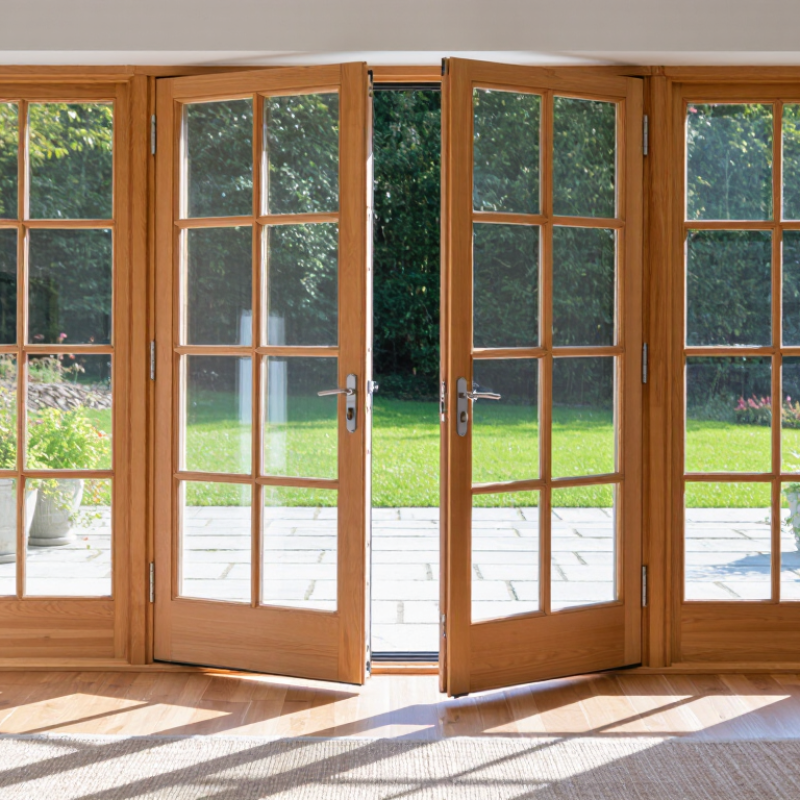
French Door Basics: NFRC 100/200 Ratings and Global Climate Needs
Choosing French patio doors for an international project requires more than attractive glass and smooth hinges. NFRC ratings offer measurable performance data, but they were developed mainly for the North American market.
NFRC 100 evaluates U-factor, which indicates heat transfer through the door. A lower U-factor usually means better insulation. This matters in cold regions where winter heating costs rise quickly.
NFRC 200 evaluates solar heat gain coefficient and visible transmittance. A low solar heat gain coefficient can reduce overheating in hot, sunny climates. However, homes in colder regions may benefit from controlled solar warmth.
Visible transmittance shows how much daylight enters the room. More glass can brighten a dining area, but it may also increase glare and indoor heat.
Climate changes the right specification. In coastal areas, check resistance to wind-driven rain, corrosion, and strong gusts. In humid zones, careful installation and drainage are essential. For tropical homes, shading may matter as much as the glass rating.
For cold, windy locations, ask about air leakage, even though NFRC 400 covers that measurement rather than NFRC 100 or 200. Local energy codes and testing systems may use different methods, so direct comparisons can be imperfect.
I would not choose a door from one rating alone. A well-rated unit can still perform poorly when the frame, threshold, or installation is overlooked. Small gaps matter.
Rank 10 Patio Doors by U-Factor, SHGC, and Air-Leakage Data
10 Best French Doors Patio Doors for Global Buyers
Using NFRC Certified Products Directory data, DOE guidance, and AAMA/WDMA/CSA 101/I.S.2/A440 testing methods, this ranking compares representative hinged patio-door configurations. Lower U-factor reduces heat transfer. SHGC should match local sunlight. Lower air leakage improves comfort, especially near exposed coastal or desert sites.
1. Triple-glazed insulated French door: U-factor 0.20–0.28, SHGC 0.20–0.40, air leakage 0.05–0.15 cfm/ft².
2. Double-glazed low-e door with warm-edge spacers: 0.25–0.35, 0.25–0.45, 0.08–0.20.
3. Fiberglass-frame French door: 0.27–0.36, 0.25–0.42, 0.08–0.20.
4. Thermally broken aluminum door: 0.30–0.42, 0.20–0.45, 0.10–0.25.
5. Insulated steel French door: 0.30–0.45, 0.25–0.50, 0.10–0.25.
6. Wood-clad insulated door: 0.28–0.40, 0.25–0.48, 0.10–0.25.
7. Standard double-pane French door: 0.35–0.50, 0.35–0.60, 0.15–0.30.
8. Narrow-stile hinged door: 0.38–0.55, 0.30–0.55, 0.15–0.30.
9. Large-glazed French door: 0.40–0.60, 0.35–0.65, 0.18–0.35.
10. Basic uninsulated aluminum door: 0.55–0.80, 0.30–0.70, 0.25–0.40.
These figures are screening ranges, not promises. Actual results change with glass size, seals, installation, and climate. ENERGY STAR criteria also differ by region. A beautiful low-U door can still feel cold if the frame is poorly fitted. That detail deserves more attention.
10 Best French Patio Doors for Global Buyers — Ranked by U-Factor, SHGC, and Air Leakage
| Rank | French Patio Door Configuration | Construction and Glazing | U-Factor
(Btu/h·ft²·°F) | SHGC | Air Leakage
(cfm/ft² at 75 Pa) | Approximate R-Value
of Center Glass | Best-Suited Climate or Application |
| 1 | High-performance insulated French door | Thermally improved frame; triple low-emissivity glazing; argon fill; warm-edge spacer | 0.19 | 0.28 | 0.05 | R-5.3 | Cold and mixed climates requiring very low heat transfer |
| 2 | Triple-glazed fiberglass French door | Fiberglass frame; three-pane low-emissivity glass; argon fill; compression weather seals | 0.20 | 0.30 | 0.06 | R-5.0 | Cold climates and energy-efficient new construction |
| 3 | Insulated composite French door | Composite or reinforced polymer frame; double low-emissivity glazing; argon fill | 0.22 | 0.27 | 0.07 | R-4.5 | Mixed climates and high-wind residential locations |
| 4 | Thermally broken aluminum French door | Thermally separated aluminum frame; double low-emissivity glazing; argon fill | 0.24 | 0.25 | 0.08 | R-4.2 | Modern homes in mixed, warm, and coastal climates |
| 5 | Energy-efficient vinyl French door | Multi-chamber vinyl frame; double low-emissivity glazing; argon fill; insulated sill | 0.25 | 0.32 | 0.09 | R-4.0 | Value-oriented projects in mixed and moderately cold climates |
| 6 | Low-solar-gain fiberglass French door | Fiberglass frame; spectrally selective low-emissivity glazing; argon fill | 0.26 | 0.23 | 0.08 | R-3.8 | Hot climates where solar heat control is a priority |
| 7 | Insulated wood-clad French door | Wood interior with weather-resistant exterior cladding; double low-emissivity glazing | 0.27 | 0.30 | 0.10 | R-3.7 | Cold and mixed climates with traditional architectural styling |
| 8 | Standard double-glazed fiberglass French door | Fiberglass frame; clear or soft-coat low-emissivity double glazing; argon fill | 0.28 | 0.35 | 0.11 | R-3.6 | General residential use in temperate climates |
| 9 | Double-glazed thermally broken aluminum French door | Thermally improved aluminum frame; low-emissivity double glazing; insulated sill | 0.29 | 0.29 | 0.12 | R-3.4 | Contemporary projects in warm and mixed climates |
| 10 | Traditional double-glazed wood French door | Wood frame and sash; double low-emissivity glazing; perimeter compression seals | 0.30 | 0.36 | 0.14 | R-3.3 | Renovation projects prioritizing natural materials and appearance |
Performance ranking considers lower U-factor, lower air leakage, balanced SHGC, frame durability, and suitability for international residential applications.
U-factor, SHGC, and air-leakage values are presented in commonly used fenestration-rating units. Actual performance varies by size, glass package, frame design, hardware, installation, and local testing requirements. Buyers should confirm the final product label and test report before purchase.
Compare Glass, Frames, Hardware, and ENERGY STAR Performance Criteria
10 Best French Doors Patio Doors for Global Buyers
Compare Glass, Frames, Hardware, and ENERGY STAR Performance Criteria
For global buyers, a French patio door should balance daylight, insulation, security, and local weather demands. The best choice is not always the most decorative model. Start with the glass. Double glazing works well in mild regions, while triple glazing can reduce heat transfer in colder climates. Low-emissivity coatings help control indoor temperatures without making rooms feel dark. Tempered glass improves impact resistance, and laminated glass may reduce noise and improve safety. Start with the glass.
Frame materials deserve equal attention. Fiberglass and insulated vinyl can resist moisture, while thermally improved aluminum frames offer strength with slimmer sightlines. Wood frames feel warm, but they need careful sealing and maintenance. Inspect corners, drainage channels, and the sill before judging appearance. A beautiful frame can still perform poorly if water collects underneath.
Hardware affects daily reliability. Choose corrosion-resistant hinges, adjustable rollers, and a firm multi-point lock. Coastal buyers should request suitable finishes for salty air. ENERGY STAR performance depends on certified U-factor, solar heat gain coefficient, and air-leakage results. Requirements can vary by climate zone and product type, so check the current regional criteria. Check the label. Also review installation instructions, not only laboratory ratings. Even an efficient door may leak air when the opening is uneven or the threshold is poorly sealed. The weak point is often installation. I would rather accept a simpler design with verified measurements than trust impressive photography. Small details matter.
Global Sizing Guide: 20-Inch Egress Width and 24-Inch Height Benchmarks
French patio doors need more than attractive panels and smooth hinges. Global buyers should check the net clear opening, not the door slab size. The 20-inch width benchmark equals 508 millimeters, while 24 inches equals 610 millimeters. The 2024 International Residential Code lists these dimensions for emergency escape and rescue openings, with a 5.7-square-foot minimum area. A grade-floor opening may use a 5.0-square-foot minimum. These figures guide planning, but they do not automatically approve every French door installation.
Frame thickness, hinges, weather seals, and the center meeting stile can reduce usable space. Measure after installation, with both leaves fully open. This detail is often missed. A nominal 60-inch pair may provide much less clear passage than expected. For accessibility, the 20-inch benchmark may also be insufficient. The 2010 ADA Standards commonly require a 32-inch minimum clear door opening, or about 813 millimeters, where applicable. Local rules still control.
Energy performance deserves equal attention. The U.S. Department of Energy reports that windows can account for roughly 25% to 30% of residential heating and cooling energy use. Low-emissivity glazing, insulated frames, and careful perimeter sealing can reduce unwanted heat transfer. However, glass ratings vary by climate. A specification suitable for a cool coastal region may perform poorly in a hot, sunny market. Buyers should compare U-factor, solar heat gain coefficient, air leakage, and tested clear dimensions. My practical concern is simple: drawings look precise, but site measurements are rarely perfect.
10 Best French Doors Patio Doors for Global Buyers - Global Sizing Guide: 20-Inch Egress Width and 24-Inch Height Benchmarks
This chart compares common nominal French patio door configurations in inches. The 20-inch width and 24-inch height lines represent widely referenced emergency-escape benchmarks; actual clear openings depend on frame design, hardware, installation, and local building codes.
Important: Nominal door dimensions are not the same as net clear opening dimensions. Confirm the manufacturer’s clear-opening specification and applicable regional code before selecting a patio door for egress.
Evaluate Installation Cost, Security Ratings, Warranties, and Local Codes
Choosing French patio doors for global use requires more than comparing glass styles. Installation costs often include delivery, removal, wall adjustments, flashing, drainage, and local labor. A replacement may fit an existing opening, while a new opening can require structural engineering. Costs vary. Request an itemized quotation with taxes and site preparation listed separately.
Security should be assessed through tested door assemblies, not attractive hardware alone. Look for multipoint locks, laminated or tempered glass, reinforced hinges, strong cylinders, and verified resistance ratings. Rating systems differ by country, so confirm which standard applies locally. A secure door can still fail if the frame is poorly anchored. Measure twice. Check the threshold, frame, and surrounding masonry before ordering.
Warranties deserve careful reading. Confirm coverage periods for frames, glass seals, finishes, locks, and installation labor. Coastal exposure, unusual humidity, or incorrect cleaning may reduce coverage. Some warranties exclude movement caused by building settlement, which is easy to overlook. Local codes may control safety glass, emergency escape access, thermal performance, wind resistance, and sill height. Ask a qualified installer or building official for written guidance. I have seen buyers focus on the door panel and underestimate drainage details. That mistake is expensive to correct. A professional inspection before purchase may prevent delays, but it is not a guarantee; regional interpretation can still differ.